
Podcast
Transcript
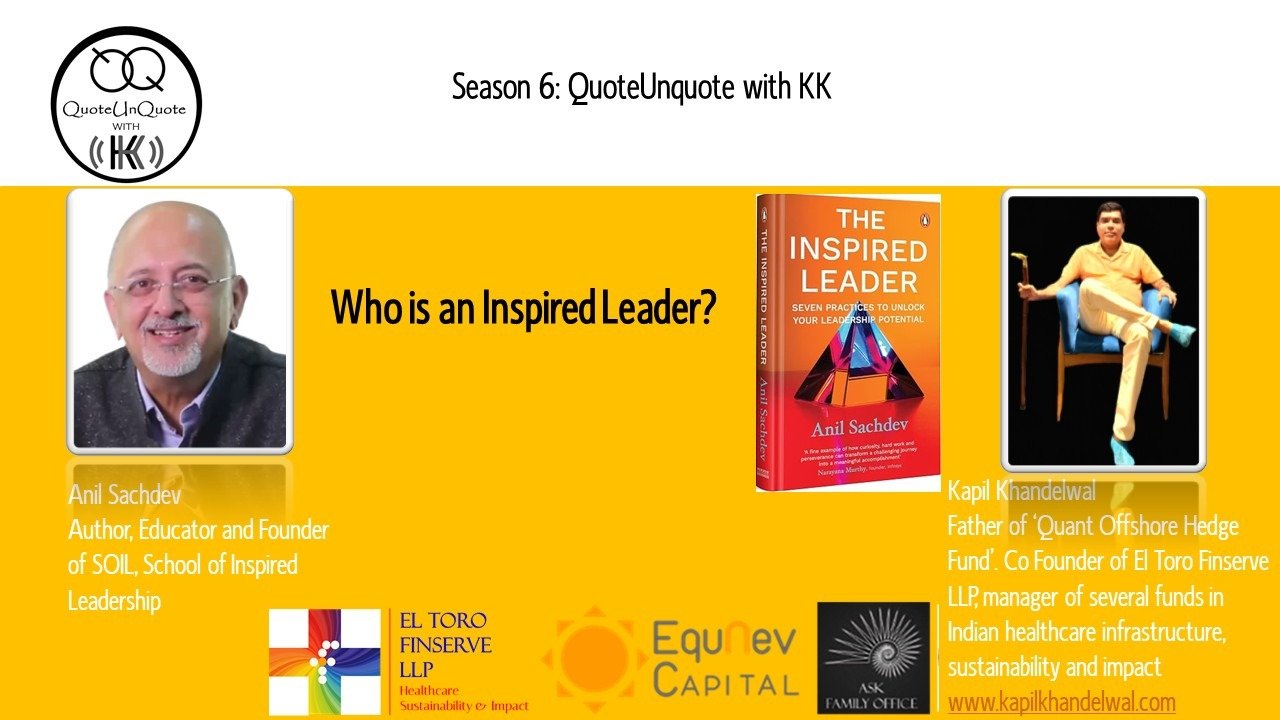
[00:00:00] Dear listeners, welcome back to another episode of Quote UnQuote with KK. Today we are going to discuss on who is an inspirational leader. Well, you see, during COVID, we started this podcast to inspire leaders, many of whom I was discussing during the April 2020 on what their plans to stewardship of their organization during the COVID crisis. This period was something unusual that challenged many leaders who I spoke to in different issues and and many of them disclose on one on one with me their fears and their inability and inexperience to lead in such a crisis and situation. In fact, some of them wanted to quit and admit their failure of their leadership because they had no experience to lead their organization. While on the other hand, some took inspiration from somewhere which we will discuss in this podcast today and took the leadership challenge and move their organization successfully out of the crisis that they face in the COVID pandemic. The world has never faced ever.
[00:01:01] This podcast was started with the nudge from Professor Jagdish Seth. Over the years and seasons, we have covered several podcasts on various aspects of leadership that have inspired me to continue this podcast. Over the last five years, we have covered topics like health, well-being, longevity, spirituality, karma, dharma, food, agri, social media impact, storytelling, innovation, social and economic impact to name a few. Our guest today has I would say package all of this in his recent book, The Inspired Leader. It is therefore important for his experience as a management consultant, leadership coach, management educationist and a wonderful friend to me who I have only been bumping at airport. After reading his book, I came to know the depth of his life and some common threads that are between us, not just our struggles with diabetes and how to reverse it, but many more. This board for that is I cannot discuss on this podcast, but we can discuss one-on-one later on
[00:02:01] this podcast after this podcast. In fact, his book has inspired me. Ladies and gentlemen, I’d like to introduce my dear friend, Anil Sachdev. Anil, welcome to the podcast. Thank you very much, KK Thank you for thank you for inviting me, KK. Thank you. And as usual, I’m fact checking Anil from the ChatGPT notes of his profile. So very quickly. Let me take a few minutes just reading it out to set the context of who our guest today is. Visionary educator and institutional builder. Founder of Cool of Inspired leadership in 2008. Designed to nurture leaders with competence, character, enthusiasm for social good. Pioneered value driven leadership model blending business excellence with human development, social impact and nation building. He has been playing his advocacy for conscious capitalism and responsible leadership in India. Partnered with industry, government, civil society to create leaders who served just not companies but communities at large. Leadership philosophy and I can vouch that listeners believes leadership is about purpose, authenticity and service and not
[00:03:03] just profit. Encourages leaders to balance head, heart and soul, recognition and influence. Wildly respected in India’s corporate and academic circles for shaping leaders who combine business acumen and ethical responsibility. Mentoring CEO’s, entrepreneurs, young professionals seeking meaning in their careers. I can go on and on and on, but Anil is so much inspirational and I have after reading his book, let me show the book here. I have removed the cover and I’ll put the link to his book from Amazon as well. Anil has been so kind to me as he’s been travelling on his book launch all over the place to give this time to record this podcast. So thank you so much Anil for spending this time and throwing a light and talking beyond the book as well. Thank you. So Anil, let me just get started with the basic, you know, I want to understand for the benefit of the audience and setting the contact, who is the leader and who’s an inspired leader? How can we differentiate both? Beginning itself in my book, I said there are two lies about
[00:04:03] leadership. That one, leaders are born. We all know they are not born. Second, that leadership is about leading someone else. Actually, that’s a big lie. All that you do is that you lead yourself. And in the process, people choose to walk along with you because it is in their interest to do so. And there are dimensions of leadership. I cover what is Who is the leader? Somebody, for example, who leads his own body, his own 5 senses. The way you observe, the way you listen, the way you communicate, get through touch, the way you eat consciously through smell and taste, the way you consciously sleep, the way you consciously exercise. So whether it’s the quality of your perception through your five senses or it’s the quality of your physical well-being that emerges when you lead your physical well-being. Both of them. It’s the starting point of leadership. Then how do you lead your breath with every breath? When you are taking a breath in, you are getting stimuli from the environment and there is supposed to be a conscious pause before you respond rather than based on your biases and impulses. When you lead your breath, you
[00:05:04] are creating understanding, you are creating communication, well-being. Then how do you lead your emotional mind sourcing positive emotion, finding a way to overcome the negative dark side of the emotion through conscious practices which helps in building trust and trusting relationship. Then how do you lead the way you think not just in a rational, analytical, logical way but also the more intuitive, the more feminine, the more creative way. When you combine both the left and right side of your brain, you think with the whole mind, and you induce what is called in yourself, not just using intelligence, but used to the ability to source wisdom, which comes out of discernment. Then how do you lead the process of action? Which means a lot of us know we are required to do something, but how do you carry out your intentions? Through stamina, through focus, through resilience? How do you do all that? And in all the four things I described to you so far in the very beginning, I say the leader’s story by what is the story the leader shares with herself, to herself about who she is?
[00:06:05] Because the words that you use to describe your own life can either imprison you and which make you feel that you know you are a victim of circumstances. Or you can use words to describe your own life story to yourself, which are empowering and which say, I can do anything that I really am inspired by. So the story you tell yourself. And you know, in addition to all that I have spoken, I in the beginning of the book, I have also talked about same. One must have a conscious process of learning, which means when you learn from your experience, you are introspection. You are doing introspection. When you are reflecting in the present moment, you are contemplating about your own actions, your own thoughts, your own emotions, even as I speak to you, that is paying attention to learning from the present moment, which is we call insight. The past is hindsight. The present is insight. And when you develop consciously the childlike curiosity to say, oh, is that so? Is that so? You know that wonder in your that beautiful childlike enthusiasm if you have of learning that means you are welcoming all the new unborn future with a childlike
[00:07:07] curiosity. Then even if someone extreme challenge comes to you, you have the childlike curiosity to learn. So what can I do about it rather than get overwhelmed with a tired mind? Finally, in my book I say that you know leadership is about really deriving power of what is the ’cause you stand for which really means something to you, something you dream about to making the world better. And how are you utilizing your own strengths and your own values to work for that cause? Because this is what I learned early in life. You become the best follower of a ’cause that is very dear in your heart. Leadership happens to you because the power comes from the cause, not from any, not from your ego. So when you say I am going to serve this cause, not only you derive tremendous amount of self sort of satisfaction and inspiration from within you. Many people choose to come and support you because the cause is worthwhile. And that’s why you know you get all the power of people. So I describe all this in my book. And finally I also say in a very realistic way that all that I’m describing may not be easy for
[00:08:07] some people who still are stuck in some difficult story they are telling themselves or are not thinking with the power of the whole mind, or don’t have a conscious process of learning or don’t surround themselves with people with whom they have trust. In such cases I say to them, awaken the inner witness. Let your inner witness awaken that can observe why you are finding it difficult to transform for the better so that at one time you keep postponing your happiness. One day I will get the ideal day when I will get everything that I am striving for. And in the present I am stuck in my limited thinking. So how do you get free from that thinking? And you are limiting beliefs by awakening the inner witness and deriving the strength from within you to overcome this ego centric limitation that you have which are preventing you from learning and growing. So that’s the last chapter I talk about how to awaken the inner witness in you. So this is the not only a summary of my book, but to describe the way I am defining leadership is very different from the conventional understanding of leadership. Correct. I am saying leadership is self leadership, that’s for MP. Anil, so you have given an
[00:09:08] executive summary of your book in the first opening dialogue with us as well. I want to bring out a few things or contradictions or some confusion that are there in my mind as well. So somewhere in your book you said, you know, think about the best time of your life and replay that to bring that inspiration that drove you to carry it forward in the present and the future. You know, one of rookie in one of my startup during cold time asked me, you know, what is the best time of your life or what was the best experience of your life? And I said, you know, the best is yet to come. And the reason is that I’m working towards something which is better to the best. Otherwise, if I think about the past, which was the best, then I’ll never even want to strive and look forward to creating the best. So does that am I right in my view or do you think to motivate oneself you need to probably look for what is the best that is yet to come? KK Actually I am deriving my understanding on this from three paths, right? Right from your childhood, there are certain things you do which
[00:10:10] give you happiness. You seem to be attracted to doing certain things which you really enjoy. It could be music, could be a sport, could be writing, could be poetry, could be disassembling a toy and you know, putting it together again, could be gardening, could be anything. That is the first point that you know, this is what you seem to be attracted to and this is something you are very good at doing. Secondly, as you grow older, you begin to take make choices and then you remember that the choices that you made in which you contributed to something, whether it was in your school or college or early years in your profession, you did something with others in which you created some positive impact. Now each time you created a positive impact, what what was something that was revealed to you about what you are good at doing? Then you remember that there are some trusted people in your life, a teacher who was very somebody whom you really looked up to, a mentor whom you deeply admired. And they when they are alone with you in a very authentic way, they tell you this is what you really are good at doing. So from a trusted source, you come to know from your happiest best experience in which you
[00:11:10] created impact. You said, what was revealed to me about myself when I contributed and then what was I really fond of doing? Which way? So these are things which tell you something about what who you are, your own uniqueness. So my reason for talking about the happiest best was only to encourage you to determine what your uniqueness is because every human being is unique and you have to understand what your uniqueness, what you are good at doing. Instead of comparing yourself with someone else and instead of trying to copy somebody else, you discover what you are good at doing and then build upon that. I completely agree with you. The best is yet to come, but that will come provided you use your strengths and don’t worry too much about your weaknesses because anytime you focus on your weaknesses, at the most you can become mediocre in that area. But if you focus on your strengths, you can become fantastic. You can become world, you know, scale kind of a person, world class kind of a person. So the whole idea of this chapter is look at only the places where you are made impact to discover your own uniqueness and discover your own gifts with the idea you can leverage them
[00:12:11] in the future to make even bigger impact. That is what you know, I’ve also like you gone through consulting industry leadership now into investment and doing philanthropy. And every time I read your book, I kind of feel that inspiration at different phase of your life are very different in the context of that phase of your life. And as I am now moving toward a different phase in my life with my kids, you know, all settled and, you know, wanting to create more societal impact, the inspiration that I’m drawing is very different from what it was maybe when I started my career at Cuba’s and lab brand and I looked up to certain people who are my mentors, coach and teachers. Does this also keep transitioning as you move across age and across your career to be becoming a different sort of inspirational leader? You know, it’s very much the case because as you go through different phases of your life, obviously different things become important to you. You know, in the in the initial days you are, you are striving for achieving some kind of a
[00:13:13] position, trying to learn quickly, then get the best opportunities, then make the most of these opportunities, earn a name for yourself on reputation, on money. You know, and then time comes when something else begins to get important to you because you know, this is something which is not enough for you, but you are seeking something much more sustainable, much more durable, much more, which gives you a lot more satisfaction than name and fame is OK to begin with, but that’s not the thing that really turns you on as a person. So we say there are different phases of your life. The first part of your life is all about learning. The second phase of your life is all about earning. And then when you and I always told myself, you know, that when you are a young person, you can write down what is enough for you enough in terms of name and fame, enough in terms of money. What is it enough? And from that point onwards, when you think you have enough, you should not be leading your life only for your own sake, but from that moment you should, you should start thinking, how do I now return? So you learn, you earn that, you begin to return.
[00:14:14] And finally, after doing the aspect of returning, which means becoming a go giver, you have, you contribute to social issues. You say, how can I be part of a solution to a complex problem in society? How can be a good citizen? How can I work for my community? But after some time and all that is also done, there is an inner aspect to even ask more fundamental question, what is the purpose of my life? Why was I born? And naturally people turn toward a inner, inner journey. At that stage, you know, there is some kind of a spiritual awakening that begins to happen. In some people. The spiritual awakening happens even as they are teenagers because they have seen the emptiness of their older people achieving things but not necessarily being happy in the process. So the final stage of a person’s evolution is what we call yearn. So you learn, you earn, you return, and then you yearn, which is about yearning to understand the very purpose of life. Why were you born? You know, so I met so many people that you know in some
[00:15:14] people at a very young age, the yearning starts and then they go on a different path, in some cases very, very natural. After they have exhausted all their desires to have name and fame, then the journey begins of this kind. But at some stage and or the other in your life, this is an inevitable choice because people turn to asking more fundamental questions about their life and self inquiry. So I think it’s a very natural process and that’s how the evolution takes place. As the mind becomes more mature, mind becomes more receptive to asking questions which are which forever. At a young age, you are so much concerned about the day-to-day needs that you have of your family and you all. You first want to make their future secure and then there are more substantial issues that begin to come to your mind. So it’s very natural. I want to now touch upon who to go to in what situation. You know, you have mentioned in your book teacher, code facilitator and mentor. So what situations and what context? Who is very useful. And this is also very important because on social media and LinkedIn these words have been used so much interchangeably
[00:16:17] that they have lost their meaning and the context at which people are using it to showcase themselves to the wider world. When I use the word teacher and I continuously refer to the teacher in my life, from a young age, I became a of my spiritual teachers for me, Chinmayananda, thanks to my parents. And when I talk about the teacher and I refer to my spiritual teacher, I’m talking about somebody in whose presence you got answers to the most difficult questions just by the presence of that teacher. There are some people in their presence. You feel complete, you feel a sense of calmness, you feel clarity. So those are the teachers who you are blessed to be with because these are not the teachers who are giving you knowledge of the objective world, but these are the people whose who are teaching you about the understanding of the subjective world. That means they are helping you to know yourself. They are giving you the most profound knowledge which is self not. So if you are fortunate enough to have such a teacher in your life, I would say that’s what I mean by a teacher in that sense. When I talk about a mentor, I’m talking about somebody who is
[00:17:18] more experienced who at the same time is willing to share with you for your well-being. That means the mentor always has your need in mind and not has no agenda of his own or her own to to get something done through you but is genuinely interested in your well-being. So particularly when you have you have some difficult moments in your life, some very dilemmas you are facing, moral dilemmas, ethical dilemmas, you always turn to a mentor who is wise and who deeply cares for you because a mentor will listen to you without judgment and then will offer some insights to you. Knowing who you are and the insights can always be very useful because you totally trust your mentor that all that the person is doing is for your well-being. To have a mentor in life is a rare privilege, and you know this kind of a. Mentalist to be having a mentor, A few of them. Yes, for such people if you have in your life that is absolutely fantastic if facilitator is somebody who can help you to get out of some difficult situations. Because see, relationships can be complex when you are working
[00:18:18] in a team, in an organization, or you are in working in you are in a context, in a family life where there is some conflict or even in the local community that you are part of, there is a conflict and many people are involved. Each one has their own opinion. Such a case, a facilitator can help in facilitating a process where everybody gets a chance to share what’s bothering them and what their viewpoint is and skillfully help people to then arrive at some kind of an alignment so that they can channel their conflict into something constructive. So that is really when there are too many people with too many opinions and people are pulling in different directions. I think a role of a facilitator is very useful. Finally, I mentioned, you know, a coach, a coach, somebody who doesn’t give you the answers, but he asks the relevant questions to you to build your own capacity to find the answer. So coaches doesn’t play the game for you, but asks you helpful questions so that you can play the game better, shows you the mirror. And it’s very easy to give feedback to people, but it’s more difficult to ask them the questions so that they give
[00:19:19] themselves the feedback. It’s like teaching somebody to fish rather than giving them fish. So, so a coaches is a very skilled person because you know not all coaches are that skillful, but a coach will always remind you of the effort you need to do by asking the right question. Will never give feedback to you on your ability will help will ask you questions so that you do not get stuck on ability, but you get focused on your effort. So the more you realize that the gap between what you want to do and what you did is actually your learning agenda and the more by question you realize what you need to learn and what you need to do differently, then you can develop your own capability. And that is what the role of a coach is, to help you to build your own capability to take. Care of your own issues and to find the answer. So there you go listeners, I think Anil has actually given you the prerequisite of how to select a code, a teacher, a mentor, and a facilitator. Let’s move forward, Anil. There’s so many examples that you have given in your book and also today the attention span of people are actually reducing.
[00:20:21] Actually, as I go to some of my alma mater to give a lecture or things, I am finding the technology to be the biggest hurdle for them to think differently, think out of the context of what the whole situation to actually come out successful. And now earlier it was your the social media where people got some bit of inspiration. Now you have this AI which is now providing a lot of your answers to your issues and situations. And I guess if, if the way AI is going, we’ll probably even have AI code, AI mentor, an AI facilitator or something like that in the future, which I do not know how surreal or how real that solution is going to be for humans. But I want to bring the whole issue is, is technology actually an impediment to being an inspirational leader? Because sometimes you look at social media and you bring in what do you call jealousy or benchmarking against other people. Sometimes you look at ideas
[00:21:21] which are not even proven. It is just something fake, not even Fact Check. Is there a way that to develop ourselves as an inspirational leader, do we need to cut out these sort of tech based interventions and actually go back to the humans and have that human based interactions to really feel who you are and what you are and and what where you need to really connect to? See, as in everything and as we always know, technology can be used either way. And this is true from each form of technology. You know, now AI you can use it in a consciously in a way which is useful to improve productivity, to do some work for you, which makes your work and life easier. Then you are getting it to work for you. You can get also overwhelmed by it and you can allow it’s it to dominate you. It can allow you to give you the wrong answer that can lead you. Sometimes AI can start hallucinating, can make you up the go the, you know, up the garden path. So you have to be very conscious of what questions you ask AI and how do you work with AI in such
[00:22:22] a way that it actually helps you. And you, you cannot replace ultimately your judgment to a machine and to AI because it’s a language model. So all the words that are written there in the universe, it tries to make sense very instantly and very beautifully to give you what you’re seeking. But you have to remind yourself that the words that exist out there, the prompts that you are giving, the kind of response that you’re getting, ultimately, it is your role to take a call. You cannot outsource your discernment and wisdom to intelligence. So I call AI augmented intelligence rather than artificial interest. You can use it, for example, it’s a very good thing to tell you which are the other sources of information of a certain kind. It can, you can use it very nicely to, you know, make a presentation to improve what you have written. You can make videos, you can make a we all know what it can do. So I think the most beautiful part of it is that if it is doing the work for you to make your life and life of others better, that’s fantastic. But if you start depending upon AI to take make make conscious
[00:23:23] choices, that’s where the trouble will start because then you are outsourcing your basic power of discernment and choice making and decision making to technology, which is where the dangerous part of AI takes. So similarly, there is enough research to show the power of social media and always being connected. If you aimlessly scroll through social media and if you keep on consuming content, which you don’t even know where it is coming from, and you start believing that content is true, again, you are outsourcing your thinking. And then that the dangerous part that you start getting very polarized. You start having very strong opinions about matters without having understanding of whether that is true at all. And I think that’s the dangerous part. So in either case, whether it is social media and what we call fake news and content that is being created, or we talk about using technology in a in ways that, you know, you are actually allowing technology to govern you rather than the other way around. So, but you can by all means, you can use it beautifully. For example, you know, we did
[00:24:24] this book launch in Bangalore and there Mr. Narayan Murthy and Mr. Muthuram 1 of Tata Steel Rekham and and you know, Viren Shetty were together. So it’s all on YouTube. So I just now I was doing that before your call. I used an AI tool to give me. A Yeah, I missed attending it. I was in Bangalore. Yeah, so you know. Got an autograph of your book as well? On the book, yeah. So this transcript I prepared just now with the help of AI tool and then I was making a summary of it of it using AI because I because in LinkedIn, if I were to put a post on what happened that evening. One is to attach a document with the entire transcript. The other is to attach a video, which I can do but what are the key messages Now this is where technology can help you a lot in very simple way. And when you read the summary, you know this is a good summary of what has happened. So in other words, normally it would have taken me two hours to prepare the summary. Here I’m doing it in 5 minutes, right or three minutes or 4 minutes. So this this way, it is a very, very beautiful way of using technology. On the other hand, if you have
[00:25:24] actually start doing some completely wrong prompt you give to it might convert that into some lecture on leadership which was never discussed and people who attended it might begin to think what the hell is wrong with this guy’s reporting something which never happened. Because you can, you know, you can easily, AI can start doing things for you which it is not supposed to. It can start connecting all kinds of things. It can connect to what Mr. Narayan Murthy may have said in five occasions and attributed to this this particular evening where there he was focusing on very specific things which had a lot of relevance to my book. So I think that’s how that’s an example of how to use technology. That’s right. Yeah. And I think the key take away here is that there could be false positives and false negatives, correct from the technology which if somebody wants to use those tools to create those context towards inspirational leadership has to actually use it judiciously. So there are caveats and limitations of to technology and don’t clutter it on a everyday basis to automate and to think that this can save time and this can dehumanize all your
[00:26:25] interaction. Correct. I want to move ahead on, you know, a few things that have really touched me in your book and I wanted to talk a little bit on, you know, the purpose and meaning. You know, at this point in time as I look back toward my life and I as you also reflected back in your book, you know, one of the things that I wanted to understand, obviously a leader who has his day-to-day dominated with quarterly target deadlines, PNL pressure and man managing of people management issues to be resolved. How does he get out of that to actually inspire him to go on to do much beyond what he is achieving in his day-to-day leadership context? You know, I, I believe that instead of just spending all your life in just doing what you are doing today, we have to consciously create some me time, that quiet time to actually learn about the way one is leading one’s life. So this is something which is an absolute absolutely critical if we have that desire to make something more of our life than
[00:27:28] what we have today. And it is such an important practice for each one to do so when you spend quiet time with yourself, which is a gift you can give. So I have a practice every morning I go for a one hour walk and rather than go with friends who are available plenty to walk with, you know, in the neighborhood where I live, I actually like to spend solo time with nature by itself. And you know, in that time I’m actually doing my inner work. And it’s such an important part because first, of course, I begin in my morning with a morning meditation session. So I’m sitting in my dhyan. But after my dhyan, then I’m up for a walk. Then that is my quiet time with myself. And in this there are all kinds of thoughtful questions to you. Which way is your life going? What is truly important to you? Who are the people you deeply care about? What are their needs you are inspired to serve? Are you making full use of the strengths you have to make a difference to them? Are you really doing your best to help people of the kind that truly are important to you? And many things you know appear in your mind even inside an organization instead of completely surrounded by today’s business.
[00:28:29] If you don’t give attention to which way even your business is evolving. So even for the sake of the long term success of your business, you have to have quiet time to look at in which way are you contributing to that business. But this side, this is a business. But then what about your life? Is there a sense of inner contentment and peace and happiness? Are you genuinely happy? Is there something Missy that is missing that is bothering you? Is there something about the way you are utilizing the time of your life that doesn’t agree with you? Are you taking the time to spare, invest on your health, on your relationships, on learning? And if you find that you are burning your candle at both ends and you are not having enough time for your health and for relationships of the kind that matter to you, then of course you have to ask. You have to have a wake up call to say why am I surrounded in a circumstance which I am refusing to change? Why am I ruining my health and ruining my relationship to achieve something which later on I will have deep regrets about? South, I think at that quality time and that gift which you can give, you know, that time, individual time, that solo time, it’s like your date with
[00:29:32] yourself, you know, and that’s such a beautiful gift to give to yourself, you know, So that’s that’s the way to do it. I want to understand people are always confused with the purpose of their leadership and their life mission and goals. And that is always, you know, laced with a lot of fear, fear of failure, fear of judgment, fear of getting out of context and so on and so forth. How does one actually balance this to really come ahead in a very uncluttered way, fearlessly understanding their life purpose and inspire themselves on their leadership journey? See if if in your heart of hearts, in the secret conversations of your heart, if you’re dreaming about something which is very idealistic. Let’s say some people are dreaming about solving the hunger problem in this country, the poverty problem in this country, the air pollution problem in our city. And they’re deeply inspired by this idea because they think that it’s something worthwhile for them to do. Then finding a way to utilize your strengths for the dream that is really important to you. This is where it begins.
[00:30:32] The idea is not to reach the goal. The idea is to strive to reach the goal. That means in your attempt to reach that higher purpose that you are defining for yourself the very process of learning how to make that impact of that ideal kind. In the process, you are enjoying the journey. Because when it appears like a huge task and it begins with a step of your asking, what can I do to make a difference? See, the moment you define something in your life as a problem you want to give attention to or a vision that wants to be manifested through you, when you have a deep concern for that cause inside your own heart, then all kinds of new things will emerge. You will find all kinds of people will emerge in your life because they have similar interests. You know, we, we attract people based on our intentions. If our intent is pure, you will be surprised as to how people will come around to help you. All of a sudden you will get people who will be wanting to be with you and and you will get support from people. So at that time of dreaming, one should not be miserly, you know, because. People fear aspect because
[00:31:32] people fear a lot and the fears could be very different psychologically. I do not know how to define all that, but that fear is something that holds them back to even understanding their life purpose and sometimes. So that’s the the biggest thing in your book. If you don’t get off that block, how do you inspire to to go? That is where I’ve seen a lot of people. Why I have been talking to some of my mentees is that fear. That’s the first stumbling block to anything further. I think if that is solved, then the whole book is very much inspirational to as a template for you to move and be an inspirational leader. Let’s talk about four basic fears that people prevent people from realizing their potential. The 1st is fear of failure. In order to overcome fear of failure, I encourage people to practice in a safe environment. It’s like when you are in a simulator in an aircraft before you actually learn to fly so far to simulate a condition in which you can practice what to do and experiencing failure and failure
[00:32:35] in a simulated safe environment helps you to learn. And there are many beautiful ways to do it. I have written my book as to how I participated in. Sandboxing. Sandboxing failure. Yes, I would say that. Exactly. And you know, I’ve written. With a testing failure over there and then move forward to the real. Exactly. So it’s like there are experiments I have written in my book, like engaging in a firewall, going for outdoor training, experiential stuff. There are people who make you do that and you get over your fear. Second fear is fear of criticism and what will others say? So here I think having really close friends will just give you feedback on your effort and who will speak honestly to you, who will confront you, that on one hand you say this is important. On the other hand, what are you doing about? Or having a mentor who deeply cares for you and show you and shows the mirror to you. So when people who you get feedback on your areas of development from people you trust, then your allergy to criticism goes down and then you are able to handle criticism from anybody because you are
[00:33:35] used to getting authentic feedback from people whom you trust. Then there is a fear of lack of resources and time. A lot of people feel they don’t have the time to engage in what is truly important. They’re helping you to understand how you’re spending your time and making a log of what you do actually faithfully. At the end of the day, write down how did you spend your day and once you start doing that, you realize there are so many things you are doing today which you need not be doing and therefore you can create time for something which is truly important. Then there are some people who are fear of the unknown, fear of ambiguity, fear of uncertainty. I think this is this especially happens to us, some of us who are engineers, people who are accountant, finance people who are very numbers oriented, who are very, they get very uncomfortable in an ambiguous environment. I think for those people who get very, who get very, very paralyzed in ambiguous situations, for them deliberately learning from the Fine Arts, learning from people who are not like them, exposing to new cultures, trying out new things, even watching TV without sound, these are habits which
[00:34:36] can help them to overcome the fear of ambiguity. So for each one of the fears, there is a possible solution. And finally, KK, I want to say that what I learned from my spiritual teacher, the opposite of fear is not courage. The opposite of fear is deep love. When you deeply love a ’cause that is really important in your heart, then teacher used to say that then you rise in love, you don’t fall in love. And when you deeply love something, then the fears go into the background. That means the cause itself is so beautiful that you are inspired by. Then you develop the strength and then people come from nowhere to help you. So that’s where it also happens, really choosing what you deeply love and you deeply love something. There is no space in your heart for fear, But because you are indecisive, because you’re not even sure whether that is important to you, your mind keeps keeps on giving you excuses and keeps on making up fear because the real is, you know, a friend of mine, a very dear friend called Peter Block, who’s a great author. He has written a book, written many books, but one of his book is called the answer to how is yes. He said. Then people keep asking how do I do this?
[00:35:37] How do I do that? How do I overcome fear? He said the only answer to how is yes, meaning get totally committed. If you’re truly committed, you will find a way. Which is like burning the bridges. Yes, that’s right. I want to touch. One thing which I did not feel you have given much attention in the book is the power of positive manifest. You know, many a times I have set on a journey very, very inspired and clueless as to what are the net depth. But somehow that power of manifestation that I have acquired in my life because of certain blessings or whatever I have received in this second life of mine, I was actually declared dead and then I got revived. And those powers that I have gained on has actually increased my power of manifestation and that has led me to overcome the fear of anything fantastic. And I wanted to understand does that also help overcome fear because part of manifestation? Lot of leaders are very higher order beings somewhere they have that power in them and that energy to be able to positively manifest.
[00:36:38] I found that was a little bit missing in your in your commentary. It is there, but it is not in a straightforward, not in. Not in the way you are defining it. Not in the way you are defining it, but in my last chapter of the book, I say what prevents you from realizing potential? And I talk about how inside your own mind there are all these fears and limitations and limiting beliefs, which we call about immunity to change. And I talk about invoking the power of the inner witness, which is how when you invoke that inner witness in you and realize all these fears and limitations are linked to your ego. But when you go beyond that, and that’s when I refer to my spiritual teachers framework. I refer to my spiritual teachers framework. I also refer to Robert Keegan’s framework from Harvard University, the famous book Immunity to Change. Both are telling you that when you become as to how your mind is preventing you to move forward, then how can you launch an experiment which begins with a different positive heart,
[00:37:38] which begins by using your own strengths, which begins by saying how can the power of your intent help you to overcome that? So, which is very similar to what you said, except that it does not begin only with positive affirmations, but begins with recognizing what is preventing you to change in vocal, the power of inner witness. Then invoking how you can launch an experiment to overcome what is stopping you from growth and then using the power of positive thinking to help you to overcome. So, So I have described it in that way. And of course what you are saying, there is a meeting place between both of them, but I have not dedicated enough space in my book only to talk about the power of affirmation. But I have referred in that chapter the power of faith, power of faith and prayer and those kinds of things. I’ve. Talked that’s what I just wanted your point of view. Maybe a few parallels there or a few sections in that thing would have been very helpful because that’s something that I’ve always felt in my journey to be inspirational after 2030 is that powerful manifestation and that manifestation and that energy. Whatever you have also mentioned the universal blessing that you
[00:38:41] you get actually helps you or leads you to other like minded people to actually join the force and you know, propel the whole movement forward. So you’re not regressing back and but you are actually moving forward. So that is something I felt that in my case of the leadership experiential leadership that I’ve gone through in my journey, that was the case. But there are 4 cases I’ve given in the book and three very powerful cases, which are exactly what you just now talked about. 1 is Doctor James Doty, the neurosurgeon, the world’s best neurosurgeon, and how he changed the language of his mind and how he started giving himself positive affirmation thank to a mentor called Ruth. So Doctor James Doty who set up the Center for Altruism in Stanford, then I talk about Ashok Kapoor, the founder of Krishna Maruti, how he learned to give this affirmation saying I am on top of the world. I even have talked about that being converted into a movie where Anil Kapoor in that movie called Dil Dhadakne do whenever anybody ask him how are you, he said I am on top of the world. And he gives credit to my friend
[00:39:43] Ashok Kapoor. So they have given directly the evidence of what you just not talked about. And the third case of Shanta Raju who was born out of complete poverty. And I’ve also given Doctor Mashelkar as 1/4 case study. Both mothers were maid servants, extremely poor, and how through self talk they taught themselves the power of positive affirmation in both. So although I’m not written about the word positive affirmation, I’ve talked about how can you change the language of your mind by giving the four case studies which are exactly around the point that you. Talk about it. Got it. Thank you for the clarification. I want to move on the practical application. I want to understand, are you also trying to bring in another book or a workbook like many authors have done for Happiness? There have been a workbook and trying to get it regimented in some sort of a format. Yes, basically self-paced and self this. That would be very beautiful for the readers and people who want to get into this journey of being an inspirational leader. Yes, actually I’ve been teaching
[00:40:44] a course on self leadership for the last 20 years both globally and in my own campus. We have a 30 hours curriculum with a series of exercises around this. And we, I, I have even now trained many of my faculty members on how to conduct that course. And we even have a facilitator manual to the teachers how to conduct this course for others. Oh, wow. But yeah, so we have that. But it’s already in my mind to come out with a next phase, which is like a manual where people, this book can be converted into a actually a manual for people to. Workbook or something like that. Workbook, that’s right. So that is something that we are going to do next year and also Penguin wants to convert next year from a hard, you know, hardcover addition to a copies and paperback edition will come out by next year. So that many more people can, because paperback always sell large number of copies is cheaper, also easily available everywhere. So paperback but this they wanted my content to be, they said no, this is premier content so it should be hardcover. Actually I was arguing with them, let it be a paperback that way many more people will have
[00:41:46] access to it. But for whatever reason they have started with this and then it will get converted into paperback later. Yes. So Kindle is also not there I guess. It is there. Kindle is there. It’s there, OK, I prefer sometimes when I’m getting it onto a pot or rather, you know, make notes and you know, go to sometimes the Kindle thing is too digital for me to get that deeper mind share and internalization. So that’s something I always try to get a book version rather than read on the Kindle. Sure. Now Anil very close hearted chat because I think this is something will be helpful for our listeners who want to be, you know, the next Gen. or how do we bring the next Gen. of inspirational leaders. Obviously you have pivoted to create the pool of inspired leadership and thank you for inviting me for your inauguration. Obviously, I I could not make it at on that day, but I came in much later. Fabulous campus, fabulous infrastructure and and something that was really lacking in our system here. And I think you’ve actually broken that shackle. I want to understand that
[00:42:47] journey of you pivoting from a consultant to actually education is and actually revolutionizing and changing the way management education pedagogy was being delivered through our MMS and different, you know, management institute those university programs of for two year into a very different program. What has LED that? How did you go about doing that because I guess a lot of that is coming into this book as well. 1st A story. When I was just beginning my career, I was in Aisha. I was heading HR for the Aisha group. I had a colleague called BP Singh and his wife Kumkum saying both Excel or I graduate and I went to BP’s house. He was staying with his in laws in South extension in Delhi and I met his father-in-law, Kumkum’s dad, Mr. Aryan Chopra who was a former chairman and MD of Indian Iron and Steel Company. He started asking where did I come from, where did my parents come from? And when I told him the name of the town, he told me what was your grandfather’s name? And the moment I gave his name, he said, you know, he was my
[00:43:48] teacher and the headmaster of my school. And he, he had tears in his eyes, gave me a very warm hug. And he told me your grandfather was the finest human being and teacher and his life and his work transformed so many of us. There is a whole group of students whom he mentored who there’s a whole worldwide following for your grandfather’s name, he told me. So I was saying, wow, a simple teacher in a small school near Lahore can make such a difference to hundreds of these people who went on to achieve positions of eminence. But they remember the power of that person’s not just teaching but that person’s life. So I promised myself that one day when I can help it, I will create an institution like that. Then when I founded Aisha Consultancy, I told Aisha group, let us set up a leadership school, a university. But I could not justify any capital investment based on any returns or whatever. So I could not get the support of my colleagues to invest. But I told myself so. But when I was heading Aisha Consultancy, 2 unusual things happened. Within three days of each other, I got offers to become director
[00:44:49] of I am Ahmedabad and director of I am Bangalore. Very unusual. I’m 37 years old. I’m the founder of Aisha Consultancy Services. But because what we had achieved in Aisha, we were known as a good company with very good practices. Both the two preeminent institutions of management who were looking for directors wanted to recruit some non academic because they felt that they had good academics but they needed somebody from outside to help them to become a good team and to perform well. So I was saying to myself, you know, I’m not I’ve not studied in a top school, but some of the best schools in India want me to become their director. Then I knew the credit goes to my colleagues and asked what work we had Co created in Ayesha. So I said to myself one day when I have the resources, I would what experiments we did in Ayesha, the kind of learning we had, we should convert that into an educational institution. So fortunately later on when we sold our management consulting business because I had founded by then grow talent company, which had become a significant consulting company. So when we sold it to our American partners and the money
[00:45:50] came, I said, this is now the time for me to set up and to and I was 45 years old. I said, I’m still young. So let’s now create this whole experiment. So when Grow Talent became from 45 years age to 52 years of age, it became the largest management consulting company in HR. And when we sold it, I said, now I am in my 50s, I better spend the rest of my life into serving this dream I had. So that’s how soil happened. And I said, now let’s do it. Let’s talk about ecosystem design, not just an institute. So I talked to all our virtuous clients, Tata Group, Aditya Birla, Mahindra, Infosys, Levers, Schneider. They like the idea very much of what I had in mind. So they joined hand with us and we created a consortium of companies. Next I turned to a consortium of social organization and NGO’s. I said you know we want to work with you. We want our students to come and serve. Then I talked to some very thoughtful practitioner people who were very thoughtful practitioners. Some of them are CEO’s of companies, some of them were managing partners of consulting
[00:46:50] firms. I told them that I want you to come teach with all your heart, not just teach out of a book, but teach out of a good experience about some thoughtful practices you have done. And then in the first few years we identified, I had a lot of friends globally and I brought some of the finest minds, whether it was from Stanford or other schools to come and teach in our school in the first few years. And one other thing we did which was very unusual, I talked to all my friends in industry. I said will you mentor our students? So I was very fortunate that many CEO’s of companies became our mentors and they wanted to do because I believed in the vision that we were trying to do to make young people socially responsible who will create good impact in the right way. So this ecosystem design took almost two years to do. But then the benefit of that was that we because we were in new school, we were able to ask new questions and we didn’t go by the tested methodology that others were doing. We had some very revolutionary thinking in the way to be designed our curriculum and made those experiments. So when you start afresh, you know you can do many things, you are not burdened by your existing structure.
[00:47:52] So it was very beautiful, this experiment and I think the new campus that we have built where we said we will now do a multidisciplinary curriculum before the new education policy was born, we were thinking like that. Ten years before that new education policy came in 2020. In 2008 we talked about interdisciplinary curriculum and in 2012, eight years before NEP, we actually put an NEP based curriculum in action where we combined liberal arts, design thinking and management education. So it is a very beautiful experiment. I think God has been fine to us. I think the experiment has so far worked well. I think we have got good people and good students. So now I feel satisfied that the experiment that we launched 18 years back is finally it is showing some impact. It has reached some scale and I think it has been a source of great satisfaction to be able to serve this cause. So that’s what I would say. It’s a very inspirational storytelling session you have had in our podcast as well. One of the things that you talked about. Thank you, Anil, you have been very inspirational to a lot of people.
[00:48:52] I want to know as a sequel to this book, some of the lessons or mistake inspirational leaders should not do would also be very useful guide. And I can tell you I’ve made enough mistake along the line along the way and how I have represented myself or how I have manifested it in a wrong way, thinking of a certain direction, but that that scenario never happened. So is there something that you’re thinking that you should add as a sequel to this? Because that’s very important. Once you’ve gone through this process and journey from this book, there’s also something that one should also be aware of what not mistakes to make? I will what mistake one should not make. I can talk about that first, but I will also talk about a sequel to what I want to write next about South. I’ll take sure, sure see the mistakes one does when 1 is very young, for example, and one is traveling a lot. 1 is I think in my early 40s. I did not pay enough attention to my personal health and you know, instead of collecting my
[00:49:52] life, I started taking medicines for cholesterol and later on for sugar. If I had realized this earlier, I was always, I had given up. You know, I was not smoking that I gave up at a very young age. I even drink, Start Stop drinking alcohol at a very young age. I was, I became a vegetarian at a very young age. But Despite that, there was some because I was traveling for my consulting work a lot, I was not as disciplined about my health as I should have been. I was not going for my regular exercise and walk. I was probably 456 kilos overweight at that time. So when I realized that then I became very conscious I could actually start improving my health. So I would say that, you know, at a young age one has no business to engage in any habits which have an adverse impact on your health. It is not worth it. So that’s the first mistake. Second mistake is never allow people’s doubts to impact your idealism. You know, when I was creating Aisha consultancy and I was at a very young age a member of the board of Aisha and we had developed quite a reputation for
[00:50:53] ourselves or being a good employer. I was, you know, member of Cii’s National Council at a very young age. In my 30s, I was chair of their national committee. So in that in the national committee, I was sitting next to Ratan Tata, Rahul Baja, Jamshed Kotrej, Suresh Krishna, all these industries, Brij Mohan, Lal Munjal. And I was the only young professional in the National Council of CIA. So sitting there like that, I had an idealism to create the consulting committee. But you know, a lot of people tried to talk me down. Oh you are successful in Aisha because of the way Aisha culture is which you have Co created. But setting up a consulting company is not going to be easy and a lot of people’s fears which they because they think it cannot be done, they pass it on to you correct? And sometimes you get into self doubt. Is this something that right thing for you to do? I would say that every time we have I have done something new in my life. A lot of my near and dear one people who close friends of mine told me that it was not possible to do those things and that would be sometimes put put me into doubt, sometimes it would make me go on my back foot.
[00:51:54] Am I doing the right thing? Thankfully I came out of that thankfully thanks to my wife who was always up for the adventure. You know I met her when I was 20 and thanks to a very loving family I found a way to overcome that. But you know when you are near and dear ones and you are well wished, especially your friends told you tell you that you are much too idealistic. These things cannot be done that can prevent you from being at your best and that can make you less resilient at time. So you have to be careful not to allow people’s fears to impact who you are, but it’s very natural for you to get impacted. So I would say that is the second thing that if I was to improve myself further, I would say develop greater resilience. Take adverse feedback on your hopes and aspirations in your stride. Don’t allow that to cramp what you are planning to do. Because I think some of that adverse feedback made me take less risks. When we were, for example, in Grow Talent, the second company we have Co founded, we bought this land where we are now having this first campus in Gurgaon. A lot of personal friends told me not to take risk, not to apply for bigger piece of land
[00:52:56] that we were getting here in Gurgaon. That made us buy a small piece of land. And I think it was a very, it was a wrong decision. I wish I had gone to what I was inspired to do to buy a bigger piece of land so that we could have created a bigger campus in the heart of Gurgaon. We were getting more land, but we somehow felt overwhelmed that maybe you know, so that’s where your risk taking got reduced. I wish I had taken more risks at that time compared to what I actually took. So. These are two things I would shift between mistrust and higher risk. Those you trust lead you to take lesser risk, so it’s better to go with people who you mistrust so that you could take a higher risk. Not mistrust, I would say people are not too much attached to your future and who are who worry for you, but people who can look at the merit of your idea rather than have those attachments to you. So I would say that not the other, not mistrust, but I would say people who look at the merit of your idea rather than worry too much about what will happen if the idea failure. The downside risk aspect. All right, What is the next book
[00:53:56] you never talked talked about your next sequel to this? Yeah, So I’m inspired by the idea and the title may be something like circle time. Circle time means, you know, in all our offices from a very young age, we do morning circle. And even in soil where we all come together and even in meetings, we have a circle of sharing. Even in any celebration, we have a circle. Even in the local residents where we stay together, there are circles. I think one of the reasons why India is not developing to its potential is that we have lost that sense of connection and community and somewhere where we support each other towards something bigger than ourselves. If we have circle time, if we have a real deep connection and pride in what we are trying to do together and if we believe in interdependency, I think a lot can be achieved. So in an organization, when you build a strong community, it can create great culture. We can learn from the Indian Army, for example. We can learn from some of the social organization like Amul for example, where I have worked. So there are great experts and community, but unfortunately they are very limited experiment. A lot of our companies don’t
[00:54:58] achieve high performance because they don’t have enough circle time. So I would feel that if we can build a strong sense of connection and community. So the book is going to be on circle time. That’s what I’m talking about. If we can create the very powerful connection and collective pride and in doing something together, I think huge things. Something we can learn from Japan, Something we can learn from certain societies, something we can learn from certain organization. I just want to pick up what you’ve talked about other societies. Don’t you think post independence, the last 10 years, there is a dramatic shift in the way our risk taking, our leadership is evolving and we need to probably be also be looking internally as to what are our concepts, our Dharma karma, our and some of it you have written. But I think rather than looking westward or to the Japanese or Koreans or others, I think there are there’s now whole body of knowledge and work. I think somewhere it needs to get assimilated and and compiled into Indian way of management and leadership. Absolutely I am. I am deeply inspired by our own scriptures and our own Upanishad
[00:56:01] from the Bhagavad Gita. So there are lots of lessons to be learned about and India had that at one time of the kind of society I think we have to make our civilization great again. The Japanese are deeply inspired by India because my work with Japanese for last many years. So it’s the common ground to see actually they are living Bhagavad Gita. We only have it in our position. So some people in India are living it, but large majority are not living our own Gita way. Whereas the Japanese inspired by the inspired by Indian philosophy, including Buddhism, how it helped them to become a great country, which they acknowledge that it is because of what they learned from India. So I think we need to remind ourselves of the greatness that is possible in our own culture, in our own society and we need to bring that sense of community, the sense of connection with each other, the sense of pride in our country. Not all the time running our country down, not all the time and not and the worst disease because to me the biggest disease because of the loss of community in our country is corruption. And corruption comes because there is no sense of community.
[00:57:02] People say what is in it for me. Then politician become selfish and corrupt. So do business, so does the average person who closes his eyes and engages and also ignoring what is happened. But when we truly get connected and hold each each other accountable then I think a lot of greatness is possible. So yes, that’s what I want to talk about. I will do research for quite some time. I will study organization where such things are being done in this country so that we can achieve the highest in ourselves. Anil, before I let you go, there’s so many things we covered, such inspirational picture of you for our listeners as well. Truly inspirational. I want to understand that for the benefit of my readers because a lot of them are in those court of 3035, the mid management, that tier of people that if you could hand this book to yourself 30 years ago, what page would you tell your younger self to read from your book? The story you tell yourself about yourself when you are alone in the words of Amitabh Bachchan meh or meri tan hai aksar bhatkar ustan hai may
[00:58:03] ustan hai may. What do you? What are the words you use to describe yourself? If the words you describe to yourself are empowering, you will achieve greatness in your life. But if you keep using the language of a victim then you know then you will keep on thinking that you are not good enough. So never tell yourself you are not good enough because you can become the greatest in anything that you wish to do, but your mind prevents you from doing that. So don’t allow the mind to lead you. You lead the mind. That’s what I would. Lovely. With this, I like to just say that true leaders don’t just manage, but they inspire. And that’s the legacy I get from this discussion and your book. And I’m hoping that this podcast also kind of adds on to the persona of you as an author and opens up the minds of many of the listeners and readers as well as we go along. Anil, I definitely want to meet you face to face, have a cup of tea, coffee, get this book autographed as well. Thank you so much. Really inspirational to talk to you rather than very meeting at airports and just chit chatting. Thank you, KK.
[00:59:05] Thank you very much. Thank you for lovely talk. Thank you.
