
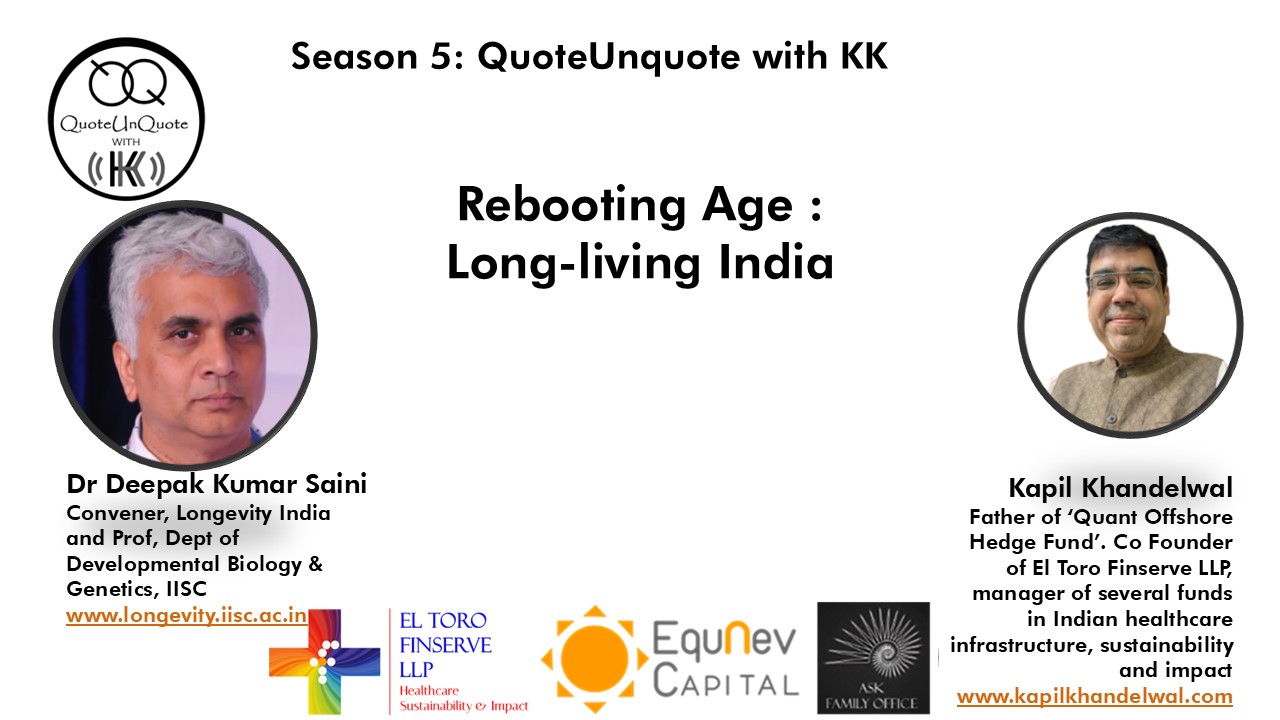
QuoteUnQuote with KK and Dr. Deepak Kumar Saini, Convener, Longevity India and Professor, Dept. of Developmental Biology & Genetics Indian Institute of Science (IISC), discuss Bet #3 on anti-ageing tech and products that is going to be a major trend in the next 5 years. Why is it so?
As 50s is the new 30s now. Present Genx and seniors would like to reverse age or age slowly. By 2047, over 300 million Indian would be Senior Citizens and our dependency ratio will be around 40%. Indian would like to extend their lifespan 20% to 50%. But the trick here is to ensure that the end of life after prolonged life is a quick process rather than a prolonged decline.
A conversation on longevity and healthy ageing in India, including the science of biological age, the Longevity India initiative, lifestyle and traditional practices, emerging interventions, research evidence, and the need for India-specific health data.
Kapil Khandelwal and Dr Deepak Saini discuss why extending healthspan matters more than simply extending lifespan. They explore biological ageing and the limits of commercial age tests, the four pillars of Longevity India, the role of yoga, fasting, nutrition and sleep, and the evidence gaps around supplements and experimental therapies. The discussion also examines Ayurveda, preventive medicine, physician education, public participation and the need for reliable Indian population data.
Podcast
Transcript
[00:00:00] Kapil Khandelwal (KK)
Hello listeners and welcome back to another episode of Quote and Quote with KK. It is a very auspicious day today and I wish all our listeners Happy Ganesh Chaturthi. and We wish that the world is, with the blessings of Lord Ganesha, is a peaceful and a prosperous world. Coming back to our podcast today, we had released our. healthcare life sciences investment manifesto for India. And we talked about how things are going to transition and how the world is going to look like in the next 5 years and what bet India needs to take in the healthcare and life sciences space.
[00:00:40] Kapil Khandelwal (KK)
And hence our podcast was themed Happiness, Happenings and Hookup. Now if you go through our investment manifesto, our bet number 3 discusses on anti aging tech and product that is going to be a major. trend in the next 5 years. And why is it so? You see today the 50s is the new 30s and the present Gen X and seniors would like to see how to reverse their age or age slowly. And let me tell you as part of think tank for the Bharat Varsh 2047 team, I had been working and making several recommendations and some of the key takeaways over there is that by 2047 when India turns 100, we’re going to have over 300 million senior citizens and a dependency ratio
[00:01:22] Kapil Khandelwal (KK)
is going to be over 40% and which means that we need to be investing a lot more into our geriatric and senior citizens health care. But what if we could do something better? If we could extend the lifespan by 20 to 50% of our current people who are going to be senior citizens and ensure that this this prolonged life life is a healthy one rather than a prolonged decline decay and disease that many Indians would suffer in their old age, that would probably be taking a lot of our healthcare resources and costs and hence the whole topic today which is repooting age long live India.
[00:02:00] Kapil Khandelwal (KK)
To discuss this whole opportunity and topic, I have invited a very prominent scientist and a thought leader who’s also initiated a new platform called Longevity India. Now, as usual, we do a fact check of what ChatGPT profile profile of our speakers look like and here’s what ChatGPT says about Dr.. Deepak Kumar Saini. Dr. Deepak, as I I keep talking in my podcast as doc Doctor Deepak Adipak is a prominent professor at the Indian Institute of Science Bangalore, which is India’s leading research and development institution in the League of the IIT S for Life Sciences and many other sciences.
[00:02:40] Kapil Khandelwal (KK)
He is part of the Department of Development of Biology and Genetics and he is associated with the Department of Biology. His research primarily focuses on signalling in aging anti inflammation. infection with a particular interest in microbacterium tuberculosis. Deepak has an extensive educational background, including a PhD in biotechnology from Ames, New Delhi and a postdoctoral fellowship at Washington University Medical School and the University of Arkansas Medical Sciences. His work has been published in numerous journals contributing significantly to the field of aging and infectious disease.
[00:03:18] Kapil Khandelwal (KK)
One of his key areas areas of interest is is is how aginging affect the immune system and its ability to respond to infections. I would be very honoured to have Doctor Saini talk about how do we develop strategies to improve health span combating age related diseases and the platform that he now heads Longevity India. I will talk about Longevity India as well very briefly. It’s a platform that has been launched by ISE and I would let Doctor Saini talk about it as well about the platform.
[00:03:52] Kapil Khandelwal (KK)
His team What the their agenda and their charter is, but I would love to just make a small comment before I let Deepak talk about it. is our friend and an investment manager, Prashant Prakash of Accel Partners. He has been a founding patron for giving a grant to start this whole initiative in India, which is to me a very honorable and a very, very intellectual initiative that could add a lot much more to what’s happening in India, both from. Research and Industry Development. So welcome to the podcast, Deepak.
[00:04:26] Kapil Khandelwal (KK)
It’s a pleasure having you on our podcast today.
[00:04:29] Dr Deepak Saini
Hello Kigai, thank you so much for your invitation. First of all, happy Ganesha Chaturthi to everybody. And as the Ganesha says, may everybody live healthy and happy. And I think this should be the tagline for our Longevity India initiative also because that’s exactly what we are aiming to work in this country. We actually want everybody to be happy as Ganesha and as prosperous as Ganesha and live longer as Ganesha. So I think with that theme to what KK said, we are starting this Longevity India initiative. Actually, we have started it in the Indian Institute of Science. And if it’s all right, I will spend next couple of minutes to describe you what exactly this initiative is all about.
[00:05:07] Kapil Khandelwal (KK)
Sure, please go ahead. Although we had a sequence on it, but I would love to kind of first take this off the bat. But Before that, I wanted to ask a few fundamental questions sure before we get into why longevity and what This is all about So what is aging just as a basic fundamental definition and why do people age?
What is ageing, and how should we measure it?
[00:05:29] Dr Deepak Saini
I think if you think about aging from a very very you know rudimentary or outside the volume and everything which has got a shape and architecture which could be living and non living things undergoes deterioration of this basic fundamental design overtime because of use, misuse or simple getting old and that is it very simplest to speak. So if you have any item a vehicle. The day it was manufactured and as its manufactured, it is losing its fundamental character because of usage. It undergoes aging and the human body is one of the same thing which undergoes aging as a function.
[00:06:03] Kapil Khandelwal (KK)
On this question on aging, you know, there are several concepts of measuring age. You know, yes, in our finance system, assets are aged in different ways, right? But in humans, age could be measured in very different ways. You know, there is a chronological calendar age, there is a biological age, there is a physiological age, there is a social. sociological age. Now, with the advancement in sciences, we also have metabolic and physical age. Then there is the gut age and there are many other scientists and people, thought leaders who have defined age in a very different way. So, could you help us elaborate what’s the best way to measure human age?
[00:06:41] Dr Deepak Saini
No, It’s a very interesting point. It’s a fascinating point and I think this point is at the heart of what we are trying to do also, given that there’s so much noise and this given that there’s so many options actually right now. The aging area is almost like going to a buffet. You can choose whatever you like your age to be, but it will not satisfy you because there’s always something which looks better than what’s on your plate, and that’s a fundamental problem. We have not understood aging very well till now, simply because as a human race, we were always more fascinated about how not to die young, and that is always the main thing.
[00:07:15] Dr Deepak Saini
We were always worried about infectious diseases, nutrition, and wars, and now since we have more or less tackled these 3 major. killers of humanity. We have shifted our attention to how not to die now old. So basically the idea is that how can we live long and how can we live healthy as much as possible? So the shift of model of modern modern science have gone towards health span. So lifespan is something more or less is constant for humanity. We do not believe that we would like to be aligning with the lifespan extended, but I would like to associate myself with health spanning.
[00:07:49] Dr Deepak Saini
And one of the main thing would be how do you categorise somebody’s age? you right here. Is it metabolic age? Is it biological age? Is it physiological age? And I think this is like asking somebody is what is your favorite colour? You can choose different lenses, different approaches. And why so much diversity? Because we still have not understood the underlying cause, underlying driver, underlying changes which occur in human body as a function of age, and more so in context of India, because India is you indians are genetically, metabolically, economically, they are very different. So while the West says measure this, measure that, it does not necessarily.
[00:08:23] Dr Deepak Saini
will apply to India. So right now the canvas is empty for us. The canvas is white. We can choose our characters to draw on that, but it’s going to be a while before we decide what defines our aging in biological terms rather than chronological. It is still an open story.
Age calculators and scientific validation
[00:08:39] Kapil Khandelwal (KK)
That’s a great starter to the topic today. And let me just delve a little bit deep into it, because now that there is clarity of age, you see, there are various tools on the website and Internet that are providing calculators. And then tests available to measure your correct age. I wanted to understand, are these scientific calculators or tools or tests validated and should people fall for into these traps of subscribing to these sort of platforms and conducting these sort of tests?
[00:09:09] Dr Deepak Saini
So great question, KK. And I think the question which you asked, the answer is within your question. Is that should people fall for it? So again, a rigour in a scientific question comes from how many people agree to make this. same observations which somebody is claiming the Newtonian experiment. The apple falls. Well, so should orange and so should papaya and so should coconut bean. The experiment got repeated itself multiple ways, multiple platform. Exceptions are not to be. So it becomes a hard fact. There is gravity and that same rule applies for a lot of fundamental discoveries. Which However, for aging, given that we have recently woken up to aging and we’re still not invested on the fundamental science, there’s a lot of gimmick which is out there.
[00:09:49] Dr Deepak Saini
A lot of them are based on early stage of scientific discoveries. Salaries, which still needs a lot of testing and validation in a larger population. But given that the market is demanding such things to be there, I think just like any other place India also, the demand decides what the supply should be. There is a lot of kits, K ages, calendars, calculators which have been launched there. Reliability of everyone of them is questionable because if you use 2 or 3 or 4 different calendar, you’ll realise you have 2 different age groups. But more or less, if you think very carefully, what these calendars are trying to tell. is very simple which they’re trying to tell you how good is your metabolism in your body does your body have high signs of inflammation basically signs of deterioration and more or less if you check these 2 boxes you will be able to put your chronological age and your biological age in one basket.
[00:10:41] Dr Deepak Saini
You might end up saying that I am biologically young or a biologically old based on an inflammatory and metabolic signation and that’s what the reliability of these markers as of now scan.
Anti-ageing, rejuvenation and longevity
[00:10:50] Kapil Khandelwal (KK)
Given that now we have understood all this. There’s a lot of stuff on the Internet again and people when you do search terms like age reversal, anti aging, age renewal, rejuvenation, defying age, longevity come up and I’m although they may sound very similar, but I’m a bit confused and I would love your clarity as to what is the difference between all these terms such as anti aging, age reversal, age renewal, rejuvenation, defying age longevity because now you are also doing longevity related platforms. Just for the simplicity of our audience, you would love to understand, you know, are they the same or are they used interchangeably in a wrong context?
[00:11:30] Kapil Khandelwal (KK)
What are they?
[00:11:31] Dr Deepak Saini
Great question, KK. I think these nomenclatures are as baffling to a common person has to us. That Why do we need so many different nomenclature to describe, or ascribe or define something which fundamentally same thing everybody wants, is to figure out ways to slow down the rate of aging which we are undergoing, and that is largely to extend our lives. Great. So why do we I need to? To call it anti aging because it is catchy. I would be able to sell my 2 bit of wisdom very easily if I says anti aging because aging has got a very huge negative connotation in an audience. I can ask you to do a survey. You take 500 people and ask how many of them like to live long and I’m sure almost 90% people will raise their hand.
[00:12:11] Dr Deepak Saini
And if you ask the same people how many of them want to get old, I bet nobody would raise their hand because we do not want to get old but we want to live long. So that is the whole Grail of the document. Market where anti aging is a procell, age reversal is even bigger cell. People tell I will reverse your age and who doesn’t want to get Everybody says Kashyang pathsal pahle. So that means it is an age. It is a time thing. We don’t want to do that. But at the same time we would like to feel younger. Feel younger means reversal and that is what we people want to talk about. Pretty much what you are trying to do is you are improving your body’s metabolism.
[00:12:46] Dr Deepak Saini
You are keeping the inflammatory markers in check so you physically start feeling younger. It is not an age reversal. It’s basically signatures itself. You are fitter because you’re taking care of yourself, and that’s what is another way of telling people that they need to take care of self. And that’s cadres itself. Longevity coming to another term, which we use longevity is dictionary meaning means durability. Durability means if I am going to do something to my body, an adverse event, how rapidly can I restore back to my fitter state and to start executing as normal? People undergo surgery, they make make some accidents.
[00:13:21] Dr Deepak Saini
How fast does the person come back? To the normal and that’s durability and that’s what is longevity is all about. How durable can I be in long term? Age renewal is another term to use the word age reversal. There is nothing bit too bit different between them. Rejuvenation and rejuvenation by word itself sounds fascinating. It is like making a new candle out of the old wax which is a fascinating point to say. So everybody would like to rejuvenate. Can I renew my body such that I can start abusing it again? That’s a very cruel way of putting it, but that’s what most people want to do. I have heard people say that I run a job. Because if I run and jog, I will not put on weight.
[00:13:55] Dr Deepak Saini
If I don’t put on weight, I can eat. So the luxury of reversal rejuvenation anti aging is people want to relive the moments which make them feel happy about themselves. Now you can do it multiple difference. Defying age is another term which you have used. Defying age means you know you deny your physiological aging such that you even if the as you said in the beginning and the last time we met, you know you are older but you look younger. That’s defying age, a classic example a lot of people. Feel very good about it because of course it is a stinct to feel good about that you are actually not looking older. But that is simply because we attach a negative connotation to getting older.
[00:14:31] Dr Deepak Saini
If everybody is fitter around you, a defining age would not be a unique concept, it will be the norm and we would not call it defined age, we will actually call it aging grace, having dignity in aging. And that is why people will find new purpose in life. So all these nomenclatures or naming are basically for those who would like a quick fix solution to the people who are who have invested. And understand longevity. For them, these words pretty much mean the same. It’s no difference because they’ve already adopted the culture of plan. But all these nomenclatures which you talked about, they are for the non practitioner, they are for the gimmicky, the star power seeking people who want to figure out what works best for them without really investing themselves.
[00:15:11] Dr Deepak Saini
That’s the difference. For the learned, they are same. On the unlearned, they are all different. You need to figure out where you want to sit on.
Dr Saini’s journey and Longevity India
[00:15:17] Kapil Khandelwal (KK)
Well said. Now I want to jump in about you. Lets talk a little bit about you and longevity. What is your interest in your journey in longevity?
[00:15:26] Dr Deepak Saini
So, you know, this question I can talk for hours. It’s been a very interesting ride. I was on. I’ve been working on a lot of biological problems. I was praying in a completely different area. My work in US was in another different area, which is regarding pain and drug pharmacology. So I would say I’m an accidental adventurer in longevity space. It was a serendipitous observation during my studies in US that I was looking at a molecule. Which seemed to be doing something to aging and it kind of struck with me and I said, why don’t we come back to India and start my own group? Maybe this is something I would like to work and I had even more adriged student with me who said, this problem is what I’m fascinated, let’s work on it.
[00:16:06] Dr Deepak Saini
And I think way back in 2010, when I started my lab in India, we started the first sets of serious experiments and trying to understand how cells in our body undergo aging and what kind of new design of aging occurred and that’s led slowly to get us interested. To dwell deeper into aging aspects of aging and about last few years back, what we had a very interesting I wish a lot of my colleagues in the department and the institute. I’m part of several departments and we were talking and I realised that you know, our education system, which is one of the best in the world and has actually generated a humongous number of specialists.
[00:16:41] Dr Deepak Saini
We take pride in generating specialists and actually, the modern education system has motivated everybody to become a specialist in something. There is a gastroenterologist, there is an ophthalmologist, there’s an endocrinologist. Everybody becomes specialised. So when I was talking to this interesting eclectic group of faculty in our institute, I realised we have a colleague who looks at gut microbiome. I have a colleague who looks at ovarian cancer. I have a colleague who looks at pancreas. I have a colleague who looks who’s a bioengineer. Who There’s one colleague who looks at genetics. There’s one colleague who’s looking at lung 18 immune system. I said, you know what? This is a fascinating group of individuals but they’re all specialists to problem like aging and longevity.
[00:17:17] Dr Deepak Saini
You need a journalist, somebody who is a naturalist, somebody who can understand and integrate these small. It is under one umbrella. Now, given that we all were already specialists and asked us to become just simple, pure, simple speaking, generalization is not going to be easy. I said the best way to put everybody under one umbrella and let everybody. Contribute they are too big point with expertise into what we call as aging and that led to genesis of this longevity India initiative. So we have almost 20 plus faculty, they’re machine learning guys, they’re AI computational modelers, biomaterials specialists, immune system specialists, epigenetics, gut microbiome, you name it.
[00:17:54] Dr Deepak Saini
There’s somebody who’s put this idea was to get everybody to bring their specialization under one umbrella and start working on a problem which needs a wholesome holistic approach. And that’s where we started longevity. So. Environment of Prashant was the nucleation. Basically, you know, you can talk endlessly, but once you have some gel which is in form of support, people start gelling automatically because you know, we’re not just talking, we’re now in a position to doing something about So I think Prashant’s contribution was absolutely instrumental in this gelation process where people actually readily came together and put their thoughts and energy to this initiative.
[00:18:28] Dr Deepak Saini
That’s where we are.
Research, industry and public participation
[00:18:29] Kapil Khandelwal (KK)
As a supplementary question to what Prashant has initiated, how can public support? India, people like us, what can we do to enable further research programs and support whatever your charter that you have defined at Longevity India? How can we be part of that journey and make it much more powerful and inclusive?
[00:18:50] Dr Deepak Saini
Pavita, thank you, KK for asking that question. First of all, I must you know, emphasise the word which you used as inclusive and that is the mandate of our issue. Inclusivity is what we are mandated. So if whosever is interested, please checkout Longevity India. You’ll realise we have actually built this initiative in 4 pillars and we call them pillars because it’s all about inclusion. So there are 4 pillars. People like us who do deep science for a living. We have been trained in deep science and that’s what we keep doing because that’s what we are good at. But also there is a whole lot of clinicians who have to give us constant feedback and input to improve our understanding of human body.
[00:19:24] Dr Deepak Saini
So a second pillar is clinician. A 3rd pillar is something which KK will understand much nicely is the industry. See industry, no matter you can call them devils because they want to make the profit because making profit. Is not bad. Industry is an absolutely integral segment because a lot of fundamental discoveries can be motivated by industrial demand. If there is a need, we need to cater to that need. If fundamental scientists and industry come together, we can meet that demand. So that’s the 3rd pillar. We have industry who was given lending a support of in terms of funding, in terms of idea, in terms of instrumentation, technology, and make things accessible to fundamental scientists.
[00:19:59] Dr Deepak Saini
And the 4th, which is a very important pillar, is society. What I mean by society? Society includes people. Again, KK belongs to one of them policy makers, people who influence decision making bodies. And why we want them? Because the awareness about longevity needs multiple formats of engagement. It needs government, it needs public, it needs coordination, it needs lots different type of people to come together to support this initiative, but also societal. In terms of a common man, I say my team wants to look into longevity and ageing of Indian population. Now, somebody might ask me, tell me what do we know about Indian ageing?
[00:20:35] Dr Deepak Saini
My answer is nothing because we have not looked at systematically at a molecular level. What happens in Indian aging, our genes, our genetics, our diet, our lifestyle, everything is different and we have never accounted for those. You have mentioned KK in the beginning clocks of aging, this clock, that clock, these clocks are different. Indian clocks are going to be different. And we know that we know that because our rules of aging are very different. First of all, this is where we think society can come first number one, when a person goes to a hospital, they say we are going for a Health care assessment. Fundamentally, that is a problem because when we go to hospital, we are going for sick care assessment.
[00:21:10] Dr Deepak Saini
We are going to look for whether we are sick or not. We are not going for to check our health. We just go there, get our blood work and say we are not sick and we are OK with what Rangevich India wants to do is a health care health assessment. We want to onboard healthy Indian population so that we can study how healthy aging people look like so that we can understand if an unealthy person comes, which organ in their body is have a different clock than they are. Chronological. And that’s where the discovery in terms of managing healthcare will help. Building hospitals is one ballgame, but we need to understand what can we do to keep people out of it.
[00:21:44] Dr Deepak Saini
And that’s where I think public can support. So not only what I’m saying is public can support us by you know, contributing to this initiative. This is a very, very resource intensive exercise. We are trying to work with a whiteboard. We need a lot of resources, a lot of support. We need more people like Prashant Prakash who are a little more adventurous in supporting fundamental science. Given that its root of this initiative is an ISA. As he’s been always on the forefront of modern science, we do emphasise that we will definitely make sure that we contribute to this cause as many ways as possible. So we need societal contribution. We also need people who are in various age groups and clinically defined as healthy so we can start sampling them and understand pan India how East Indian versus North Indian versus South Indian body signatures look when they undergo aging.
[00:22:30] Dr Deepak Saini
So there is lots to be done. We have just begun. The road is long, my friend, and we can do with as much support as.
[00:22:35] Kapil Khandelwal (KK)
Let’s invoke Lord Ganesha once again today on an auspicious day that we are all successful in doing it the Indian way. Yes, since you mentioned the Indian way, I wanted to also discuss a few things. You know, see, there are many Yogis in the Himalayas who are meditating and living for hundreds of years. I’m not sure there are many YouTubers who have visited and spoken to them and stuff like that. But the more important issue is that does yoga and meditation impact longevity? And that’s the Indian contribution to longevity. I would say directly great point Kate.
Yoga, meditation and healthy ageing
[00:23:07] Dr Deepak Saini
So personal view, these are all my personal views by the way. I must give a you know, clear declaration. These are not views imposed by anybody or funder or institute. These are my personal views. You know, yoga, I think lot of Indian science was way ahead of times. So a lot of our practices which is there in India inherently were adding lot of deep understanding to human physiology. You know, While in India we talk about various aspects of aging from this is one. Country where we have reduction, we actually endorse the concept of getting old and we endorse the concept of getting old by going into a different phase of life.
[00:23:43] Dr Deepak Saini
This is one country. Yoga is another thing while people say I must do cardio and I must do a lot of muscle building. While muscle building is good and people have shown that people who have more muscle mass live longer and live healthier. The point of yoga is to maintain suppleness, keeping it very supple, keeping it smooth, no matter how old the door is, if the motions are smooth. Nobody asks rage and no matter how young the door is a new door, if it starts creaking people, the first thing I say, how old is this door? So I think it’s a very valid point. A creaking body creates more noise, create draws more attention.
[00:24:18] Dr Deepak Saini
A smooth operating system draws least tension. Yoga is about that smooth. It’s about living in harmony with the environment. Yoga is something another fascinating to work about. Let’s take an analogy of human body to a week. You drive a vehicle on a highway at a steady state rate. You do not accelerate very rapidly do not break. too hard, you are actually going to get the best mileage of your brakes and we know it. Vehicle manufacturers always claim that we also know that if you do that, no sudden braking, no sudden acceleration, your vehicle is going to run for a very very long time. It’s a well established work. Now you think of your this as your body. If you do not accelerate deaccelerate, you’re going to that means you do not over consume.
[00:24:55] Dr Deepak Saini
You do not starve yourself to death, you live longer. Yoga tools talks about moderation. It talks about making things simpler and in synchrony with your body. Yoga doesn’t. not want you to do extremes. It wants you to do what your body is capable of handling without any discomfort. One of the main thing in yoga is about not addressing things to take it to discomfort level. Second thing ho yoga does is very interesting. It slows down your breathing. It talks about very big emphasis in yoga about slow pranayama. Basically breathe and realise what you’re breathing and that’s like moderating the vehicle speed.
[00:25:29] Dr Deepak Saini
You normalise, you make it do not accelerate, do not deal and that is one simple thing which will allow you In a healthy state because you are not abusing your and yoga is about that. What can I do to my body that it is fit and it’s not so? Yes, yoga is a fantastic way to impact longing, it’s a fantastic way to improve your health. But let’s look at 1:00 simple way. Is yoga going to be just enough? Let me just do yoga and that will be enough. The answer is no. So think about a lot of factors. If you’re running a car, you also need to make sure you put a good gasoline, you put the good petrol, you also keep your interior clean.
[00:26:03] Dr Deepak Saini
So there is a maintenance which is required. along with that yoga is only the best one so while you do yoga you need to make sure that other aspects good sleep good nutrition supplement healthy social connections you know reduced anger and anxiety they are going to make you yoga is one of the main medium but not sufficient necessary not sufficient.
Fasting, metabolism and autophagy
[00:26:23] Kapil Khandelwal (KK)
Well put I wanted to bring one of my personal experiences here you know my great grandmom she died at the age of 90 wow and that’s.
[00:26:31] Dr Deepak Saini
Why any standard is long?
[00:26:33] Kapil Khandelwal (KK)
Yeah and this is I’m talking 25 years or 20 or 30 years ago. Alright, so that time the average female life expectancy was what 58 or something like that. I’m talking of absolutely 70s, early 70s 70s.
[00:26:47] Dr Deepak Saini
Yeah, yes, right.
[00:26:48] Kapil Khandelwal (KK)
And you know, there was a catastrophe happened. She had a fracture of the femur surgery was done. But then after that there was a decay and decline. But till that time, you know, she had a certain regimen. She would eat one time in a day, she would fast 2 days in a week and stuff like that. that. And she may look frail, but bodily very strong and no muscle mass. Obviously, with her age, she must have lost her muscle mass and at post menopausal. But that brings me to a point here. You know, our Indian mythology religion talks about fasting, and I saw this in my great grandmother also, who may be following certain religious practices, but there are certain religious and mythological practices about fasting.
[00:27:30] Kapil Khandelwal (KK)
Does fasting also increase life expectancy? And improve longevity or are we missing something else? Yes, this is a key concept of religion and myology.
[00:27:40] Dr Deepak Saini
Well, actually fasting is in every culture of the world in one form or every religion in the world undertakes this aspect of fasting and different flavours and formats. Very hard grain in India because India is always known to you know fast bunch of days every month or every lunar calendar. Yes, fasting has got clear positive impact on the body. Let’s think about our gasoline tanks and the vehicle. Let’s think about that gasoline tank as a vehicle which is. Not a fixed capacity, but it’s a balloon which you can keep filling it up. Now, unless you figure out that you need to let some of the fuel which is there and the reserve used up, you’re not undergoing.
[00:28:16] Dr Deepak Saini
You’re not going to allow the additional weight of your body to get out. So fasting is one way you give to this cycle of use and metabolism and then you start feeding it again. So basically keep you supple one. Second, ourselves have got unique ability if you starve them of nutrition, they trigger a process called autophagy means eating what is deposited. It starts making use of available nutrition, available resources and at a cellular level it happens. And at all organisms, organ system level it happens. So this is basically a cleansing mechanism where you use the reserves so you can actually restore this. It’s like you know, storing nutrition in the depots or the storehouses.
[00:28:53] Dr Deepak Saini
But if you never access them and they’re going to rot and that rot is going to cause an efficient. So the fasting allows the deposits to be utilised. So there is a circulation of this nutritional pool which is available to us. So I think. Yes, fasting has always been associated with better new metabolic proof. People have shown time and again intermittent fasting or fasting for a certain day hours teen hours plus always have a pro health benefits where you actually end up reducing inflammatory markers improve metabolic health. So given that thing, yes, fasting has been always in the force.
[00:29:27] Dr Deepak Saini
Also in multiple models of Aging which we use study in the lab using various organisms, the only thing which has shown to have a. life extending property has been caloric restriction. So you reduce the calorie, you live longer. So it’s been the mainstay of long life. Eat when you need, let the body demand that nutrition. That’s always been the case for people who actually show a better lives.
Traditional knowledge and Indian practices
[00:29:50] Kapil Khandelwal (KK)
We talk about a little bit further about mythology and Ayurvedas. You see there are certain people people who are immortal, Hanuman, Shiva and so many of them. And then there are certain people people people in our mythology and Vededas that have lived I think centuries and now our modern Vedic science people are researching how long they have lived and what whatever from what time we see to what time we see and they’re trying to see if there are any fossils or whatever. I’m sure these are certain ancient practices which were part of our Vedic practices and which had given longevity to the people in the past.
[00:30:28] Kapil Khandelwal (KK)
I want to understand how do we revive these ancient practices? I mean I’ve been part of certain other platforms and have kind of been working on this because of my own interest, but how do we kind of revive these practices and make it much more mass oriented and acceptable, which probably would have a incidental benefit of longevity as well?
[00:30:46] Dr Deepak Saini
So it’s an interesting question. I would not talk much about mythology because mythology is called mythology for a reason. That is that absence of clear tangible evidence, which is what makes mythology. A lot of history has become mythology simply because of lack of clear clear evidence. That does not mean they are right. Return me they did not occur. Those are not necessarily mean. What mythology is saying is cannot be achieved if possible. But again, I don’t have any evidence to say either ways. Now coming back to their, what were the practices which they must be doing which probably allowed such fascinating aspects of immortality, immortality or long life to be talked about?
[00:31:22] Dr Deepak Saini
So I think a lot of our ancient knowledge is in the lost domain, basically either because of loss, because of you know, the country has been invaded so many times. So we have lost that ancient knowledge because of natural calamities. Bloods and so on and so forth, those knowledge is lost. But again, a lost knowledge does not necessarily mean we cannot visit those arts. So, as I said, a lot of Indian knowledge was far ahead of the curve in terms of understanding. A lot of those understanding took form of spiritual aspects because those aspects are easy to understand for a common man’s person. Scientific nitty gritties gets muddled for a lot of people and that’s why they do not get practiced very frequently, whereas spirituality becomes gets practice because it’s easy for.
[00:32:05] Dr Deepak Saini
People to understand because we always associate with the unknown, always associate with the supreme, and that is how it works very well. What is lost in our current understanding of life? A lot of things have been lost. We have. Stopped following unnatural diet, which is at the heart of lot of our early sciences or early natural thing. Our medical system used to treat an individual as a whole, not an organ specific treatment. We used to do a lot of emphasis on our holistically. lot of that thing is coming back. But what lot of knowledge in process of being specialist got lost.
[00:32:39] Dr Deepak Saini
So it’s now we need to figure out how to recover that’s a big problem. Number one second thing is the availability of nutrition, which is predominantly carbo. Hydrate rich diet has undercut lot of our efforts which we have our Indian system laid emphasis on. That is the way we said eat according to the season, the seasonal. Consumption of food has actually changed because it’s we are able to grow everything and eat right. The cycling of food, the nutrition value that has gone away. Taken the aspect of stage what we eat in what place. Basically there are food which is an India specific food which grew and which allowed us to live that way.
[00:33:18] Dr Deepak Saini
That local hyper local consumption has actually been lost again. We have become in. every Indian is now a global and this global citizenship is hitting us maximally in terms of our health and. We have signs of more. India takes pride on everything also, but we should feel bad that we are the capital, cancer capital, GI capital, everything because we just have too many people who are suffering from these problems because we have more or less bypassed the local doctrine of we have actually changed the way we started living. So people say there’s a benefit of sitting down and eating. There’s a benefit on how you consume with your food, with your hand, you consume your biome, your microbiome, which comes with the skin to your body.
[00:33:59] Dr Deepak Saini
Start listening. to what your body tells. So there’s a lot of things which our mythology or basically ancient Indian history practice as a norm. Those norms have been lost because of global citizenship of India. So those norms are what we are actually going to be loser in this race because that’s where things are.
[00:34:17] Kapil Khandelwal (KK)
I think this should also become part of the research agenda at Lanjuita India also looking at what was in the past and what could we revive back.
[00:34:26] Dr Deepak Saini
Yes. So the biggest problem is we don’t even know what we have lost. And that bottleneck is going to hurt us big time because incomplete knowledge is far more dangerous than the not knowing anything. Now we are trying to bring back a lot of ancient wisdom without even knowing what we are have lost in the process. So this is going to be a very, very difficult task because I can teach in a blank slate. I can write something completely new, but a slate which has got something already written, I need to make believe that story is as per I would like to hear to me. So that becomes a problem.
[00:34:59] Kapil Khandelwal (KK)
I would like to share. a little bit from mythology to our modern medicine and health care, and you know there are some poster boys in India now. Very recently, India Today group got in Doctor Sinclair, author of Lifespan and his wife, and he talked about several things that he follows, and he is also a guinea pig to his own body about what he takes and whatever he knows at Harvard and what’s going on. I would love to get your take. He has talked about several issues, but since our health… Life sciences manifesto is a 5 year horizon and thing I would love to kind of get your take on whatever has been talked about.
Nutraceuticals and lifestyle interventions
[00:35:37] Kapil Khandelwal (KK)
And there’s a whole ton and ton of content on the media and the Internet as to you know, which what do you think would hold immediate promise and outcomes, say, in the next 5 years? And I would like to start picking up a couple of these approaches to longevity. The first of them would be nutraceuticals. I also take certain high end nutraceuticals, which is what shows on me and my body. Does it hold? Promise and people have been trying a lot of things as well. So is it good or bad? Do we know what sort of outcomes does it give to longevity?
[00:36:08] Dr Deepak Saini
OK, let me ask the question back. You say you take some nutrition. Let me ask one thing. I would not ask you what you take because that will become a product publicity. But I will ask you one simple thing. Is that the only thing you should do towards your longevity or your health? Is that the only thing you do? Do you just consume nutritionals? Do you not sleep properly? Do you not interact with people socially? Do you not eat healthy food? Do you not exercise right? So if your answers are not for all of them and you think nutraceuticals are only thing which you are doing to your body, I would believe nutraceuticals are working. So what’s your answer?
[00:36:42] Kapil Khandelwal (KK)
I’m coming from a supplementation point of view. What my I’m asking what no I do all of my question is except a little bit on the sleep side work is something that takes me on wrong times. Sometimes I have to wake up at 5:00 in the morning and come and have a call or sometimes I have to wake up or keep. myself awake till 1:00 in the night as well, but then I catch it up over the weekend or something.
[00:37:04] Dr Deepak Saini
So now let’s let’s revisit that question that why did you start taking pills? Why do we do other things? Because you were cognizant of the issue or aware of the issue that with aging your body undergoes deterioration and it needs addressing. And you approach that addressing aspect by multi pronged approach, which means you ended up addressing 1234 aspects, which is what you. You said well nutraceuticals alone are not special. The first aspect is awareness that your body needs mending, your body needs healing, your body needs repair and once you have that awareness you would make multi pronged changes in your life and lifestyle.
[00:37:46] Dr Deepak Saini
So longevity and aging is basically at heart an issue of lifestyle management and once you have understood nutraceuticals are just a small pillar, a small. Add on to that whole gamatic things which you’re doing in your body, which is allowing you to work with maximum efficiency, appreciate pure physiological wellbeing. And that’s where nutraceutical alone is never going to be sufficient. You cannot repair a broken car with a touch or dash of paint. You need a systemic overall that awarenesses are most important.
Prescription drugs and medical supervision
[00:38:17] Kapil Khandelwal (KK)
I want to bring very important yes, very very serious subject here. Obviously, Doctor Sinclair made it very public. He is taking certain. Prescription drugs like metformin, certain immunosuppressants, certain biologic. We also had people who are looking at towards marijuana as well for anti inflammation and stuff like that. And in Indian culture, marijuana consumption has been there for ages, although societally now with regulation, it’s been restricted, but it’s opening up globally as well. What are the pros or what are the dangers of getting into these sort of products for ensuring that you’re arresting some of?
[00:38:57] Kapil Khandelwal (KK)
those metabolic issues in your body or repairing yourself, is it advisable or is it not advisable? How do you see that?
[00:39:04] Dr Deepak Saini
So the way I see it is very simple. That is, prescription drugs are called prescription drugs for a very simple reason. They are for pathology. They need to be consumed under medical supervision. And there’s no magic. First of all, there is no magic pill. If you look at all the list of drugs or molecules all these longevity champions consume, they have 2 very simple motivations: improve metabolic health reduce. Inflammation question one should ask themselves is, can I do the same by something else? Can I achieve the same outcome by other means? For example, can I control my metabolic intake, reduce my carbohydrate intake, improve my protein intake?
[00:39:42] Dr Deepak Saini
Right if I start taking more plant phytopenols, do I really need to take immunosuppressants? Do I really need to take anti inflammatory because my physiological inflammation has come down? If I reduce the sugar intake in my body, my metabolic health is so all this prescription drugs is. Additives in your food which have low nutritional value but have more palatable so they probably make you feel good about that your metabolism improved. But if you do major lifestyle management changes, which is definitely not the most what you call palatable and very interesting changes is for which one would be who doesn’t want to eat their salsas every other day?
[00:40:18] Dr Deepak Saini
Who does not want to eat parathas? Who does not want to eat sweets? As long as you keep doing that, you have to keep relying on this prescription driven drugs because you are actually abusing your metabolic. But if you slow down, those these drugs will have at best a minuscule addictive value. So yes, prescription drugs are prescription for a reason. Unless there is a need, don’t go for these things, especially self administration without medical reason is not going to be great. Immunosuppressants works in the rest beautifully. India is a tropical country where bacteria, fungus, human being, enzymes, you know, insects live together. So can you think about what will happen to you if you take immunosuppressant?
[00:40:52] Dr Deepak Saini
You will definitely not die because of it, because probably you will not even reach that stage.
[00:40:57] Kapil Khandelwal (KK)
So I like cigarettes, we should have a statutory warning. Yes, could be injurious to health.
[00:41:01] Dr Deepak Saini
Well, it could be injurious to you, it’s just not your health completely.
Hyperbaric and hypoxia therapies
[00:41:06] Kapil Khandelwal (KK)
I want to now bring you know, certain celebrities have done certain things and that went as a rage. So Michael Jackson used to go and sleep in a hyperbariatic chamber right? And now there are certain sports people and mountaineers who actually do the rivers. They go for hypoxia related therapies. Yes, now the science is. Pivoted on both sides for longevity. Is it advisable to go once a year in a hyperbiotic chamber for a few hours? I mean, I have done it once because of the recreation.
[00:41:36] Dr Deepak Saini
But lets lets look at the world. Lets look at the world around us. You go to Nordic country, do sauna it help go to Russia to a chilled ice water, go to Japan, sulfa bath, eat fish, go to France, eat meat, drink wine. So every country has their own you know, special things which they do. Again, not enough data to support anything either. Not enough trial, not enough controlled studies to say it works or not. Recent studies in one you know organism says hypoxia is good, some hyperbaric experiment. So all these things are they are used to flush your Think about that.
[00:42:10] Dr Deepak Saini
All you’re trying to do is resetting your metabolism, resetting inflammation, so you feel suddenly rejuvenated, you start feeling good about yourself, and that’s all they are playing. We do not know the long term implication of therapy. There’s not enough data to support one from us. So from my perspective, I will refrain from saying. Anything works because evidence exists for everything, but there’s not enough data to say they should.
[00:42:32] Kapil Khandelwal (KK)
Again checkbox for statutory warning.
[00:42:35] Dr Deepak Saini
Yes, I like to come down. You might want to say sorry, you might want to think about what are you doing? it. I think if you start asking this question to people, you’ll be shocked by the real answer is that 99% of just doing for the feel good fact. That’s it. You ask how many of are them doing this for the long run? The answer is not going to be there. Most of the athletes in the world they are not the longest living individuals, so. That should tell you that a lot of these things may not have a clear implication bearing on long live.
Cord blood and plasma rejuvenation
[00:43:02] Kapil Khandelwal (KK)
Well put. I want to bring up one other practice of, you know, in India, obviously a lot of people have frozen the umbilical cord for future use. At some point in time, it’s an insurance for their future and a lot of it is now frozen. And now comes this whole emerging thing of young plasma transfusion or using cord blood banked thing for rejuvenation and regeneration. And there is a stat, it’s about how many crores of caught banking and has been banked and that population is now in their 30s, started somewhere around that time.
[00:43:36] Kapil Khandelwal (KK)
Is this something acceptable or is it something that needs further validation before they unbank and start using it for their age related harvesting purposes?
[00:43:47] Dr Deepak Saini
Again, not enough evidence for a value preposition high realizable value unknown. So from that simple perspective, yes, I think human beings ever since. We learn the art of storing, we are storing everything. I think from time immemorial we started storing pickles and making murabbas and everything. We love storing because you do not know when we are going to need it next. Kab zurat parjai. So I think the latest healthcare system has allowed us to store everything. People even store their blood draws, people store their plasma. We never know what we want. The idea sounds fascinating, but I don’t think we’ve reached a level of maturity in terms of our scientific understanding that the clear tangible use of them is real.
[00:44:27] Dr Deepak Saini
It may happen in future. I would not deny it. I would not say no, I would not say yes. It’s a matter of time. We have to wait and watch. Are we ready to put something right now? I don’t think because again no long term study has been done. But again that does not mean it should not be done or cannot be done. It’s definitely doable, definitely something which people should invest in. So there are people who are dedicated to understanding the usability of this you material. Perhaps they are in a better position to answer that right now no obvious use is. clear on for these materials.
[00:44:58] Kapil Khandelwal (KK)
So this is on the hold I sell hold.
[00:45:00] Dr Deepak Saini
I would say our understanding comes becomes very I want to move to.
Reprogramming and future therapies
[00:45:05] Kapil Khandelwal (KK)
This whole thing of rebooting, reprogramming and there is different streams of sciences working on chemistry, genetic and other biology as well. How near or how far are we to actually now bring this to reality? Is it 20 more years before people can say that this would be something that would be a reality?
[00:45:27] Dr Deepak Saini
Technically speaking, we’ve always been rebooting our body by fasting. We’ve always been rebooting our body by undergoing, as you call in Indian system, navratra. We fast for many days, get the gut cleansed, get repopulated, get the tissues organs in our body undergo reset. We’ll be doing this reprogram. What are these other reprogramming you’re talking about? These are the fast reprogramming protocols we want or the reprogramming for long term commercial ways. Is that commercial? So yes, it’s like the fundamental difference for most of the people. A Maruti is sufficient, but people still aim for signal. So these are all reprogrammings are Mercedes of the healthcare system.
[00:46:04] Dr Deepak Saini
Doable, possibly. How far? Maybe not very far, maybe close. But what are they relying on? The chemical molecules which we’re relying on a pretty It will come back to the same arsenal of chemicals which we give to people to reset or affect the lungity. So ultimately, the buck is the program is rotating on the same thing. What can I do to improve my metabolic and immune health? What can I? Do to improve my renal or hepatic or liver health. These are the simple things which people are looking at. Anything which improves those functions would have an implication and it’s a matter of time.
[00:46:38] Dr Deepak Saini
We’re there to see how it’s going to do.
Ayurveda and evidence-based research
[00:46:39] Kapil Khandelwal (KK)
I know a lot of scientists like you would always push back on Ayurveda, but on the Internet now there are a whole host of you go to Facebook, you go to and there are all these Ayurvedic solutions that will do your metabolism, our microbiome, gut microbiome. Reprogram you all that. Obviously like Chinese traditional medicine, we have not invested a lot in clinical validation. What do you suggest? And obviously scientists, many scientists that I have worked in the past in my avatars say that this is just a placebo effect and this is what let.
[00:47:15] Dr Deepak Saini
Me let me correct you again. My personal thing, I disagree that Ayurveda is something which we disagree. I think it’s something which lot of scientists realize that Ayurveda perhaps. Works on a slow and steady bolus of resetting the metabolic and physiological rather than our existing design of quick fix solution, which is what the drugs industry. So that transition and thought process is indeed occurring in a lot of scientists and a lot of global scientists also. So it would be incorrect to say that we are not endorsing Ayurveda.
[00:47:50] Dr Deepak Saini
We are all endorsing Ayurveda from a simplistic viewpoint that given that the evidence based. Examples of Ayurveda are low. We have not investigated molecular mechanisms of Ayurvedic P. The integration of Ayurvedic hearing system to a common person is low because the quick fix solution seem to have worked for very long. Aging is one process which I always tell people will not do with quick fix. It needs long breast medic. It’s resitting a body to the best metabolic state. So it will take time. And Ayurveda probably is much better placed in dealing with these changes than any other you know courses of.
[00:48:27] Dr Deepak Saini
And as I said, Ayurveda is about a general physiological science which are always about all organs in total and it links gut to everything which is all the modern biology is now talking about gut brain gut, mind gut, heart gut, everything is a gut access to everything so yes people have connective aspect of gut drives a lot of change and Araval has been talking about it for forever that gut drives and people have now clear evidence to show that if your gut is leaky means your gut has got barriers which has been in. Infringed upon or broken, you show signs of accelerated aging because your inflammatory markers goes up, your metabolic health comes down.
[00:49:05] Dr Deepak Saini
There are evidence to show gut is a major culture because evidence based medicine has been implemented there. Ayurveda needs that. We’ve been exploring options of engaging with Ayurved Acharya to understand that if we can start collecting molecular markers of Ayurvedic, you know, individual categorization and therapeutic responses, we would be able to bring evidence to the you. notorious Ayurvedics just simply because we have not tried to align with there have been 2 schools of thoughts for a very long the allopathic and the Ayurvedic their need there is a need to integrate these schools of thought while the evidence from the allopathic medicine is very very clear they are not you know they are very evidence driven approach is taken Ayurved that the systems believe in healing they are not worried about evidence because evidence tends to vary between but I think this good time we can amalgamate bring to these 2 streams
[00:49:57] Dr Deepak Saini
Teams Together and bring them to the mainstay that there is evidence of certain Ayurvedic practices which imply in implicitly affect our health. I mean Ayurveda medicines are loaded with phytophenols loaded with plant based nutrients which has been shown to positively affect like lot of these anti aging drug molecules are actually there in some form or another in one of the Ayurvedic formations Avalaya you know we call it Avalaya is a very popular form and we talk the ghta form the lipid soluble fraction of. Nutrition. We now know the lipid soluble and vertical soluble fractions are different and implicitly affect our health differently.
[00:50:33] Dr Deepak Saini
There is a value. We have been dominated by the Western thought because it was evidence based, but now is the right turn to bring that evidence to our system also.
[00:50:41] Kapil Khandelwal (KK)
So there is a lot about integrating traditional medicine with yes, modern medicine and genetics to create a holistic approach to longevity.
[00:50:51] Dr Deepak Saini
Yes. So if you look from an Indian perspective, we have this different temperaments of an individual kapha pita vata. Can we do a genetic analysis? that Is there an association of some genes to these 3 different forms? Actually, there could be 3, there could be bi, or there could be 3 features. So there could be multiple gender and metabolic features which Ayurveda has always captured. Can we bring genetics to that? Can we bring epigenetics? Can I bring metabolic indicators of those individuals? I think that is a way lot of interesting things will be done in a country like India.
Consumer education and policy
[00:51:21] Kapil Khandelwal (KK)
Very interesting topic. Now that we are talking about this whole Ayurveda, I want to also understand. Would Longevity India also do certain amount of policing because there is a proliferation of services, both allopathy, Ayurvedic available online, people have been cheated, nothing happens or there is a decay or decline also and deterioration of their health as well because they are getting gullibly led by these sort of services online. Is there going to be or are you going to start looking at policy to even work with the government to organise this whole unorganised sector which is?
[00:51:57] Kapil Khandelwal (KK)
grooming, mushrooming online and also do some amount of education of consumers.
[00:52:02] Dr Deepak Saini
So interesting question KK. So policing is something which I think bodies like government, we are information generators and information providers and we would like to stay in that role because ultimately we have to believe in the evidence which we generate. If evidence supports certain impact of a certain nutraceutical or therapeutic entity, we will present the way it comes and if some evidence suggests. Just that XYZ is not doing what it is supposed to do it will be present. It is up to the policy makers that how do they decide to regulate the proliferation and market for everything.
[00:52:37] Dr Deepak Saini
about. However, as said that most of our study which we are doing under Longevity India, the findings will be made public. So public would be free to consume that information and make their own decision. I think these days, with that technology and media being a very dominant force in a person’s decision making process, Longevity India has got a very. Active social outreach channel where we bring people with scientific training to talk about various aspects like metabolic health and so on and so forth. We actually have constantly been engaging with the public. So ultimately if the information is out there, I think the public will get will be smart enough to know what our evidence is.
[00:53:17] Dr Deepak Saini
Just gullible time of being gullible, time of being the snake doctor is gone. The media percolation in India is dramatically huge and I think that is.
[00:53:27] Kapil Khandelwal (KK)
I also had a lot of backlash when we released our manifesto saying this is not going to happen in India. India is not prepared for it and stuff like that.
[00:53:35] Dr Deepak Saini
I said, well, we always, we always, India has always been an underdog. India has never been prepared for a lot of things. And India still comes out because we are historically very resilient country. We are very, very able to come back with adverse things very rapidly. And that resilience is what makes us very unique. And I think while we adapt to things very rapidly because of our resilience, we also in the process. what makes us unique. So I think there has to be a fine balance between resilience and identity in the long phrase and the scheme of things.
Rapid-fire questions and ethics
[00:54:05] Kapil Khandelwal (KK)
I want to ask a few rapid fire questions. Obviously, we are now running a little bit behind time. When will humans achieve near mortality immortality.
[00:54:14] Dr Deepak Saini
Not in my lifetime.
[00:54:15] Kapil Khandelwal (KK)
Give me a year. 205020.
[00:54:17] Dr Deepak Saini
That’s it. That’s my answer.
[00:54:18] Kapil Khandelwal (KK)
2075.
[00:54:19] Dr Deepak Saini
I see from my personal facility, I’m not interested in the motor…..
[00:54:23] Kapil Khandelwal (KK)
Immortality, I I would say if we we gain immortality, then we we are going.
[00:54:27] Dr Deepak Saini
Words, I think the number is difficult to put on this because you still we are on the surface. We are scratching the surface of longevity right now. So the answer would be we should be prepared for surprises, but it is difficult to nail on.
[00:54:38] Kapil Khandelwal (KK)
When does longevity treatment become unethical?
[00:54:41] Dr Deepak Saini
As long as they keep calling themselves as life span extender extending treatment, they are unethical. I would say as long as they keep calling them health span extenders, I think they are absolutely fine. The whole idea of living forever. I think that is something I personally don’t understand.
[00:54:57] Kapil Khandelwal (KK)
Now tied to that, obviously, is with longevity, will euthanasia will also be legalised? Interesting question Jite jite maine bahut curly.
[00:55:08] Dr Deepak Saini
It’s a fascinating question, fascinating question. But I think this is a debate which needs lot more stakeholders than you and I alone, which which should include lot of, you know, people who have lived healthy long life and taken their opinion, would actually be a really crucial party. Euthanasia, though sound. Interesting. It’s a very, you know, interesting ethical dilemma, which is not easy to address. So I would not even, you know, try to understand this aspect because it goes into those grave zones where opinions, personal opinions tend to colour the global thing.
[00:55:43] Dr Deepak Saini
So it’s not something which we can say right now. Will it be legalized or not?
Physician training and Indian health data
[00:55:47] Kapil Khandelwal (KK)
My major problem now is that many of our doctors who are also want wanting longevity, those doctors who who I have worked with in my age group who passed out out their MB. IBS in their 80s are now also hitting in that time zone of, you know, wanting to practice longevity or even, you know, get certain remedies for themselves. Yes. How do we train our current lot of physicians in the science of longevity?
[00:56:12] Dr Deepak Saini
I think the most interesting part of longevity is to understand the weak link in your body, understand which organ in the body is ticking at a different rate than rest of your body. But that weak link is going to be the driver for your future health care. of needs and that identifying that weak link is going to be the most important aspect in our broad vision of launch. Because if I can identify that weak link early on, I can make changes in an individual in terms of their lifestyle to think about shifting a clinician’s role from a curative person to a preventive healthcare practitioner.
[00:56:48] Dr Deepak Saini
And that’s what is needed in there. Now we do not need more hospitals, but we need people who will champion health over sickness. So we need. Healthcare practitioners, which is what everybody calls themselves, are, they’re actually sick care practice. We need to shift to healthcare people.
[00:57:04] Kapil Khandelwal (KK)
Obviously, the paradigm shift, you know, and many healthcare leaders also have been talking about it. I want to understand, you mentioned that you are also creating content and program for CME for physicians and doctors as welland you’re going to be launching that sometime in the future. Would that really help the cause for longevity?
[00:57:22] Dr Deepak Saini
Absolutely, absolutely. The way it sees is the mole so human being is a very. interesting creatures. We believe what we see. We very much it says seeing is believing. So I think the more information which is made accessible to a clinician, a physician or healthcare practitioner, the more they will buy into this idea about maintaining health, more they will be able to make early decisions, whether it is preventive rather than curative, predictive rather than diagnosing. We would have we will undergo that shift in thought processing. It will happen. It will happen once we make data information
[00:57:57] Dr Deepak Saini
Information available to the clinicians. There are a lot of health parameters in India are still based on the Western data. We have not methodolically collected Indian data. So one of the first thing which we’re doing in this exercise along it is collecting Indian data, collecting Indian health parameters to understand with their age. If this feature changes naturally in healthy aging people, you don’t need to intervene. If a healthy Indian as they get older cholesterol goes up, I don’t want to give them therapies for managing the cholesterol. Cholesterol just using as an example. But we don’t have that information. You know, we always have a broad ballpark number of healthcare parameters which is coming from Western data.
[00:58:33] Dr Deepak Saini
We need that data in it. Maybe the data is already have lived a lot of, you know, labs, diagnostic labs around.
[00:58:39] Kapil Khandelwal (KK)
Yeah, Framingham score doesn’t apply to Indians and Indian genetics.
[00:58:43] Dr Deepak Saini
Yes. So while we need, we really need to relook at the information which is available, define Bharat standards for Indian healthcare and work with. That’s why the India is one country where always being the greeting with Ayush. Man Baba, may you live long and that can only be achieved once we understand what the actually our health is trying to test.
Digital health data and public contribution
[00:59:04] Kapil Khandelwal (KK)
Well, you talked about data, now our Digital India initiative is there, Aadhaar is there, a lot of other things are there. How do we make it easy for our seniors and people who will be becoming seniors to contribute their lifestyle and other parameters to a data lake which could be used for training and research purposes?
[00:59:25] Dr Deepak Saini
The This point is where is this data? That’s the biggest, biggest challenge. is Where is this data? So it is with Android usable. Is it data usable? Yeah, that’s a problem. We need data which is our data, accessible data using which we can design you know, approaches to handle people before they get sick. Access to data is a major problem. You have 7, you know, 100 billion data points available in a lot of hospitals. and Most of them are unreadable, unusable, non digital format. We need high quality digital data. That’s what we want to generate first in the first phase of our system.
[00:59:57] Kapil Khandelwal (KK)
Doc, my last question, how do we contribute to your journey and longevity India and I think longevity message to the public at large, how do they become a larger force to longevity India on the ground?
[01:00:07] Dr Deepak Saini
I think there’s a okay, let me answer the question one which answers how do we contribute? So you know, most of the biology or research and medicine have always taken a very interesting route. The route has been what can I do in my study which will allow me to give my answers quickly. So we’ve always been in an accelerated mode. For example, I make an app launch tomorrow study. In aging cannot be accepted. Thankfully, we need to work with people who are of various age groups. So one thing which we need from people is support, support in any form they can think of, access to technology, resources, policy changes, such funding support.
[01:00:41] Dr Deepak Saini
I mean, we are as a country where our priority has always been placed at different places which were at the right time, the right point. We need little bit more unconstrained support to invest in aging. One 2, we need people to volunteer to come us to us for sampling. We are able. As Indians have a very interesting bottleneck for health data collection because we always think if data has been collected, that means we are sick. Now when we have to collect data for healthy people, we have a very fundamental challenge. If I want to go to an individual, I said I want to collect, give me some blood so I can see how healthy you are. They simply say no, why should I give you blood when I’m not sick?
[01:01:16] Dr Deepak Saini
So that’s a problem here. I want to look at a healthy gut biome. Our societal implications on giving blood or school samples is linked to sickness. We request society to help. actually come forward who are healthy people to give us healthy samples so we can define how a healthy gut healthy blood healthy blood profile looks like for a minute we’re having a very interesting challenge we cannot walk to hospital and ask for sample because in hospitals you get sick people we want healthy people they are not in hospital we need to reach out so it’s a very interesting challenge which we have taken up in our hands and we would need support from as many quarters as possible so that’s one how can society contribute to this and I’m sorry what the second question was.
[01:01:55] Kapil Khandelwal (KK)
People like us and the society at large so that the blessing of Ayushmann Bhawa happens to the whole team at Longevity India and Longevity India contributes back to the whole society yes and the people being Ayushmann Bhawa blessing from Longevity India it’s a very symbolic relationship now that we are going to be forging.
Closing conversation
[01:02:15] Dr Deepak Saini
Yes so today is a very nice day so actually today is with Lord Ganesha’s blessing weekends Ayushmann Bhawa to entire India the idea here is very simple idea says how can you live happen How can you live defied? How can you contribute to the society as a meaningful societal member? There are multiple. I think we people have to change their mindset that once a person is retired, they are not a contributing member to the society. We must be vigilant and aware about the fact that every individual needs dignity in their and that’s the most important part. And the dignity comes by appreciating health as it stands.
[01:02:52] Dr Deepak Saini
Learn to realise your health, what are the limitations of health and take care of your eat. well, sleep well, exercise a bit. Nobody else is going to come and help you out in your health because that’s a way which will give you dignity when you’re and that’s the message.
[01:03:04] Kapil Khandelwal (KK)
I really appreciate you giving the time and the message and I hope this podcast also runs far and wide, taking the message and also helps rebooting the age of the Indian population and people globally who are listening to us as well. On behalf of my team, Deepaka, I wanted to thank you a lot for being very candid and open talking about various Depth of subject matter which we cannot cover in depth. This is a as you mentioned in the beginning of our podcast, so it’s an ocean and it may need podcast after podcast for next 5 years to cover the whole subject matter.
[01:03:40] Kapil Khandelwal (KK)
But I guess this is a great teaser to start with this whole concept of longevity and I’m sure in the next few years time I’m going to hold you back to say where have we reached, where are we going and what’s happening. So we’ll probably also try and measure and recalibrate because I also want to do. Recalibrate these 40 bets that we have taken. How are these things moving on the ground with the startups, with the industry and everything, and obviously with the research institutions as well? So that would be a great way to understand and calibrate. But I would love to say that the message that you’ve given, Ayushman Bhawa, is aptly put and I think I should have changed my podcast title to Ayushman Bhawa instead of rebooting it.
[01:04:20] Kapil Khandelwal (KK)
Thank you so much for your time.
[01:04:21] Dr Deepak Saini
Thank you, Kk. Thank you for inviting and I hope to talk to you soon.
[01:04:25] Kapil Khandelwal (KK)
Lovely. I will catch up with you in Bangkok. Bangalore soon.
