
Podcast
Transcript
[00:00:00] Kapil Khandelwal (KK)
Hello listeners and welcome back to another episode of Quote and Quote with KK.
Today we are talking something very different, but still it twines with the philosophy and ideas and thoughts that we talk on our podcast.
If you remember, we did a whole season on happiness and since last year we are talking about.
healthcare and life sciences manifesto and ideas around the new age health and wellbeing.
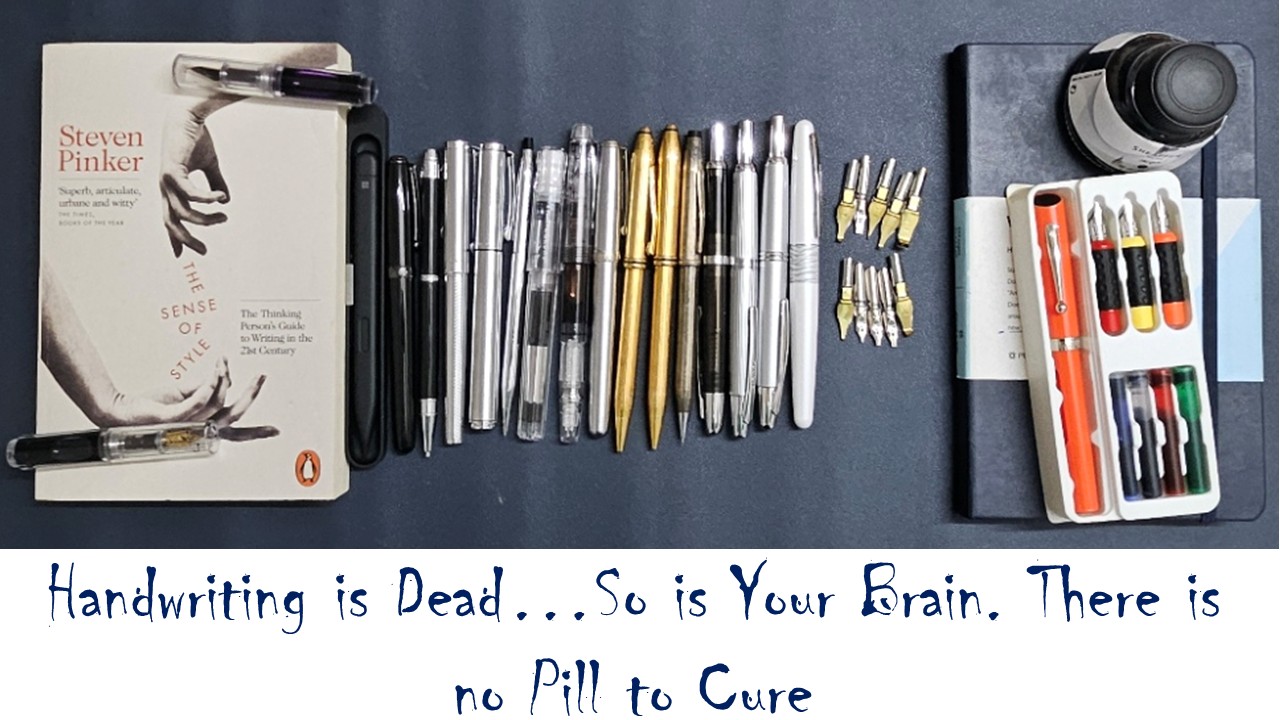
And intertwined with that, I wrote a blog on handwriting is dead and no pill can cure this disease.
[00:00:36] Kapil Khandelwal (KK)
Let me bring out a few simple ideas and some data points to connect to our today’s speaker and I’ll make that introduction very quickly.
During the COVID, there was a huge trend towards digitization and post COVID.
A lot of anti digitization or going back to the analog trend has occurred.
And with that, we have seen health issues like brain fogging, loss of memory, and confusion among a lot of people, including Gen Z’s and Gen X and a lot of people.
[00:01:09] Kapil Khandelwal (KK)
We have tried to remedy that on some of the solutions that we believe would be the bet of the future.
But this is not a bet of the future that we are going to talk about today.
Ladies and gentlemen, writing with a pen on a paper solves
a lot of problems.
One, it brings happiness and joy of having a writing instrument in your hand, putting your thought crisply on paper help in cognitive memory.
And by the way, we are bringing in one very, very interesting and a leading thought leader in the space of neuroscience as well to talk about this issue of cognitive memory, calling and journaling in another podcast.
[00:01:46] Kapil Khandelwal (KK)
But Since I have talked about handwriting and penning down, I have invited Sudhir Kali.
Priyankar, who is a very unique person and has a credo of his own in this space to talk on various issues for our podcast today.
A pen for your thought.
Let me quickly invite Sudhir to our podcast, make the fact checking of the ChatGPT profile with him and then get started.
So welcome Sudhir to our podcast today.
Quote unquote with KK.
Very interesting profile.
I would like you to fact check this because that sometimes garbage in garbage out happens on our ChatGPT.
[00:02:23] Kapil Khandelwal (KK)
So your profile reads as Sudhir Kalyankar is a lifelong believer in quiet power of the written word.
Lovely for him.
Fountain pens are more than instruments.
They are companions of thinking, reflection, and intention.
In a world that moves fast, Sudhir chooses tools that slow him down just enough to make every thought deliberate and every single line meaningful.
A collector with a discerning eye, his gravitasis towards pens that balance engineering
Precision with artistic soul.
[00:02:53] Kapil Khandelwal (KK)
We’re going to talk about this, whether fountain pen is a work of art or science with him as well later in our podcast.
He enjoys the ritual of writing, the weight of a well crafted barrel, the whisper of a smooth nip, the personality of ink that shifts with mood and movement.
Each pen of his desk carries a story, a memory or a lesson.
Lovely.
Professionally rooted in leadership and governance, Sudir turns to fountain pens as his anchor during during.
deep work, planning, journaling, sketching ideas, or simply pausing to think.
[00:03:25] Kapil Khandelwal (KK)
His love for pen reflects his larger philosophy that craftsmanship matters, that details shape experiences, and that the tools we choose say something about the lives we want to lead.
This reamble and introduction to Sudhir opens up a lot many topics for our discussion on our podcast today.
Whether he’s discussing nibs, gifting a meaningful pen or discovering what others write with, Sudhir brings warm curiosity and
a sense of connection to the world of writing.
So ladies and gentlemen, handwriting is not dead.
[00:03:56] Kapil Khandelwal (KK)
And here’s one expert who’s going to talk about it today.
Sudhir obviously is the head of governance, IT governance and partner management at Ultratech Cement.
He has a doctoral research at BITS Pilani and he has over 25 years of experience in the areas of IT vendor governance, contract management, digital transformation.
He has an MBA and an MSc from Hafkin Institute, a BSc
from Bombay Wilson College and he has appeared in several podcasts on pen, penmanship and also runs a unique organization which is a community of fountain pen users, sellers, vendors, as well as aficionados like me.
[00:04:39] Kapil Khandelwal (KK)
We’ll talk about that as well.
[00:04:41] Sudhir Kalyanikar
Sudhir hi Kapil, thank you so much for inviting me on this podcast.
It is a pleasure and a privilege to be here.
Lovely to be here and thank you so much also for that.
Wonderful introduction.
I couldn’t have written it better myself.
So with your permission, I will borrow it and put it on my resume right now.
[00:04:58] Kapil Khandelwal (KK)
Lovely.
[00:04:59] Sudhir Kalyanikar
So thank you so much for having me here and I look forward to having a chat.
It’s I’ve had discussions with multiple people and fountain pens somehow keep creeping in for some reason.
They’ve kind of, I don’t want to say it fully, but kind of gotten link to my identity.
So I like it, I love it.
So I’m happy to have a discussion with you on.
Whatever topics you feel merit discussion.
[00:05:24] Kapil Khandelwal (KK)
So let me tell you today’s podcast and also for the clarity of our audience, we’re not here to sell or cross sell fountain pens.
It’s a much deeper discussion and that’s why the topic of our podcast today is a pen for your thought.
And what I have written in my blog and what is going to follow from this podcast to another expert that we be bringing in is to talk about happiness.
The neuro linguistic.
Benefit as well as a lot to do with the neurology and the health and wellbeing, including emotional wellbeing of writing, which includes fountain pen.
[00:06:03] Kapil Khandelwal (KK)
Since fountain pen is one of the oldest writing instrument, I am not talking about writing the history on parchment and all, but in the modern era of our writing.
So lets talk to an expert, Sudhir, lets start with is fountain pen a work of art or science?
And depending on what you say, we’ll delve deep on that first and then take the other one later on.
[00:06:27] Sudhir Kalyanikar
So I feel that primarily it is a tool.
It started its life as a tool and it still continues to be a tool, a pen, a fountain pen, which has then evolved into a ballpoint or earlier which was a quill or a reed with which you would write on parchment were all tools.
So the primary value is utilitarian, no doubt about it.
However, with a lot of things which.
Art as utilitarian items.
I mean, even if you look at what we conventionally call art, which is the paintings made by caveman 5000 years ago, 7000 years ago, they started as just a mode of communication, telling people that look, we killed a huge beast or something like that and was more a mode of communication and then it evolved, it developed and the natural stage of evolution is that it comes to a point where the utility value keeps dropping down and.
[00:07:21] Sudhir Kalyanikar
The artistic value keeps going up and I think that is the same thing that has happened with fountain pens over years.
They I mean, it is about what, 150 years since we have had fountain pens, give or take a few.
Yes, they did start and even the history says that they were utilitarian tools, but today they continue to be utilitarian tools.
But there are also pens which you know, stand apart by themselves as fantastic works of art, especially some of the Japanese pens, the Namiki pens with Makiye work on them.
Very intricate, very.
[00:07:51] Sudhir Kalyanikar
Delicate work and which takes decades to master and a single pen is it reflects the cost of the pen, also reflects the amount of work that has gone into it.
So both but I would say primary and this is a little bit of a selfish thing that yes they are more science or utility oriented than they are art oriented.
But no doubt there are some pens which people would buy as works of art, keep them as works of art and you know kind of just appreciate them and maybe not even write with them.
So yes.
[00:08:21] Sudhir Kalyanikar
I think that is where we are today.
[00:08:23] Kapil Khandelwal (KK)
So you’ve been very political in balancing out your initial idea of whether it’s an art or a science.
So let’s talk a little bit.
[00:08:32] Sudhir Kalyanikar
Sorry, if you want a yes no answer, let’s go with science.
[00:08:35] Kapil Khandelwal (KK)
All right, lovely, because there are a lot of things that on the science of writing and innovation on to replace paper and a pen.
I have done a lot of work and invested in one of our startup which has not taken off yet from India.
So there’s a whole host of data and understanding
There as well.
So let’s talk about the science first, let’s just talk about the science of the fountain pen itself.
Then we will talk about the neuroscience of using the fountain pen, perhaps and then we’ll circle back on the artistic side of what the fountain pen can bring to the table.
[00:09:08] Kapil Khandelwal (KK)
Is that fair?
Works for me?
Yes, love.
So tell me, you know you’ve been into engineering and you have you’re a NIP Messier, a fountain pen Messier.
You are a doctor of fountain pen as well, so you understand the science behind it.
How is the engineering?
Of the fountain pen evolving, whether is there any innovation happening?
Are there new materials coming in?
And obviously, the way the renaissance of fountain pen with the younger generation is that it is more with to do with the ES of writing, environmental science and those factors.
Because if you see a lot of wooden material, fountain pens and writing instruments are coming into play, they’re moving away from digital or over digital indulgence.
[00:09:47] Kapil Khandelwal (KK)
And there is a word called Ludolite, a term called Ludolite as well.
So they want to.
Probably deep top themselves digitally and that where a resurgence of demand for font pen and paper and stationery is now emerging in India.
Let’s first talk about how is the engineering of the science evolving around pen and where is this innovation taking us in future?
[00:10:08] Sudhir Kalyanikar
That’s a lovely question.
See, essentially if you look back whatever 150 years of the fountain pen existing, fundamentally nothing has changed.
And I say that because the principle of a fountain pen.
There is this gentleman called Richard Binder who is based in the US and by all means he is the original, if I could call him, the doctor of the fountain pen because he has a lot of knowledge and he disseminates that knowledge through his website etcetera.
So he says that a fountain pen, the way it works, is nothing but a controlled leak.
[00:10:41] Sudhir Kalyanikar
There is ink, there is a reservoir in which that ink sits and through the nib and the feed, it is leaked onto paper, but it is just done in an extremely controlled way so that and.
It uses gravity, it uses everything, it uses capillary action and then the ink which is sitting in the fountain pen hits the paper and then you get all that beautiful art that comes out on paper, right?
So that has fundamentally not changed.
However, what has changed are I would say essentially 3 things.
[00:11:11] Sudhir Kalyanikar
There has been a lot of development, a lot of evolution in the art of nibs themselves.
Earlier nibs were mostly made of gold.
Today you have nibs.
Nibs made of steel.
You have nibs made of titanium.
I don’t know if there are nibs made of any other material.
There could probably be, but in common use, these are the 3 and pretty much every nib that we get, if it is put properly put together properly with the feed in the fountain pen, works and it works properly.
The issues that we normally see are the nib and the feed and you know the package not being put together properly.
[00:11:46] Sudhir Kalyanikar
Sometimes the issue is with the nib cells.
So nib technology has definitely evolved the sector.
Second thing that has evolved is the materials that are used in making a fountain pens.
If you look at the 1920s, 1930s, 100 years back, Parker and some of the other people who used to make fountain pens, they were limited by availability and they had to use ebonite, which is hard rubber, and ebonite was the material of choice at that point of time.
But slowly, as the material science itself evolved, we got into resin, we got into plastics along with ebonite.
[00:12:20] Sudhir Kalyanikar
Celluloid was also a very.
Very material of choice, but it is not easy to work with when it gets heated, which happens when you turn it on a lathe, tends to catch fire.
So cellulite is something that is not easy to work with.
But ebonite was probably the first choice 100 years back.
Then it came to plastic resins.
Now we have really fancy material.
We have metal, we have titanium, we have brass, copper.
We also have other material like Ultem which is being used to make fountain pens and there is that which is definitely.
[00:12:51] Sudhir Kalyanikar
Definitely progressing again.
It is not progressing at a rate at which generally civilization is progressing or evolving, right?
If you look at digital, everything changes within 3 months.
Within 6 months, the phone that you have is no longer.
It’s obsolete.
It’s no longer the latest and the best in fountain pen universe.
It’s slightly different.
It takes a few years to make that change, which is both good and bad.
And the 3rd thing that has changed or evolved is are the filling system.
We started with the filling system.
[00:13:21] Sudhir Kalyanikar
known as a lever filling system, which was nothing but a rubber sack inside the fountain pen which could contain.
Then we then there was eyedropper filling system, which is nothing but you know, the entire fountain pen is filled with ink, and then you just start writing.
Then towards, I think, I’m not sure of the dates, but maybe the 1940s, 1950s, we the cartridge converter system was invented, which is probably today the most common system.
Then there was a piston system that was invented.
And now we have an evolution where there is a vacuum
[00:13:51] Sudhir Kalyanikar
automatic filling system and also there is a company out of Belgium called Konid which does some fantastic pens.
It was the background of the people running it.
They were aeronautical engineers.
So the precision the technology is all there and they build their own proprietary filling system.
It’s an I believe it’s an old system but they modified it for their own requirement and that is evolution which we are seeing on a scale.
But the fundamental principle still remains the same.
It is a controlled leap.
It is how you fill the pen, it is.
[00:14:21] Sudhir Kalyanikar
what material the pen is made out of and how good is the nib.
If these 3 fit together, we have a well writing pen.
[00:14:29] Kapil Khandelwal (KK)
You know, I want to bring in analogy and what you’ve been talking.
I was just thinking years back, I was consulting with one auto major, global auto major in India, and the CEO remarked, you know, a car is a very beautiful amalgamation or different science.
You have the fuel that is the chemistry and internal combustion, which I look at the ink.
Then the whole meteorological, which is the body and the engine and different alloys getting put together.
And then there is the electrical system which basically leads to connect different subsystems in a car and that leads you to drive on the road.
[00:15:08] Kapil Khandelwal (KK)
Right now I want to bring that same analogy to the fountain pen.
You have the body, you have the fuel, whether you use an injection system or whatever.
You have the metrology of the nib, but there are no electrical systems in the
fountain pen that’s got left behind.
Why is that electrical side of not incorporating in the fountain pen?
Are we waiting for an Apple to create a Apple fountain pen like they redefined the watch industry which was mechanical and what not?
Or is there not a lot of investment in the industry to really redefine the whole pen industry as such from a science and from an engineering point of view?
[00:15:49] Kapil Khandelwal (KK)
Where are we lacking?
[00:15:50] Sudhir Kalyanikar
So if I was to.
Stretch your analogy a little further.
Digital pens do exist, right?
But they work.
[00:15:56] Kapil Khandelwal (KK)
Yeah, I’ve invested in a remarkable life.
But you know, it’s an ecosystem by itself.
You have to use their own thing.
Here I am out of that ecosystem.
So can I not have a Bluetooth or some sort of an electrical thing which allows me to do digital work as well as analog work and write on anything that I want to write on, whether it’s on my whiteboard here or whether it is on a paper or I want to.
Digitizer it on my Samsung Note fold or on my Microsoft Surface.
[00:16:26] Kapil Khandelwal (KK)
Can that not be a thing?
You know, a pen for all roads.
[00:16:29] Sudhir Kalyanikar
You know, honestly, I have never thought about it like that.
And what it tells me now is there is a startup idea right there and let’s get together over a coffee and discuss this first.
[00:16:38] Kapil Khandelwal (KK)
Lovely, I would lovely want to invite you because I learned a lot while mentoring this startup.
They’ve not been able to launch the product in India, but about the whole history of writing and what about pen and they went the whole year.
route to saying yeah we will remove paper altogether and that’s a credo to you know, bring back writing but not on paper.
But that never took off.
And obviously 2 startups that I know remarkable still not yet mainstream that whole experience of writing on things is not that haptic or whatever.
[00:17:08] Kapil Khandelwal (KK)
I also struggle to write on my fold or on my Surface screen doesn’t give me that pleasure of writing unless it is on a paper.
And I think 2 generations, 3 generations genetically as humans evolve, maybe that would become the mainstream.
But sir.
The science of it is lagging behind, I guess cars have moved forward to now smart cars, and but our pens have not yet moved forward.
[00:17:29] Sudhir Kalyanikar
They have not.
I agree with but in a way, I think it is a good thing because I mean, I have used smart pens.
Again, like you said, you use the word ecosystem.
If you look at it from a point of view of a fountain pen or any other pen is also an ecosystem.
There is the pen, there is the ink and there is the paper, and then there are the accessories that you buy to keep your pens, to keep your ink, to keep your paper.
and then its.
Never ending.
So I would rather, if you ask me, and this is a personal opinion, of course, I would rather stay in the analogue ecosystem than move to the digital ecosystem.
[00:18:00] Sudhir Kalyanikar
But I think both of their have their own place.
The analogue ecosystem has its own place.
It has its own time.
I am at work, for example, my notes are all taken by fountain pen, but the work, most of the work I do is on a laptop, is on a phone.
So both of them need to coexist.
In my opinion, it is up to us how well we can make them coexist.
So that’s where I would say I stand on this.
[00:18:25] Kapil Khandelwal (KK)
You know, a small nano chip with a software embedded, you know, right by wire.
I thought maybe that would be the next innovation coming in pens and writing instruments in India globally.
[00:18:36] Sudhir Kalyanikar
It could very well be and it could be wired to a nano chip in our brain where we don’t even have to say anything.
[00:18:41] Kapil Khandelwal (KK)
Oh, that’s a separate thing.
This is a very different podcast.
We have taken a bet on that as well.
But those sort of things are at this point in time for certain
Brain related ailments and disorders to course correct that which is basically rewiring the brain, but it is still not clinically proven.
There’s a lot of the many startups and giants, including Google and Twitter’s founder, also spending a lot of money and on research of this.
So there are a lot of variables that are there to allow, but something that comes in the hand handable like a fountain pen is still not So what do you think?
[00:19:18] Kapil Khandelwal (KK)
Is there a lack of ideas?
Is it lack of?
entrepreneurs or is a lack of investment funding?
What is it that the whole industry or the innovation has not taken off whether in India or in the world itself?
[00:19:32] Sudhir Kalyanikar
So if we look at this merging of the digital and the analog that you were talking about, I don’t think anyone has thought about it that way.
We have not, at least I have not heard anyone.
You are the first person and it’s a very, very interesting thing as you can be sure that I will take it up with my the fountain pen fellow enthusiasts and we
We will see is this really something that can happen, but it’s a vision that has not come to anybody.
To be honest, that’s one point because the idea or the vision is not there.
[00:20:02] Sudhir Kalyanikar
Nobody has approached anyone for funding or entrepreneurship or anything of that sort.
It all starts with an idea, correct?
And if the idea itself is something that was not thought of by anyone else, then the other things which are sequential have not fallen in line.
This is with respect to specifically the cusp of.
Digital and analog that you spoke about within the fountain pen industry.
If there is no innovation, I think a lot of it, I would say the issue is on both sides.
I think the customers are not demanding enough.
[00:20:33] Sudhir Kalyanikar
They’re not saying that we need new things.
They are happy with what they have because they like me, probably enjoy the analog ecosystem and they do not want innovation.
That could be a reason.
I’m not sure.
On the other side, because customers are not demanding, the pen makers themselves are saying, okay, we will do innovation to a.
limited extent, we will change the material, we will change the filling system, we will change the nib, but essentially we will keep it the same.
I don’t think any of the manufacturers has also thought about incorporating a chip that can, for example, very simply tell me when my ink level is low.
[00:21:07] Sudhir Kalyanikar
OK, or something else.
If I am taking it on a flight, if I can connect it to my watch or my phone and say that, you know, if this pressure or this temperature continues, my pen is likely to leak.
These are issues which we face and I don’t think I don’t know being a tech.
person, I feel anything is possible at heart.
I’m a tech person.
So because I’ve spent my life in technology, I feel anything is possible.
So I think you’ve just opened up a can of possibilities and let’s.
[00:21:33] Kapil Khandelwal (KK)
Go back step back to the car analogy.
You know, there are fuel, which is the ink in the pen.
You know, there is a gearing system.
As you step up the gear, there’s more fuel to the thing.
If I want more ink to the nib, I have to change the nib to a broader and what not.
Why can’t we put a gearing system?
I’m just opening up this as a thought.
If gear one is fine, gear 2 is medium, gear 3 is extra broad, gear 4 is whatever Nipco, why cannot that be done instead of you know sticking to Because the redefining of a problem statement leads to innovation and a new opening of a new product category.
[00:22:13] Kapil Khandelwal (KK)
Swiss watches were great, but they are now nowhere and they have to now come back and fight with the Apples and the Samsungs of the world.
My concern is are.
the manufacturers not aware of this or they don’t want to think laterally even in their own sphere, which is currently.
How can they innovate even on a nib?
When you talk about the materials, all it needs is one gear or whatever you need to mechanically and just broaden the nib, it will make mooring flow.
Gear system like a car definitely yeah speed badao or automatic as we want to write smart smart fountain pen.
[00:22:49] Sudhir Kalyanikar
It will obviously involve a lot.
mechanical and moving parts which will complicate things.
And secondly, we don’t want to make a fountain pen the size of a car, right?
[00:22:59] Kapil Khandelwal (KK)
No, electrical when that becomes compact karna padega.
You have to do that engineering around it.
[00:23:05] Sudhir Kalyanikar
Correct, correct.
[00:23:06] Kapil Khandelwal (KK)
Lovely.
I want to understand.
I love fountain pen because you know, I’m not restricted to the colors.
There is the ink depending on what mood and what I use different ink of different colors.
How is that evolving?
Is that something also moving?
Moving in some direction, the chemistry of pen or the writing, is there innovation there as well?
[00:23:27] Sudhir Kalyanikar
It is there, but it is limited.
New colours keep coming out.
But you know, as physics says that there is only a certain spectrum of colours that you have.
I’m not talking about the base colours.
Even after you mix, there is a limited number of colours that you can get.
And today, technically it is, I think, possible to have any colour that if you want a specific blue with slightly less tinge or something like that is possible.
so.
I do think ink mixing has is using automated mixing tools so you can make a colour.
[00:23:58] Sudhir Kalyanikar
There are manufacturers who offer customised inks of your own colour.
They will make let’s say 10 bottles or something like that.
So that is definitely there today.
People have started adding shimmer inside inks.
They have started to make inks which sheen a lot, which means when you write a layer forms on top which gives it that shiny the sink.
There are inks and this has been on for a long time.
It’s not I wouldn’t.
Call it latest innovation, but there are inks which shade a lot.
So if you take a broader nib and if you write with it, the top of the ink letter would have a slightly darker and then it would get into a lighter one or ink would pull towards the bottom of the letter.
[00:24:36] Sudhir Kalyanikar
So all of that is definitely there.
Whether ink it is still physical though pens are physical, inks are physical.
I to take the analogy which you took for the pen, I don’t know what we could do to make ink you know at a cusp of.
Digital plus analogue.
So kind of preambling your question, I think.
[00:24:55] Kapil Khandelwal (KK)
Let me bring before we close the science and innovation on the pen.
You see a lot of the digital or the tech players, Apple, they killed the music industry by bringing in from analogue to digital.
They killed the watch industry by moving the quadz analogue watches to digital.
There are a lot of other things also in the pen also that they have done with their iPad and.
Right.
And obviously, you see the photography industry, Kodak is the real industry, and their Polroid and all these players are all dead.
[00:25:31] Kapil Khandelwal (KK)
They were the thing of the past.
How are pen manufacturers doing vertical or horizontal integration or partnerships in their own supply chain, the paper and ink to basically increase their relevance in the current shape or form for the future to increase?
increase the primary driver for their own product, which is writing on paper.
What needs to be done there?
[00:25:57] Sudhir Kalyanikar
So if we think about, you know, the trifecta, pens, inks and paper, right?
Are the manufacturers talking to each other?
I do not have that in depth knowledge or the behind the scenes knowledge whether they are doing, but based on what we see as products coming out, based on that evidence, what we can figure out is the pens and the ink manufacturers definitely are talking to each other.
In fact, in a lot of
lot of cases, they are the same.
Most good companies manufacture pens and they also manufacture inks.
[00:26:27] Sudhir Kalyanikar
Either they do it in house or they outsource it, but then it has a very high level of control.
So if you look at any major brand today, whether we look at let’s say Schaefer, Parker, Montblanc, Pelican, Sailor, Pilot, Platinum, all of them have their pens, all of them have their inks also.
So yes, they are definitely talking to each other because a pen is no good without an ink and ink is no.
good without a pen.
Paper is an interesting point because paper is much larger than pens and inks.
[00:26:58] Sudhir Kalyanikar
I mean, pens and inks only work with each other, right?
Paper, on the other hand, works with anything.
So it is very easy for a paper manufacturer to be at the lower end price sensitive part of the market and make, you know, what we call copier paper, which you put in photocopiers which paper is measured by GSM and that is around 706570 GSM and it does not.
Change too much and that’s good enough for writing, for making photocopies, for printing and for writing with ballpoint pens, etcetera.
[00:27:29] Sudhir Kalyanikar
On the other hand, ink fountain pens and ink require a slightly higher GSM, maybe a coating of paper, paper of a higher quality which does not which does not you know, feather or which does not bleed through to the other side.
You write on one side and then you can see the ghost on the other side.
So that is important for paper manufacturers.
There are a few for sure who make paper which is.
very specific to ink.
But I think by and large, the large manufacturers, those who go for volume are not really bothered about the fountain pen industry or the ink industry because for them it is too niche.
[00:28:03] Sudhir Kalyanikar
The good ones, the boutique ones, I call them, are the ones who are making paper which is and they make paper.
There are a few who make paper which is very specific to fountain pens.
And this is a problem not just with fountain pens, it is also a problem with art.
I mean, if you are painting or if you’re doing any other kind of art.
With other media that also requires a higher GSM and that also requires a very specialised paper, a standard paper manufacturer.
I don’t want to name names, but a standard paper manufacturer making copier paper would probably not go into that segment.
[00:28:36] Sudhir Kalyanikar
It would be somebody who is a boutique manufacturer who would manufacture the high quality paper for this thing.
But yes, they it looks like they are definitely aware that there is a market for fountain people writing with fountain pens and inks.
way there is a market for people who paint and do other kinds of art.
So yes, I think in a way, yes, they are talking to each other.
Are they collaborating with each other on innovation?
I wouldn’t, but it doesn’t look like it doesn’t seem so based on the kind of paper.
But then one also needs to look at the economics of it.
[00:29:07] Sudhir Kalyanikar
The demand for a niche product like fountain pens and inks is not high.
It’s growing, but it’s not very high.
The demand for you know, printer paper is 1,000,000 times more.
So maybe that’s the reason.
Reason why they don’t see any point in investing in innovation.
[00:29:22] Kapil Khandelwal (KK)
I think we need to talk to ITC.
They have got papers, they have got luxury collections, they have got stationery also.
Now they are into a lot of things including pencil and what not.
Why are they not coming into high end brand of their own or fountain pen?
It goes very well with the type of people they have got into high end chocolates called Fable.
They have got into upholstery and bedroom related thing.
They have got a brand there.
Why is ITC not really thinking?
[00:29:52] Kapil Khandelwal (KK)
Arey, I have got paper, let me increase, let me go backward and see what I can do to increase the demand and be monolithic.
Clear.
[00:30:00] Sudhir Kalyanikar
That would really help a lot because most of the boutique brands I spoke about which make paper related to fountain pens are not from India.
And because they are.
[00:30:09] Kapil Khandelwal (KK)
Not from India fountain pens for their own paper only na yaar increase the demand for their paper as well as increase the whole ecosystem.
Let them make acquisitions and then start innovating.
Right.
I’m sure this is what 4000 5000 crore at the lower end paper you’re saying yeah only for education and writing.
[00:30:26] Sudhir Kalyanikar
Baby I don’t have the date.
[00:30:28] Kapil Khandelwal (KK)
I’ll have to check and the pen industry or the writing instrument industry or the stationery industry is what about 3500 odd crores in India?
[00:30:37] Sudhir Kalyanikar
It would be because when we had done this there was some study that was published and I think it was in 23 or something like that where it talked about how it was going to touch by 2030 it was going to touch.
4 billion dollars globally so it’s not a small industry but it’s not a large industry also so and how much of that is India India ranked about?
[00:30:59] Kapil Khandelwal (KK)
I’m just talking of India only.
[00:31:00] Sudhir Kalyanikar
Okay so in this in the fountain pen thing India ranked I think about 7th or 8th in the top 10 so even if you take 10% of it that’s about 300 million dollars for India which is not a insignificant amount if you ask yeah.
[00:31:15] Kapil Khandelwal (KK)
So about almost a billion plus half a billion let’s move to art sure there are
Collectors, collectors of wine, collectors of different art form.
And since if a fountain pen is an art form, why is there not a primary market or a secondary market of buyers and sellers?
Why is everything going?
If I want to buy a old chaffer or a waterman of 1950, I do not know where to go and buy it from.
I have to go to eBay or some other place outside of India and buy it from there.
Why is that art market not happening?
[00:31:47] Kapil Khandelwal (KK)
Or do we need to start a flea market?
For artistic fountain pen in India, no startups there either.
[00:31:53] Sudhir Kalyanikar
No, you’re right.
There is no I do not know.
I have gone to a few pen shows in India and there are I think one or 2 maybe 3 sellers who have some different type of pens if you ask me.
So like you said a Parker from the 1950s for example, or something else like that or a Parker duo fold from 1930s are not very easily available in India and you have to go abroad.
You have to go to a pen show.
In the US or you have to go somewhere else?
I am seeing some people get it, but then again, what happens is because their source is also not India.
[00:32:27] Sudhir Kalyanikar
So is there a source in India is what we need to checkout first?
Is there a, like you said, a flea market?
There is.
There does not seem to be a flea market.
Do people really understand that there is a value in an old pen, which is my grandfathers pen, which is lying in the almirah for like?
30 years or 40 years and when they bring it out, can then there is a point of can it be restored?
Are there good restorers who will restore it to its pristine glory?
It is like a vintage car and then somebody, a collector comes and says, OK, yes, I appreciate what you have done with this pen.
[00:33:01] Sudhir Kalyanikar
I appreciate the history, the legacy, the heritage of this pen and I will buy It is not happening, at least not in a very formal way in India.
It happens informally, I know for sure there are WhatsApp groups.
There are people here and there who do have access to these kind of pens, but it’s very limited.
It is not mainstream.
It is like, for example, if you went on the Internet today to do it, you would probably not be able to do it.
But yes, if you were part of this inner circle, so to say, you would get access.
[00:33:32] Sudhir Kalyanikar
It would not be cheap, but then it would be comparable to the cost of getting something, buying something in the US or Japan or one of the other places and then importing it into India.
it The cost would be.
Comparable.
So I guess is the sources are the same.
These people travel to pen shows and where there are 1000 pens, they buy, let’s say 50 of them, come here and sell it and they make their 2 cents in that.
So you’re right, there is no formal flea market or anything for vintage pens, especially pens which you can think of as art.
[00:34:06] Sudhir Kalyanikar
But OK, I think we’ll stop it here and see.
[00:34:09] Kapil Khandelwal (KK)
What we need a vintage car rally type of event every year in this industry to show.
[00:34:15] Sudhir Kalyanikar
We should do, we should do that.
[00:34:16] Kapil Khandelwal (KK)
Vintage car rally happens in every city and I know a friend who has 150 vintage cars including the Tatas actually asking him to maintain some of their vintage cars as well.
Okay, so I am sure there are ways and means to make the whole art form and the collection of art of pens also work.
Before I close the art part of the fountain pen, I want to understand from you, but talking about people losing their mind.
How does a fountain pen promote that creativity, creative thinking, balance, memory, dexterity and various other neurophysical and neuropsychological functions which somewhere they have now during COVID and beyond have started losing and that is a big healthcare threat just to the older people but as well to the younger generations as well in India.
[00:35:09] Kapil Khandelwal (KK)
How do you think something can be done about this?
[00:35:12] Sudhir Kalyanikar
Okay, this is a great question.
I do sincerely.
Sincerely believe that fountain pens can contribute to a person’s overall wellbeing.
Now I am a layman, so I cannot speak for the neurological basis of this and how it actually works in our mind and our nervous system.
[00:35:29] Kapil Khandelwal (KK)
But as a layman, you can always express how you feel.
Yeah, exactly when you write or how I feel when I lie, what is my joy?
What makes me happy?
Emotions, emotional wellbeing.
That’s what I wanted you to talk about from an art.
Artistic point of view, whether you are journaling, you are scribbling or you are noodling, whatever.
[00:35:50] Sudhir Kalyanikar
The journaling is definitely one of the best tools that anybody can start and then they can start it, you know right away as they are hearing this, they can pick up a piece of paper, they can pick up a pen if they have and just write down anything.
Journaling is about us, it is about me as a person, it is about my thoughts, it is about what I am feeling at that point of time and when I write it down, it kind of removes.
And if it is, let us say, a stressful situation that one is journaling about, it removes the stress from the mind.
[00:36:20] Sudhir Kalyanikar
This is what I feel.
It removes the stress from the mind and puts it on the paper.
And what it does is it gives you back that mental energy to get a fresh perspective or to use that energy somewhere else.
So journaling for sure helps a lot.
And my recommendation to people who I talk about journaling is pick up a fountain pen and start journaling because there are 2 or 3 things that a fountain pen does which are very different from.
What a ballpoint or a gel pen does one is with a fountain pen.
It is extremely difficult to write very fast.
[00:36:51] Sudhir Kalyanikar
You have to slow down, there is no choice.
The pen will make you slow down and what happens when you slow down.
What I have noticed is it slows down your thinking, it slows down and kind of removes all those wild thoughts which keep coming.
When you are trying to do something, you are forced to focus on what you are right and that act of writing slower that act of deliberate thought really.
At the end of the journaling session, it could be for 2 minutes, 5 minutes, 10 minutes or half an hour really at least to be gives a sense that you know, I did something where I removed my mental stress, I changed my negative mental energy to a positive mental energy and now I’m ready to do something positive, to do something creative, to do something which contributes to me as a person in life.
[00:37:38] Kapil Khandelwal (KK)
So journaling, in fact, we are doing a separate podcast here with a very thought leadership in this space only.
Neuroscience and neurology and he’s bringing a lot of those things.
But I wanted to bring about your experience more from happiness, wellbeing.
So I thought, you know, pen is also a tool for happiness.
[00:37:59] Sudhir Kalyanikar
Absolutely, it is a tool for happiness and it can be tool for happiness as much as in fact, the whole act of writing I feel is more contributing to the happiness because it is in my opinion as effective as let’s say meditation.
Or any other form of positive mind, any other positive action which contributes to mental wellbeing.
Let me put it that way.
And writing is right up there.
The pen is a tool for writing.
The only reason I tell people to try and use a fountain pen is because, like I said, it slows you down.
[00:38:33] Sudhir Kalyanikar
It kind of helps you focus your thought process.
When writing with a gel pen or a ballpoint pen, what happens is you tend to write very fast.
Now, sometimes I have to use that in my office because I’m sitting in a meeting and I need to make.
Some quick notes.
People are not going to slow down their thought process in a meeting just because I want to write slowly, right?
That’s a little too much to expect, but I still try to use a fountain pen.
But there are times when if my boss calls me over phone and he says OK, I want you to do 3 things, the best thing to do is write very quickly.
[00:39:04] Sudhir Kalyanikar
Sometimes I write so fast I’m not able to read what I have written myself then that’s a problem that happens with people.
[00:39:10] Kapil Khandelwal (KK)
Happens with all my doctors.
Yeah, I don’t know what they write on the principal.
that the whole industry now, because of the medical legal issues, are now asking them to type it in the system itself their prescription right.
[00:39:23] Sudhir Kalyanikar
So yes, the pen is definitely it is a tool.
[00:39:26] Kapil Khandelwal (KK)
And I want to talk a little bit on the personality behind the pen.
And now that we talked about the writing and your legibility of the handwriting, I did a little bit of an experiment with one of my startup which was into day care surgery.
and see many of the doctors they just scribble.
Even then, they don’t know what they’ve scribbled.
Sometimes and how they become doctors writing exams by that scribbling.
I am still not sure how they became a doctor.
If they are scribbling like this in their exam papers, I’m sure if that is what it is.
So it is by purpose or I do not know.
[00:39:58] Kapil Khandelwal (KK)
So since William Penn’s first showroom was next door, I ordered for Shafer fountain pens as a Diwali gift for all my doctors.
I gave it to them with he actually etched it and all.
My point here is still didn’t improve the handwriting and now I want to bring about.
The next issue here you talked about your handwriting is much more legible when you write with a fountain pen.
There is a parallel science that can tell a lot about your personality based on your handwriting.
All right, now based on how you write your patterns and all.
[00:40:29] Kapil Khandelwal (KK)
And if I were to take prescriptions of many of my doctors and give it to somebody to analyse, it will say he’s a criminal personality.
Theek hai, so I want to and obviously I agree with you when I write with a fountain pen, I have a very different script based writing versus when I write with a Reynolds pen, right?
It varies because it is to do with the ergonomics or the grip and how it is.
So I want to understand based on the handwriting and the fountain pen grip, there is a new science or pseudo science evolving that can predict the personality of a.
[00:41:08] Kapil Khandelwal (KK)
person as well.
And let me tell you, you know, I don’t like fountain pen that have that wedge on the grip because I twist a little bit my nib to write which is why many of my fountain pens I have to write a lot to make my grip and the nib smoother to write, right which only happens after a lot of writing, or I have to use a broader nib to write the way I hold and write because of a slanted grip.
So based on the grip.
There’s also a lot of personality reading reading that I have seen in social media
[00:41:38] Kapil Khandelwal (KK)
media and people talking about it.
And further to that, there’s a lot of analysis around personality of a person based on the type of fountain pen he’s carrying.
How true is this science evolving?
I know handwriting is condition and handwriting a lot of investment and a lot of things are happening.
But is this also becoming a pseudoscience?
[00:41:57] Sudhir Kalyanikar
It is definitely not a science in my opinion because I’m saying pseudoscience yet.
[00:42:01] Kapil Khandelwal (KK)
To be proven with research and a lot of research papers and stuff like that.
[00:42:07] Sudhir Kalyanikar
Yes.
It could be that this is correct, but then yes, like you said, for it to be brought into the realms of science or academia, there has to be good formal research on it and there is a very strict methodology for doing this formal research.
You would be knowing about that social media top 5 personalities based on your grip etcetera is if in my opinion it is a starting point.
Maybe there is a truth to it, but that needs to be investigated further.
[00:42:38] Sudhir Kalyanikar
Needs to be gone into.
I would not take viral Instagram reel and say that this is It is very much a pseudo science.
Whether it develops and evolves into a proper scientific line of thought, somebody has to do that research before we come to that conclusion.
Handwriting analysis is very, like you said, it is very much an accepted form because it is accepted even in the legal system, correct?
So that is important.
But I don’t think I can go to a judge and say just because somebody has a hook grip on their left hand.
[00:43:08] Sudhir Kalyanikar
This person is a criminal or somebody has a tripod grip and they are not a criminal.
I don’t think a judge is going to listen to if I went and said that in a court as an expert.
[00:43:18] Kapil Khandelwal (KK)
Great.
But one thing I can say that Surpya enrolls pen, whoever uses and carries is Kejriwal.
[00:43:24] Sudhir Kalyanikar
How do you say that?
OK, it because it is Aam Aadmi.
[00:43:27] Kapil Khandelwal (KK)
Yeah, OK, sometimes I judge people based on if they are a fountain pen carry.
I don’t talk a lot but I observe and I see some people carrying expensive pen.
no knowledge.
I just used to sign or something.
It’s there on their table as a presence of their personality.
Whereas there are people I see who are very creative and who have a very different way of using a different type of a pen.
So that is where I was coming to that I’ve been able to judge people based on what is there on their desk.
[00:43:58] Sudhir Kalyanikar
Okay.
[00:43:59] Kapil Khandelwal (KK)
And maybe 90% of the time I’m correct of their personality.
Maybe that’s intuitive or what I do not know know but that is something that I have been
able to assess a person at least 90% of the time correct?
[00:44:12] Sudhir Kalyanikar
Okay, maybe see it could just be that you’re a good judge of personality and using fountain pens as one of the parameters and that helps you make the decision.
But I would love to hear from you on what basis you make these judgments because I categorize people into just you know, three categories of fountain pen users.
One is people who don’t use them.
Second is what I call the casual enthusiast.
So people who probably have used the fountain pen or have seen
Their mother, father, grandmother, grandfather use a fountain pen and want to try and use it.
[00:44:43] Sudhir Kalyanikar
They use it for a little while.
They don’t want to spend too much.
They’re very budget conscious.
They also do not want to invest a lot of time and energy into the hobby.
They want a pen which writes out of the box.
So for these people, I recommend, let’s say Schaefer or something like that.
Just pick it up, put a cartridge and start writing.
So that’s good.
And the 3rd one is the the serious enthusiast, right?
And a lot of people who think of themselves as serious enthusiasts.
are actually casual enthusiasts.
So maybe that is what you are referring to when you say that you see a mamlang on somebody’s desk, you’re not sure whether it is a person who really appreciates a fountain pen or sees it as a status symbol.
[00:45:21] Sudhir Kalyanikar
Whereas if you see, let’s say, a pelican or a namiki on somebody’s desk, you’re at least sure that some thought has gone into buying in that particular fountain pen, some thought has gone into investing it, and then you see this person talk a little bit about how what is their favourite blue black ink or something like that and then.
Then you start understanding that this person has spent some thought.
So I fully get what you’re saying that there is there are people who think they are, you know, serious enthusiasts, but their knowledge is limited to a sample size of let’s say 3 or 4 pens and 2 inks.
[00:45:53] Sudhir Kalyanikar
I don’t think that makes you an expert.
[00:45:55] Kapil Khandelwal (KK)
Well, at 1:00 point of time I was so crazy that depending on the colour of the shirt, I would carry that colour of a pen and a pencil mechanical pencil in my shirt pocket.
[00:46:05] Sudhir Kalyanikar
Interesting.
[00:46:06] Kapil Khandelwal (KK)
So those are things of the past and.
Indulgence of my past.
Let’s talk a little bit about you and hobby.
You’ve been a renowned pen messieur or a pen doctor and you do a lot of work in correcting pens and identifying and curing them.
What sort of healing energy do you feel when you get to lift a pen in your hand?
I do in a very different way, but that’s some bit of an energy and emotion.
[00:46:33] Sudhir Kalyanikar
Yeah, so you know, you mentioned this and I have told this to maybe a select.
Few people who are also fountain pen enthusiasts that just the presence of a fountain pen for me makes a difference in the energy around me.
OK.
There are times when if I am carrying, I have not used the fountain pen, I am just carrying it in my bag.
There is a different energy than if I have left my pen case at home.
OK.
So it does affect the second thing is maybe its the knowledge of the presence of the fountain pen that if I want to write something, there is a pen in my bag or in my pocket.
[00:47:06] Sudhir Kalyanikar
The second thing is actually while.
Writing that is in my opinion, for me personally, it is a Zen state because you are able to create that bubble around you and that bubble keeps out everything else and keeps your creativity inside the bubble.
So it is a kind of a boundary, invisible boundary, of course.
But for me, yes, that does happen.
And when I write and when I write with intent.
So again, writing for the for utility versus writing for intent with intent is something that I see when I write with intent if I’m.
[00:47:38] Sudhir Kalyanikar
Writing, let’s say, my journal early in the morning or if I’m writing, let’s say, a thank you note or a thank you letter to somebody for something that happens, which is what I do a lot of times.
There is a flow to it which is very different than when I’m making quick notes or to do list or something like even with the same form.
So I think writing is important.
Writing with intent is more important and that is where the Zen feeling comes for me.
There is a 3rd this thing which may not be for other people, but when I’m cleaning my pens like I carry.
[00:48:08] Sudhir Kalyanikar
Usually 54 or 5 pens for a period of about 2 weeks and whether or not I have exhausted the ink, I clean the pens and I get others into rotation when I am cleaning the pens and when I am repairing fountain pens, setting them right.
That is another Zen area.
In fact, I have one corner in a room where I close the door, sit there and try and do this thing and that is another Zen activity.
Sometimes I don’t understand where those one or 2 hours have gone when I have just started cleaning my either my own pens or repairing my own.
[00:48:38] Sudhir Kalyanikar
Or somebody else’s pen.
So yeah, so these 34 are a they do transform the energy around me personally and it makes a lot of difference.
Sometimes if you’ve gone through a tough day, just using your fountain pen for me or cleaning a fountain pen for like 15 minutes can recharge my batteries.
[00:48:54] Kapil Khandelwal (KK)
Since we’re talking a lot about you, what’s the legacy you want to leave behind one with your kids on this space and with the people and people who follow you.
[00:49:03] Sudhir Kalyanikar
With my kids, I don’t know.
I have not been successful in getting them to adopt fountain pens.
They are still in, they are more digital than they are analog, but then that is them, right?
I would not want to thrust or force anything upon them.
I do have a couple of nieces and nephews who have expressed an interest in fountain pens.
So what I do, and I know one other friend also who does that, is we keep some entry level fountain pens with us.
So whenever a child visits and they want to see my collection or something like that, and they look at the collection and they express an interest.
[00:49:35] Sudhir Kalyanikar
So I usually what I do is I.
Gift a pen.
It is either an inexpensive Indian pen like the Click Aristocrat or something like that, or it is an inexpensive Chinese pen like the Jinao along with a couple of cartridges and I say use this.
So I know a couple of nieces and nephews and maybe you know, kids of friends who started liking fountain pens.
So spreading the bug as it were spreading the bug to people who are interested is what I would love to do.
I also want to do more work on the community, so the fountain.
[00:50:08] Sudhir Kalyanikar
Pen community, at least in India, is not a very organised one.
We do have enthusiasts all over the place.
If we can bring them under one umbrella, it would be great.
But this has evolved over the last 56 years.
There have been pen shows, there have been pen meets and things like that which have happened.
And I think the community is much more cohesive.
We have a lot more WhatsApp groups, we have a lot more groups on Telegram, on Facebook and things like that.
And it’s getting more democratised as in earlier there used to be a.
[00:50:38] Sudhir Kalyanikar
few people who are very knowledgeable who also tended to you know, behave like snobs.
What is happening now is that the knowledge is percolating.
There’s a lot of bad knowledge also, which is not incorrect knowledge, but it’s getting changed, it’s changing.
So the hobby building a community and then democratizing the interest down the line is something that I would love to do.
[00:50:58] Kapil Khandelwal (KK)
This issue is what sort of content, capability and community you would like to build in India for the users and where can we help?
[00:51:06] Sudhir Kalyanikar
So the content and the community
community that I’m looking at is primarily knowledge sharing.
So a lot of people are new to fountain pens, they are expressing an interest, but they have no idea.
They have no idea what is a good starter fountain pen.
What is what should be as they evolve a little bit?
What should be my first gold nib pen?
I have heard a lot about Pilot Hiroshizuku inks.
Where can I get them from?
Okay, they are available on Amazon, but it’s a very expensive thing.
So if this community, the primary goal of the community
[00:51:38] Sudhir Kalyanikar
Would be obviously knowledge sharing and see I see I see this hobby as concentric circles.
OK, so the first circle, the innermost circle, is a circle which where I am by myself.
I do not have any contact with anyone else.
I go to a William pen, I go to somebody else, buy a pen, buy a bottle of ink and use some paper and start writing.
The next concentric circle is where I actually start interacting with people.
Now this could be on social media, it could be one on one and things like.
[00:52:08] Sudhir Kalyanikar
That and I realised that it is not just me, there are other people with the same interest who do knowledge sharing then starts getting, you know, it is not about me, it is about a small group or a community.
The 3rd level is where you advance to such an extent that you are actually able to give back to the community where your knowledge is there, where everything is there and that is on the knowledge sharing part.
So I would like as many people to move from one to 2 to 3 so that there is more and more knowledge sharing.
The second thing which is slightly more difficult.
[00:52:38] Sudhir Kalyanikar
from a logistic perspective would be to try and help people get fountain pens and inks and paper, which is not normally available.
There are people who are doing that, but our custom structure is so bad that it really kills it.
And not everybody has a brother in the US or a friend in Japan or a sister in Europe who can, you know, bring it for them, like they can order and bring it for them.
So if there could be some way of making things more accessible, that would be a greater challenge.
But first, if we could start with.
[00:53:08] Sudhir Kalyanikar
Knowledge sharing and that could be this podcast hopefully is one of that.
We could do more podcast cycle.
[00:53:13] Kapil Khandelwal (KK)
How can I help you in terms of the custom and duties?
Could definitely lobby that through our industry forum for the finance ministry to waive off custom duties.
Is this an issue of Hakmanirbar Bharat issue where high customs duty is levied on fountain pens?
So what is it?
[00:53:31] Sudhir Kalyanikar
Customs fountain pens?
The government treats them as a luxury item.
See something that is 150%?
[00:53:37] Kapil Khandelwal (KK)
What is it?
[00:53:38] Sudhir Kalyanikar
Customs duty could be anywhere between 80 to 150%.
That’s right.
[00:53:42] Kapil Khandelwal (KK)
OK.
[00:53:42] Sudhir Kalyanikar
And yeah, and even GST within India is at the highest bracket irrespective of the.
[00:53:49] Kapil Khandelwal (KK)
No, it has been waved down, right?
[00:53:51] Sudhir Kalyanikar
Yeah, even then it’s at the highest level.
So it’s not like there are 2 slabs of GST.
This has always been on the highest slab.
I think earlier it was on the 40% or the 45% slab.
Now it’s down to the 30%.
[00:54:03] Kapil Khandelwal (KK)
I will have to check.
But yeah, OK, so can we help or can something be done?
Because now the budget session is coming, we couldn’t put in that rejoinder through the industry.
Yeah, it could reduce karo.
Actually, obviously the GST would be an issue which is not it goes through the GST Council.
It takes years to move that.
But from the Sarva Shiksha, Bian and all those things, if this can be tied through that means maybe.
[00:54:30] Sudhir Kalyanikar
Look at if we could even look at reclassifying fountain pens from a luxury item where they sit today, maybe not all of them, you know, depending.
Depending on value, you could reclassify them.
It’s as simple as that.
There are fountain pens which are less than ₹500 and those should not be classified as a luxury item.
They are more everyday use item.
[00:54:49] Kapil Khandelwal (KK)
Let me check on this and maybe if you could help offline discussion on this with what the community and what we can represent.
Let me also ask you a few things, more like a rapid fire, since we are getting a little bit off the time chart here.
OK, if fountain pen was a human, what part of the pen would be its brain?
[00:55:08] Sudhir Kalyanikar
The nib, sorry, the feed.
It would be the feed because that is what that would be the heart.
No feed controls everything.
Okay, so in a human, the brain controls everything.
So I would say the entire aspect of bringing ink from the reservoir and putting it down on paper, which is the primary purpose of the fountain pen.
The entire controlling is through the feed.
Of course, the nib also is part of it, but I would say it is the feed for sure.
[00:55:33] Kapil Khandelwal (KK)
That’s where the innovation needs to come and get digital, correct.
[00:55:37] Sudhir Kalyanikar
So even.
what you talked about, you know, if you had to put a set of gears to increase the nib size, they would still sit on the feed and that is where the mechanism would happen.
So yeah, it would have to be the feed for sure.
[00:55:49] Kapil Khandelwal (KK)
And if fountain pen would be a politician, who would it be?
I don’t want to hear Kejriwal though.
[00:55:55] Sudhir Kalyanikar
No, I would say if I looked at fountain pen and this is not an Indian politician, so no, that’s okay, fine, right.
I would say the closest I can think of is Mr.
Barack Obama because see.
I think today in today’s world, being able to bridge a heritage and the legacy and still be relevant to both the contemporary as well as the upcoming generation is not easy.
There are not a lot of people who can do that and fountain pen to my mind like a few other things, but fountain pen because I am a pen enthusiast, gets that.
[00:56:28] Sudhir Kalyanikar
You know, they have been around since the 19 late 1800s and we are now coming into 2026.
They are still around.
In fact, there is a resurgence that is happening.
They have not changed much.
They There is a certain set of core values that they carry, and whether it was my grandfather, whether it was my father, me, my daughter, my kids, or maybe their kids going forward, I think it would still be relevant.
And I think in terms of general relevance across generations, I think Mr.
Obama does a brilliant job.
So I would put it there just for that because he can bridge the gap like nobody else that I am across generations.
[00:57:04] Kapil Khandelwal (KK)
And this is a very tricky one.
I’m just comparing this with Apple and.
Android according to you which would be the apple of the fountain pen.
[00:57:13] Sudhir Kalyanikar
Oh there is no doubt about it it would be Montblanc so and I’ll give you the reasons for that it is a it is a status symbol it is way too expensive everybody wants it and once they get it they feel everything else is useless and the technology while there are a lot of other brands which are much more advanced I talked to you about coned I talk there are some other brands also which are much more advanced.
[00:57:35] Kapil Khandelwal (KK)
I don’t have a Montblanc in my collection I had one which
Loss after that, I have not bought a Montblanc.
[00:57:40] Sudhir Kalyanikar
OK, so it would if I had to compare it to the Apple of the fountain pen, well, it would be Montblanc.
There is no I don’t think there is any other contender.
[00:57:49] Kapil Khandelwal (KK)
And what would be the Android of an fountain pen or maybe pick up one Android brand?
[00:57:54] Sudhir Kalyanikar
Yeah, everything else Samsung Android.
If it was Samsung, I would say Pelican would be the closest to it.
And if it was, let’s say, a One Plus or something, then some of the Japanese companies would come close.
Pilots would be the One Plus and.
Sailor would be the nothing or something like that.
So and I am keeping away all the Chinese brands.
I am just focusing on the top 2 or 3 Android brands.
[00:58:16] Kapil Khandelwal (KK)
If you were God, what pen would you create for the humanity?
It could be a magic pen as well.
[00:58:21] Sudhir Kalyanikar
Yeah, no, I know it is.
And this kind of shows my bias also in a way.
I am biased towards one particular fountain pen, which I feel is the best designed fountain pen in the world.
It is the Pelican M 800 and I am very glad it as well.
Yeah, I am very glad of the person who created that pen because in all respects where and it is not the best pen as in see look at it like this.
It is not the best pen when it comes to lets say status.
It is not the best pen when it comes to material.
[00:58:53] Sudhir Kalyanikar
It is not the best pen when it comes to nibs.
Sailor nibs are far better material wise.
Pilot and so many Namiki do such a brilliant job.
Status symbol Montblanc is right there.
So you know if you think about a class of lets say 30 people in a school, one class of 30.
40 people.
There are people with different expertise.
There is one or 2 people who always stand first and second in the test, right?
They are always ranked number one and 2.
They always there.
Then there are people who are brilliant at sports.
One category, 2 or 3 people who play all games for the school.
[00:59:24] Sudhir Kalyanikar
There is a set of people who are very great at art.
Art, creativity, drawing, singing, dancing, etcetera.
But then there are those one or 2 people, you know, who are good at everything.
They are not the first or the second, but they are in the top 5 always.
Then they are also in the school cricket team or the football team, everything.
They are in the team.
They are not the stars, but they are in the there is also that person is also good at handwriting, is good at drawing, not the best but good, can sing if you want, that person will come and sing.
[00:59:54] Sudhir Kalyanikar
If you want, that person will come and do anything, you know.
So this is the.
person, when people don’t look at it and say this person, but when that person, let’s say, stands first in an exam, let’s say achha, okay, this guy is also there or this girl is also there.
So it’s like that.
It’s like if one of the one of the cricketers, I follow cricket very, very closely.
One of the cricketers I admire a lot is Raul Dravid.
You ask him to open the batting, he’ll do that.
You ask him to go one down, you ask him to bowl, you ask him to be an umpire.
Talking about versatility.
Absolutely, comple completely completete versatility,
[01:00:26] Kapil Khandelwal (KK)
but but I’m I would let me.
Flip this whole issue here.
If you are the God and you are giving humanity the pen for the first time, what attributes would you have created in that fountain pen?
I have a different thought and a feeling here.
I wanted to know yours.
[01:00:41] Sudhir Kalyanikar
So if I was doing it today, I would still I would not change much.
I would still want them to have that analog experience, which in my opinion is the best experience.
But based on our discussion which we had some time back, I would definitely add some elements of technology to it like I said.
Technology as an enabler.
Now see as God, I can say let there be a fountain pen with a nano chip which is at the back end connected to Pilot factory, at the back end connected to everything else.
ChatGPT also and you know the pen will fill itself.
[01:01:13] Sudhir Kalyanikar
You don’t have to fill the pen after it is done.
It will clean itself because there is a robotic arm which will do everything for It can like you said, you know, have an adjustable nib depending on what kind of writing you want to have and basically you just leave the pen there and it does everything.
thing for you.
That would be an ideal pen.
But then that would make the world lazy, humanity very lazy, correct.
But then that would take away from the whole art or the whole act of writing, which I feel a fountain pen with all its, you know, what some people might call limitations is forcing people to pick up the pen, open a notebook and actually write, fill ink and write, which I feel is the you know, is the thing that gives us a little bit of mental peace, inner peace.
[01:01:56] Sudhir Kalyanikar
And if that thing is taken up.
I will not have, like you said, we’ll get lazy and we’ll also not have that peace of mind.
[01:02:02] Kapil Khandelwal (KK)
Last question, I know we are getting a little bit short on time.
How do you see 2026?
Have you written down something with your pen?
And which pen did you write down your goals for 2026?
[01:02:13] Sudhir Kalyanikar
I do have some, you know, let’s call it very significant.
[01:02:17] Kapil Khandelwal (KK)
No, not the personal.
Let’s talk about the community fountain pen community goals.
Let’s not talk your personal thinking on the podcast.
[01:02:23] Sudhir Kalyanikar
No, it is about fountain pens only.
So we talked about this right at the beginning.
beginning, we have this association called Fountain Pen Association of India and I am looking at some level of a reboot of this because we got very active during COVID because people had time.
Then later on, people got busy with their own lives.
They’ve not been able to put down a lot of time for this with maybe one or 2 people who are willing to help, who are willing to invest some time and energy.
I would like to reboot it, bring out a version 2.0.
[01:02:54] Sudhir Kalyanikar
There were some thoughts by in, you know, when we created this organ organization.
Now I want it to be like I said, more democratised, more spread, probably looking at chapters across India and stuff like that.
So yes, that is what it is.
It is something that I wrote down and currently I am using 2 pens.
One is one is a Schaefer, it is a Schaefer heritage.
It is the latest one that has come up with William Print brought in with the steel nib, not the older ones.
Yeah, and the other one.
are actually 2 pens.
One is a pen by an Indian maker called Kiko.
[01:03:26] Sudhir Kalyanikar
His name is Arijit.
He’s I think today if you ask me, probably the best pen maker in India, but he’s a one man army, so he is able plus he has some other work that he does.
So these 2 people, this guy makes some pens and he makes good pens.
So that is the one that I’m talking about and I’m constantly trying out new Chinese pens because of late in the last one year or so, the Chinese have really upped their game in pens earlier.
What you.
Used to be just heroes earlier what used to be just heroes and Jin house today with some of the mahjons and the wing songs and things like that.
[01:03:58] Sudhir Kalyanikar
So I keep getting one or 2 pens frequently and I’m trying out a titanium pen.
So these are the 3 pens.
So everything that I’m writing down these days, at least in the last week or so, has been with these 3 pens.
So I did pen it down.
Yes, along with my personal goals for the community.
This is very much a part of what I would like to do going forward and fingers crossed it works.
[01:04:20] Kapil Khandelwal (KK)
Lovely and if God.
God gave me a pen create for the humanity.
I wish everybody would have that pen in their hand that can think that can actualise and then that could make things better for the whole.
That is what I would love and wish that 2026 you are able to revive the whole industry.
Please let me know how I can facilitate or help in that process as well.
We will talk about it as well offline and meet as well in person, but I really appreciate taking time to talk something not very specific to pens and brand make it a very biased one but more as.
[01:04:51] Kapil Khandelwal (KK)
started the whole world of pens.
I also want to inform our listeners that we’re bringing a very big, renowned neuroscientist who’s globally recognised talk on the neuroscience of writing and journaling as welland what topics and how to go about it.
We’re just not able to get his calendar synced with mine, but I we will announce that very soon.
Thank you so much, Sudhir, to start this whole journey of fountain pen and writing on our podcast today.
It doesn’t cost a lot, but it’s better than taking pills.
What I can leave me with our listeners.
[01:05:21] Sudhir Kalyanikar
Thank you KK for having me.
It was a pleasure and we should definitely meet and talk about some of the things offline.
I look forward to it.
[01:05:28] Kapil Khandelwal (KK)
Love love.
Thanks a lot.
Bye bye.
Thank you.
[01:05:29] Sudhir Kalyanikar
Bye bye.
Also Read
Handwriting Is Dead…So Is Your Brain. There Is No Pill To Cure | Kapil Khandelwal KK