Data is the New Oil: Data Wars and India’s Data Sovereignty

Data is the new Oil: Data Wars and India's Data Sovereignty

Podcast

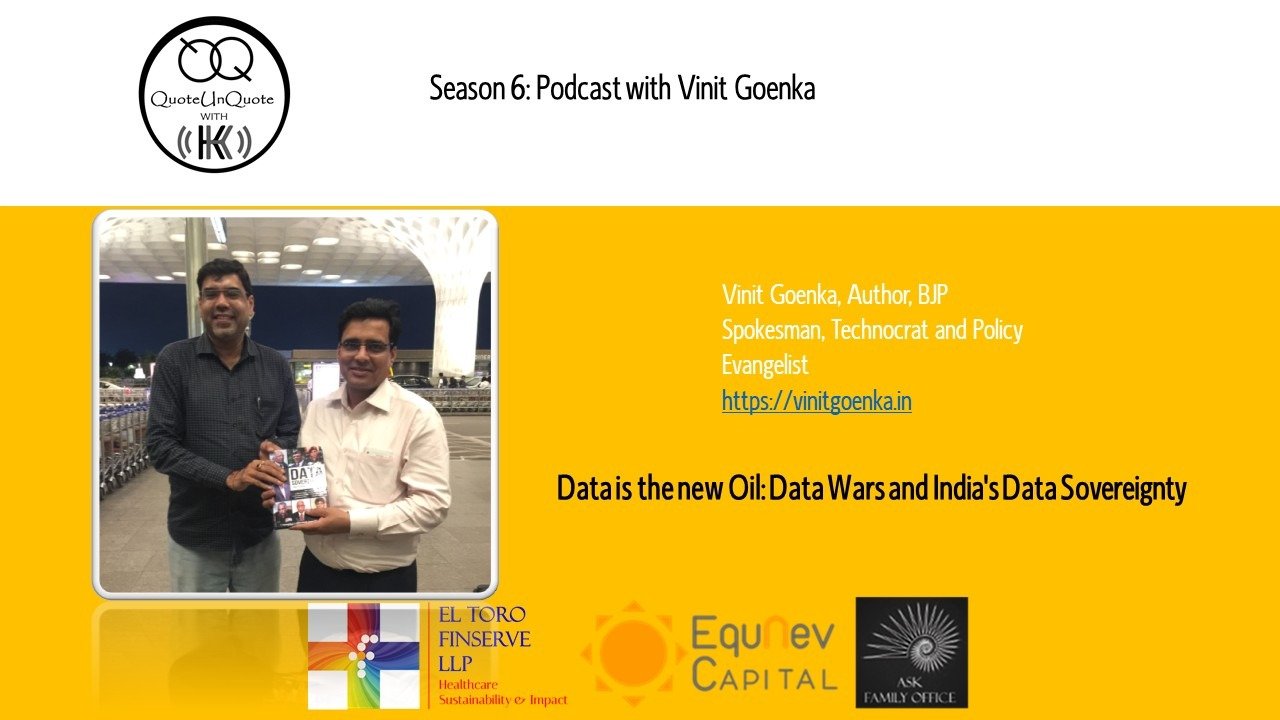
QuoteUnQuote with KK and Vinit Goenka, Author, BJP Spokesman, Technocrat and Policy Evangelist

https://vinitgoenka.in/

Transcript of the Podcast

[00:00:00–00:00:22]  This episode was recorded sometime back before Elon Musk and Vice President JD Vance made their statements on India and the policies. Elon Musk and Vice President JD Vance made their public statements and their venting on Internet data via satellite through their startling system and about

[00:00:22–00:00:44]  Indian tech workers working in the US and Elon Musk throttling their startling speed in Ukraine and many other places as well. Let’s also understand that many of the issues that we discussed seem to have preempted our response and what our view should have been to Elon Musk and Jerry Wire. So let’s rewind back and listen to the podcast.

[00:00:44–00:01:04]  Hello. Listeners and welcome back to. Quote UnQuote with KK we have been inviting. On the podcast, various authors and experts on Artificial intelligence, Leslie Demonte and Jayant Kola on Growing India’s AI X triple times also discussing on their book AI Rising on India’s Growth story. I have been personally been

[00:01:04–00:01:28]  talking and writing about India’s AI and data security and have been working with various organizations and industries body on regulating AI and data and putting the guard rails for the same before any new entrant or any new disruptions take place. In today’s episode, we are tackling some much more global issues and there have been many

[00:01:28–00:01:49]  issues in the past and some of them not just talk about artificial intelligence and data sovereignty, but just about technology and they are about geopolitic national sovereignty and global marks. And we have seen in the past U.S. government and Clod Anthropic suspended access to their latest models worldwide and treating AI software as a

[00:01:49–00:02:11]  strategic asset. So there are issues as we see in terms of foreign players and providers not just providing the best and making other users and is more reliant on them and could be very disruptive. Together, these stories tell us that AI and data are fueling not just innovation but geopolitics and policy. And today we have invited

[00:02:11–00:02:33]  someone who not only has a grip on India as political narrative but also has shaped India’s policy on data sovereignty, transportation. He is an author of two book and a top political voice on Indian TV. Indian TV echoing his views on politics, policy and his publications and advocates. Listeners, let me welcome you to Vineet Goenka. With Vineet we’ll explore what

[00:02:33–00:02:54]  all these mean for global power dynamic and for everyday citizens. Although I was an executive at Cisco and experience Cisco Huawei issues first hand across Asia Pacific and emerging markets of Europe. But Vineet has more current and up to date view on the issues to provide his expert views on the tech emerging wars of the future

[00:02:54–00:03:16]  of data and that there is an MOU in the Middle East or oil and we will start seeing some movement there. Let me rollback in time. I met Vineet during COVID times when he had launched his book on data sovereignty at the Mumbai airport and he gave me his autograph book. I’d invited him to the podcast even earlier but we were not successful. Fast forward, we have him today

[00:03:16–00:03:37]  to discuss the future of wars on data and AI and how it will impact India and his politics moving forward. Let me quickly run his profile. His earlier career began in the 90s in the corporate sector where he worked for 12 in IT and business roles. In 2003, he entered into politics, left his corporate career to join Bharatiya Jinder

[00:03:37–00:03:59]  Party BJP full time and in 2006 he wrote the digital strategy for BJP and started designing digital campaigns for BJP. He was an early mover in using it for political outreach and governance. From 2010 onward, he has had a rise in politics. He became the national Co convener of the BJP IT cell in 2014.

[00:04:00–00:04:20]  He played a role in the general elections of BJP using the digital campaign and contributing to BJP’s victory and has served as spokesperson for BJP Delhi Pradesh. HIS. Political career has. Been on rise, he was appointed to IT task force for the Ministry of Rd. Transport, Highways and Shipping. He was nominated to Central

[00:04:20–00:04:44]  Railway Information System, Cris Governing Council where he served for seven years and then he became member of Program Committee for Gandhi Smriti at Smriti Samiti under the Ministry of Culture and he has been a policy and advocacy expert and has talked about transportation rail governance, IT governance and many such related issues. He in 2021 during the COVID

[00:04:44–00:05:06]  time, he turned into an author and a thought leader where he published Data Sovereignty the Pursuit for Supremacy. Presently, he serves as Secretary for Center for Knowledge Sovereignty and continues to champion India’s Digital Independent localization and IT government. I could go on and on and on on his work, but since he has

[00:05:06–00:05:27]  limitation of time and has been called to meet the minister, we’ll keep it short and start straightforward with Vineet on his views. Welcome Vineet to quote and quote with Kik. My first question that now that you have written data sovereignty is how will this now spill? Over not just from India.

[00:05:28–00:05:49]  Or whatever happens outside of India affect our sovereignty in India as well, see. Primarily we have one has to understand that any technology which is evolving or has been invented will impact all these spheres of the life. So colonization is also impacted. Human beings are known to colonize people. So one man colonizes another man, one group colonizes another

[00:05:49–00:06:09]  group, 1 country will colonize another country. Now, the word colonization can be replaced by dominance or also can be replaced with, you know, aggression, whatever you want to call it, but it will be obviously there. And technology is part of that particular exercise. Those who lag behind in technology will always be subjected to be exploited. So you know if you see India

[00:06:09–00:06:30]  also the past the mighty Rajputs or Marathas or serious very big kings and powerful kings from the southern India were not defeated because they did not have private or valour or courage. They were defeated because somewhere they lack technology. So Mughal came with top the guns, the huge cannon and that cannon could defeat.

[00:06:30–00:06:53]  Then those mighty Mughals were defeated by Britishers because they bought in better technology. The guns which were pinpointed nearer they could fire from near and lesser cost. So now if you see this ammunition has been, now what has happened in the last 4050 years is the weapon has changed in place of a gun or a sword. The weapon is your laptop, your desktop or your machine, which

[00:06:53–00:07:14]  you’re using it, whatever name you want to call it, tablet or a mobile. And the ammunition side is the data and which can be used for progress and also can be used to exploit you. That’s why 2011 we thought of writing this book, Data sovereignty, pursuit of supremacy. I’m fortunate that I could write this along with three data general of military operations, one data general of Defense Intelligence Agency, one

[00:07:14–00:07:38]  additional director of RNW and my civilian counterpart from NPCI. So all of us came together. This is the first book where ISRO chairman has given forward to military strategies or a military has returned with raw or a civilian because they’re unique by one way whereby we explain the idea of sovereignty, a political term, sovereignty cleft with a technological term called as data. So when the data is exploited and used as a weapon against

[00:07:38–00:08:02]  you, then it is a war and we are going through this war continuously. What you have been seen in in many, many years or decades. So that’s what we talk about and this is going to be a challenge. So one has to always go with head on to the technology. We are far behind. And when I’m using this word and we are far behind, I know the political replications which can come on me. But to say that we are IT superpower and number and all is

[00:08:02–00:08:25]  one part. But another real part is do we really invent technology? Do we really own the technology? Do we all harness or are we being exploited by others? Are people dictating us? So if you see, we have been dictated, we are not harnessing as it is we required. That’s my first take. So last year I we generally come out with some predictions on the healthcare and life sciences

[00:08:25–00:08:47]  investment and how the markets will go through in a particular calendar year. For the first time last year actually, I made a submission to the world that AI is now leading. A lot of false positives. And false negative which is very dangerous to the world per SE in

[00:08:47–00:09:05]  moving narratives or changing perceptions and also predictions based on the models and how what are your feeding into those models? India had successfully, you know, ban TikTok and all. Do you think it’s time that we

[00:09:05–00:09:27]  should also ban some such, you know nefarious AI models like DeepSeek which is Chinese and Chinese origin which could be suppressing a lot of inputs and not giving a real picture about? Issues for the users. And could be probably leading to false positive or false negative.

[00:09:27–00:09:50]  And I know you have done a lot of things from your book which the Government of India has listened and actually in the policy they have given direction to data centres and and investments and so on so forth. Do you think we need to now harness a? Policy for such. Eventualities as well. So you asked me 4 questions in one question, so 1 you. Yeah, no. Time is so limited. Yes, yes.

[00:09:50–00:10:13]  So you asked me about healthcare, second question you was asked about it is a particular application TikTok. Third you talked about a geography and a nation which is our neighboring nation and we don’t share so-called a relationship with them. So that third part is that and 4th 1 is how does this impact forecast of business? So there’s four part. So let me go 1 by 1.

[00:10:14–00:10:37]  So 1, which is the easiest parties on the neighboring country named China. See whether it is China, which is a competitive country to us or there may be a most favored nation to us or their friendly nation, not so friendly nation, whatever you want to call one thing is permanent in diplomacy. And that thing is that nobody’s your enemy and nobody is your friend forever. They are dynamics which are

[00:10:37–00:11:00]  very, very dynamic situation and they change every minute. So if they achieve something and you don’t achieve, you’re behind. So one thing is very real, OK? Anything which has to be achieved, you should achieve it first. If you’re not achieved it first, you should make sure you catch up and then invent something better than that particular country. Maybe any sphere of like, not only IT, but anything else also, they should be able to do it. So that is one concern to us.

[00:11:00–00:11:23]  So whether it is China or whether it is some favorable nation, some not so favorite region, it will be better. Now second part is that particular application which you named as TikTok. Now whether it is TikTok or any other words, if you see my past. I haven’t see it now in here. Yeah. So if you see, I had a case in Supreme Court, in fact, now X and then Twitter had filed a case against me in Supreme Court and I had called upon, we had

[00:11:24–00:11:48]  serious allegations against them that they were using blood money. And I had pointed out that they had taken advertisements from terrorists, declared terrorists of this country against the country. They were trying to create sedition. And so we also went to court. They also went against me. And the court is a very famous case. You can go and check online. It went into the Supreme Court and then there was a lot of hearing subsequently as the

[00:11:48–00:12:09]  matters were resolved and also the government has made many laws. Supreme Court was satisfied and I was also certified to that. We do not pursuit further but any application we will like to explode you. As I said if they make an explosion, they would like to see that what can be expected of you and it’s about commerce. So say they made money, whether it is Twitter which made money and subscripted, when the management of Twitter change

[00:12:09–00:12:33]  their approach change but otherwise we will against it. Now can a country ban any application? We are under various treaties and there are various agreements with there, maybe bilateral agreement that can be multilateral agreement. So it is difficult for us to say no for each other’s reciprocal arrangements. And it is also not good to say no to anything and everything as a blanket because you know if you keep your backside to the

[00:12:33–00:12:57]  technology, you don’t learn what the world has, then you will be left behind. But yes, in today’s world you have to be very, very cautious. And so there are various department whether it is certain, whether it is NACS, whether it is any other department, they’re very conscious about what these applications are there, what are their real motives, they do it. When they find that the real motive is not as per stated in the statement, then they take action. So not only ticked up but many

[00:12:57–00:13:18]  other applications of many countries where then even home grown indigenous applications were also in stock. A reason because they felt it is not serving the purpose which is particular and which is has alternate, it’s a waging of war against this nation or exploiting our innocent citizen. So this will continue. And rather I’m little unhappy that government has been little lenient.

[00:13:18–00:13:40]  So whenever I get a chance to meet anybody in the government, I said you would be little conscious and do little aggressively. But then we are known to be soft people, we are known to be good people. So we don’t get that’s the second part about that particular application. Now the third part is exploitation of technology in healthcare sector. See Healthcare is 1 which does not see what geography you come from. You come from North Atlantic or

[00:13:40–00:14:03]  you come from a desert, You come from a snowflake mountain or you come from sea. Health is concerned of every human being rather nowadays to health is also concerned of animals and other living beings also. But let us focus on human beings. It is a concern. Health is agnostic to your class, whether you’re as rich as any millionaire or you are a person who depends on government age. Health is concern of both of them.

[00:14:03–00:14:26]  It does not look after gender, it does not look after class, caste, ability to deliver. So it is a great leveler. Health is a concern of this. Now in old days or earlier days, once somebody health deteriorates, only then the cognizance was taken and then the remedies were prescribed to him. And then you saw that life cycle was lifespan was smaller, illness was more, people were

[00:14:26–00:14:49]  not so healthy. But in the last hundred, 150 years, a lot of work has been done. So people who are conscious, who are capable and can afford take care of themselves, not waiting for the disaster to happen. They keep doing investigation, a lot of tests, which helps them to predict what is happening and they correct their course. So if small correction has been done by changing their food habit, lifestyle, some exercise, people do that.

[00:14:49–00:15:13]  Now this migration happened because there was inventions and then those inventions, labs became commercial. Those could be given to the common man. So what you heard earlier as a serious science, it is simply available to you as MRI or whatever. So as a user, you may not know what is the science behind it. So a user just goes there and a technician performs that act on you and your diagnosis is done. Now that’s the miracle which

[00:15:13–00:15:36]  this technology does and everyday is it changing. My answer is yes. What was there in yesterday in healthcare today’s it is absolute and there is somebody somewhere in the world making a better technology to predict, to analyze. Same way if you see second part of healthcare was what is the medicine of the ready for a problem. So they would identify a problem, then they would identify a remedy to it, go

[00:15:36–00:16:00]  through trials over, you know, various animal, whatever is prescribed under the morality in various countries. Then they would have volunteers to do it. And finally the commander kit. This is certified medicine. It may take how many years? So as I’m not a student of science or mathematics or even healthcare, I only speak what I heard from or on the search of it. This should take not less than three decades to finalize the

[00:16:00–00:16:22]  medicine or remedy. Minimum 3 decades in. Some cases 15 years minimum. Yeah, and in some cases it may go as high as 40 years to finalize that kid. This is what it and then they have to another wait next another 4050 years to see what is the resultant of that. So these two prescribes on medicine. But the over the breath they realized OK, oh, these people have been given this partition, are facing this challenge at the

[00:16:23–00:16:46]  later stage of their life. So they have discontinued many medicines. You have seen that many have been called as drugs, many have been banned, many have been restricted to shield. Now all this happens in both the cases, whether it is identification of a disease that is investigation or whether it is prescription of medicine. They used to take time and the time period was huge. Many times a scientist or a company would not be able to subscribe a remedy within their own lifespan.

[00:16:46–00:17:09]  They used to do it over the generation, 2-3 people used to do it over the time and then subscribe to the and we are thankful to those inventors, those people who have given this solution to us. Now what is happening with the introduction of computers, with the introduction of digital space, A patient or a human being when he goes for proactive investigation or reactive investigation after he’s added

[00:17:09–00:17:31]  for the problem from that day till he’s been administered the medicine, all his health records, his data counts. What is his blood count? What is the plasma inside it? What is the other factors in his blood? All has been captured in one particular play which is easily storable in very, very. And then there is analysis which can run, which will tell you what happens when happens.

[00:17:31–00:17:53]  So if two people have a similar disease and they are given two different medicines, how do they react? What will happen if they are in desert? What will happen if they are in snow clad area or these kind of variations and variables, all these combinations which were not so easily possible for human mind to do it with the help of technology. They are speeding it up. There is a speeding limit. There is an element of size.

[00:17:54–00:18:16]  Now they’re comparing more size. This is helping to invent or prescribe better medicine, better solutions, identify better. The cost is coming down, but at the same time it is generating huge data of individual. Now the challenge of which I always keep speaking whenever I get a chance to speak in public forum as well as to the

[00:18:16–00:18:38]  authorities is that when these hospitals or the labs, when they collect your data, are they deleting the data? Are they collecting the data and showing it with your permission? Are they making sure that you understand what is called as permission? Because many of my brother in this country may not understand what is called as permission. So they may give permission that I permitted to keep without knowing what is it. And these people then they

[00:18:38–00:19:01]  harvested data make monetary benefits out of this which is not passed on to the victim or the user or the person who is called as sample circuit. And those who is to invent now they take less time because they can run through this on a quantum computers. They can understand through the algorithms what will happen. A prediction can we have done

[00:19:01–00:19:21]  with the help of this available data which can be then narrowed and identified. You may not even now know that earlier this to ask you to sign up saying that you are a volunteer to the medicine. Now you may be a victim of this cartel, which will not tell you, but you are actually a Guinea pig to them. I was here. What has? Also happened is during COVID,

[00:19:21–00:19:42]  if you are aware Chinese people hacked onto our aims and and several other, you know servers and try to take information, genetic and phenotype information of Indians. Maybe that was to help them to develop their COVID vaccine or? What? But that’s a very.

[00:19:42–00:20:01]  Dangerous thing. And you know, today if I upload my diagnostic report to say to ChatGPT or DeepSeek, they give me some some bit of diagnosis and recommendation, which obviously then I can talk to my doctor to verify or cross verify or whatever. Now a lot of this information

[00:20:01–00:20:23]  going on DeepSeek is dangerous. It is in the hands of Chinese. It’s not a democratized AI system. But it’s all a lot of data which is going into hands of our neighboring country. As you said. Which is dangerous for them to create certain countermeasures

[00:20:23–00:20:45]  or bio weapons. Which is why I said, like TikTok, should we ban even deep? Seek or should we restrict? DeepSeek for certain type of applications only and not for say healthcare or some other use. So one what you rightly said can can they make some bio weapons and this can be a new age of weapons which will come up or

[00:20:46–00:21:07]  let me put it a little simple not get so paranoid and let me say in simple terms can they make the medicines expensive? The simplest way will be that pharma lobby will come together and they know that this has happened in this particular geography. So let us make the molecule expensive and once the molecule, the salt component is expensive, naturally your population will be up.

[00:21:07–00:21:29]  So they say penicillin has helped human being to survive and stay longer. But the same penicillin after even been invented, it was denied to common man because it was very expensive and because of that in the absence of the delivery of penicillin, thousands of people died even after the invention was done. So, will there be a greed which

[00:21:29–00:21:50]  will decide that this set of poor people will not get this medicine and we will only give it to her. So you see many medicines are very very expensive which actually can be afforded. And I should upload the efforts of the Government of India, especially Modiji whereby introducing Ayushman Bharat, the scheme where it takes cares of

[00:21:50–00:22:13]  the cost of the medicine. The same time Gen. Ashudis where generic medicine, general forumers, they have been taken out of branded and they can be reproduced or they can be manufactured here in this country. So those patterns which are now lapsed, those medicines have been made. So this kind of. Policy interventions are also needed along with technology. But overall, if you ask me, will countries or geographies or

[00:22:13–00:22:35]  corporates play with your data and use it as a tool to extract more money or extract political power out of you? Answer is yes, it can do it. Whether we should ban one application or not. Now that call is by the authorities because it has to establish that whether that application has been used for this particular purpose only. But yes, anything which is foreign, Sir. Your book has actually led to a lot of policy changes.

[00:22:35–00:22:59]  Also, now we’ve got the data center policy. I guess the spark of it came out from your book. That’s why I said policy. I was the youngest writer in that book. I was the youngest writer in the book. My Co theaters are great. As I said, we are total 7 authors in that. Three of them are Data, General Military Operations and they are all colored people. They have lot 1. Of them very recently even engaged in some operations

[00:22:59–00:23:22]  Hindu. So data General Defense Intelligence Agency Lieutenant General Vinod Kandare he had certainly puts additional Director RAW Jaideva Ranadevi he had so I was blessed that all these great people were there and they had vision and access to information far more than me and to they have seen life in a broader canvas. So that book encompasses experience of all these people and the vision what will happen in the next 30 years.

[00:23:22–00:23:44]  Yes, I was one more blessed that this book was inaugurated by honorable Sunil Ambekarji in Delhi. So what happened is it has was sanctity by the establishment and then I was fortunately that I was called on various dispositions to go and tell what has happened so humbly. I I can say yes, it has been referred by various people who matter to this country. So what’s next? I know there is a shortage of time.

[00:23:44–00:24:04]  I wanted to understand how the whole, you know, the Indian tech services and Indian tech export is also now going to be impacted given the recent Accenture and all these debacles that are happening globally. It’s going to also impact India shortly. And for, and obviously now we

[00:24:04–00:24:24]  have the visa issues with the US, the H1B visa for exporting our human resources there. Do you think, Sir, what the government is now trying to do is to create the GCC in India and try and retain everything in India, allowing the corporations to come to India and work within India with Indian talent is the

[00:24:24–00:24:47]  way forward or should we be doing the the political and the geopolitical and diplomatic negotiation on visas that used to happen when I used to be in Wipro every year there used to be this haggling and this back and forth negotiation with the US diplomats to increase the quotas. See, as I said, there are multiple questions which you ask in one question. So let me answer it 1 by 1 so

[00:24:47–00:25:08]  that for the user to understand. One is geopolitical situations are always dynamic, they are fluid. So what you see today morning may not be the same evening. Few days back, 2 great nations of West were together, then one of the presidents I guess. OK. And now if you see there will be a lot of this kind of diplomatic thing, geopolitical things which will impact technology

[00:25:08–00:25:30]  inventions, technology transfer employment because they are all guided by agreements. Even if it is guided by bilateral or multi level agreements or we are governed under charters, there will be the mood of the nation is decided by the relationship of that two countries on that day. So today we have a lot of good relationship with say for example, USA, but yet currently they may have their internal compulsions of not hiring people from outside.

[00:25:30–00:25:53]  And so we are being impacted. But the best thing is you invent your own technology written. My anger is not against those countries which are not hiring us, rather I’m unhappy on why are we not producing good engineers. So if I have to submit, I would request the education ministry, the MHRD ministry to focus on improving the syllabus so that the bus which we missed our children’s or our generations to come should not miss that particular part.

[00:25:53–00:26:17]  So an engineer coming out after 10 years should not have to face the same challenge which you and I have faced. So I would rather suggest that we have to see, look inside our own house and 1 #2 the compliances, all the other statutory norms which forces a person to become an employee rather than becoming an entrepreneur, rather than becoming a founder, he chooses to become a CEO for somebody

[00:26:17–00:26:41]  else’s company. Those compulsions of compliances strategy should be discussed and how we can make ease of doing business and which Prime Minister Modi’s trying to focus. But we have to run fast and get it done. Third one is the cost of capital. Unfortunately, in India Today, the cost of capital is very, very high. Most of the inventors or most of the founders fund from their own money or they’re a close family which is limiting this, which is not ample.

[00:26:41–00:27:04]  When you want to make a world class technology which will run over the world, then you’ll require institutional funding mechanism which everybody has to come together. Yes, for the same time we will have to put in regulatory compliances, stringent global regulations. We’ll have to put in security features around it so that those interventions are not leaked and not been migrated outside. So this all challenges will be there. What will happen because X country is employing you, not

[00:27:04–00:27:27]  employing you. It’s a concern of local right now, not a larger concern. Larger concern is we’ll be able to invent. See the number of patents been filed in 2014 versus number of patent filed in 2025 is very good. That tells us one thing that Indians are now getting cautious about IPL. But the number of patent filed in 2025 is not even 1 ninth of the total number of patent filed in Japan.

[00:27:27–00:27:48]  Whereas Japan is 1 ninth of my size of geography. So we are actually 181 level of Japan. So we have to really multiply our since 80 times more to to contest with these geographies. So we are far behind and we should not sigh out from saying that. So one academic environment, two, financial agreement environment for provision and 3rd with the regulatory.

[00:27:48–00:28:10]  We have to think all the three while the external affairs should engage with our counterparts in the world, see how they can we can become favorable nation to them. See how our citizens, our engineers are getting opportunities which other countries are getting. So it’s a very complex thing. It’s easy for me to sit here and tell you what should be done, but I’m sure those who are

[00:28:10–00:28:28]  sitting there know more details and that’s why they are more competitive people. But the reason they are not able to do it maybe, probably they have challenges at hand. Sir, you have also been working on the renewable and side of things and I just recently attended the Economist Resilience Summit in and one of the things was the energy

[00:28:28–00:28:52]  consumption for even AI just to type 1 command and get a response. The server and the chip consume so much of energy and don’t you think that along with our data and EI resilience, we’ll also need energy resilience to run this all infrastructure? And what is your recommendation for the government to run this infra?

[00:28:52–00:29:14]  See one good part is in the last one decade various new sources. When I say new source I don’t mean that new element has been invented but various new. For example in hydro hydral power they would have identified more locations geography to generate hydral. If it is solar, then you’ll see that can massive farms are coming up whether it is a renewable or whether it is the conventional.

[00:29:14–00:29:36]  We have also identified more basins for extraction of oil. Of course, one good part is even Atomic Energy has been harnessed and tapped and there are provisions of going. So the establishment, the government has been very consciously trying to tap all these sources which are there and judicially mixing it. So the dependence of a thermal power plant is not purely on coal now it has been gas fired,

[00:29:36–00:29:58]  it is oil fired so that we have the energy. And you have seen in this recent past the challenge which has come up because of the waste. Asia, we have not found anywhere something called as blackouts. The reason is because there has been an energy storage, energy storage and they have very judicially been done. Yes. Do we have to just triple it? Answer is yes, we’ll have to triple it. But it is not so easy to say

[00:29:58–00:30:18]  triple it. It requires huge capital. Secondly, it requires huge land to build this kind of generation centers. So you will displace the original landowner, whether it is a farmer or the tribal or a minor. We have to. So whenever you displace somebody, that will be a pain and you have to see and think about his livelihood also. So in a democracy, this will take time, but I’m happy that

[00:30:19–00:30:40]  this is going on #2 if there is less power, if there is a challenge of power, do we avoid this kind of opportunities of data centers? Answer is no, we may have to compromise, cut your residential literacy but direct it there. Now it might sound very, very ridiculous but for a strategic reason we will have to put in priority the data centers, more

[00:30:40–00:31:01]  data centers in the country. It will give you limited employment. Yes, data centers are not great employer but it also still gives you Employment Opportunity. But two thing is the data is in your control. Then can you decide whether the data will remain in the political boundaries or not? That is on the agreements which you do and the technology which you have, but yet you would still have it. So my goal will be in my hand

[00:31:01–00:31:24]  whether it is exposed or not. It depends on what kind of algorithms it is and what kind of agreements I have. So I’m a great elevate of having more data centers, even if the cost if the others rather than has to suffer a shortage of electricity. And in the meantime, we should invest in generating more power, localized power. Do we have to really go and make big dams for idle?

[00:31:24–00:31:48]  I don’t know. I’m not an expert of electricity, neither do I understand photovoltaic nor do I understand Heidel. But what I understand is if we can tap that and one small contribution, which common man is doing it? I don’t know whether you have ever realized this. Nowadays, if you go, every house now has something, either water heater or maybe they have street light, or maybe they are generating power for their own house. So even if you would generate a

[00:31:48–00:32:11]  friction of your consumption, you’re actually helping the entire country. So a few teaser questions I have before I let you go. I know time is limited. I wanna know what excites you most now that you are in the policy and governance and also with the politics about India’s journey in the coming years. And what’s your idea or vision for 2047? So what excites me is that there

[00:32:11–00:32:33]  is an in the generation especially the next generation that they should not become employee but employer, they should not become user but inventor. That excites me more because my next generation is smarter than my generation and that is a satisfaction 2 for the reason of 2014. It’s Modiji has already given Bixit Bharat and we’ve all follow him blindfolded. So our region is that. But yes, if you ask me

[00:32:33–00:32:56]  personally, what excites me is the region of Antodaya, which the last man in the line, last man who is should not sleep without proper nutrition. So if he sleeps with full nutrition, he has enough shade on his head. That is what is happiness that would I would be really happy if I survive till then or otherwise my soul will be happy if I see

[00:32:56–00:33:17]  every Bharatiya clipping full stomach under a nice shield. So 2047 no data colonization freedom for India of its own on the. Type the Prime Minister was when the Prime Minister said Vixit Bharat. It encompass these two words are magical words in campuses everything Vixit Bharat data me hoga Vixit Bharat, aya me hoga Vixit Bharat. Politically, geographically,

[00:33:17–00:33:39]  strategically, invention wise, education wise, health wise, everything. Vixit Bharat. We I know we have made some steps in every direction. I want to understand what’s your next book looking like? I know your second book I couldn’t grab your greens on but so data soberity. I can humbly claim that we have subsidized all. I have got opportunity to speak in National Defence College thrice.

[00:33:40–00:34:03]  I’ve been invited where journals and bigoted to sit. I’ve been invited many times where the bureaucrats, senior bureaucrats at the level of joint secrets and also party has been very kind. Many times I’ve been getting opportunity to speak in front of senior leadership. So sensitizing the influencer has been done. Now the second thing which we are thinking very seriously is about data resilience. Now the time has come where you say data resilience. So that will happen.

[00:34:03–00:34:26]  Correct. And is that the topic of your next book, or is something else altogether? I don’t know, but I’m seriously thinking something else should be done. I definitely agree with you and obviously there is a lot of geopolitically legal stuff both between India’s legal architecture versus other countries architecture. I guess there’s a lot to be

[00:34:26–00:34:45]  upgraded or reverted or relook as we would move to govern ourselves to 2047 vision. There are a lot of things that we send through our industry bodies, CII, FICCI, but I don’t see direction from the other side as. To what is the thought? Process there.

[00:34:46–00:35:08]  How can this kind of be more frictionless and be more proactive in creating the legal framework for the future? I know I have been talking a lot on the health UPI but nothing is moved forward there. First, let me give you my honest personal answer, which is incorrect and and diplomatic, but I would like to be candid on that and then I’ll tell you how

[00:35:08–00:35:30]  it is. So when I hear this words of the key, when we can upgrade our legal systems or upgrade our compliances, I greatly object to it. Just because one country or another economy has introduced one law or a policy and it is dominantly pushing it does not mean that my systems are downloaded or it is backward. Because that is a sense of maclose education where we are

[00:35:30–00:35:52]  thinking that the masters are others are masters and we have to follow them. They have proposed something which is good to them and is it genuinely good to them? Answer is yes. But is it genuinely good to the human kind? Answer is no. They made sure that it is good to human beings, but it will be probably a protectionist approach of them. So you name something, they don’t want to call it as a PPMA, professional market access. But these are barriers which

[00:35:52–00:36:12]  they create and sometimes of course they create standards which help their country, intern, human beings, everybody. So what we should do is learn from them which is good for their citizens and we should adopt that. While while everybody does it, we should also do that. Adoption is very good if you do it 2. Not follow them blindly but we should have our counter majors for their Pmas. So if.

[00:36:12–00:36:32]  They want us to have some kind of certifications quoting that it will assure them that the process validation is there. We should also increase our BIS. We can also increase our processes here to a level where people code this. What is currently missing is that our standards are not as per the horizon of many, many countries which are there and

[00:36:32–00:36:56]  hence many of us feel that whose country calls economic standardization the process. But do we have to blindly follow? The answer is yes. But one more thing if your business, your industry, if your talent wants to service that particular market, then you may have to be compliant to that particular market. And also back home we should. We are far behind in standardization, we are far behind in IPL.

[00:36:56–00:37:19]  We are far behind in creating hurdles which are camouflaged with nice scheme of processes. We should do that. We have been kind to the world saying that we you know we are very kind to say that. So everybody’s our brother. But now it is time you have to look into, make sure that we also create a counter damage that 1/6 of the human beings,

[00:37:19–00:37:41]  Some economy which is not even 180th of the human beings may come out with standard and tell you that what is good for the entire planet, if it is really good, we should follow it, we should imitate that. But the same time we should learn from that and immediately come out with which is better than that particular solution. And we don’t do that. And when you don’t do that, then in internationally when you sit on the platforms, you feel little behind, you feel

[00:37:41–00:38:04]  dejected. So I wish that what I could not do or my generation could not do, the listener, their generations can help us to create that kind of standards where people could say Bharatka standard, a Bharatka processor compliance. If you’re not compliant with Indian, this thing, you will not be having access to that market if you don’t lose the Indian. So that murmur, that noise, I don’t listen when I travel abroad and that pains me.

[00:38:05–00:38:27]  Am I talking to the future Minister of National Data Security and Governance? No, see, I’m not a political person being in politics. So I’m not a public representative neither. I have this kind of qualities. It requires a lot of qualities. It requires a lot of different attributes which I lack. And I know about this, the best part of this, I’m aware of this particular short run of mine.

[00:38:27–00:38:51]  So I don’t pursue that particular path. Yes, I’m more like a policy enabler. So I would like to talk in the policy space and be in the policy space, and I’m happy here. So I don’t want to dilute my vision. Lovely chatting with you Vinitji. I know you have to rush to meet the minister and have your other, but thank you so much for taking time out and giving your

[00:38:51–00:39:10]  open thoughts on what’s going on and your mind and your time to us to talk about it. Love. I would love to connect back and call for another round of discussions when time permits. But it’s great to have you here on quote and quote with KK and talk on multiple topics and

[00:39:10–00:39:33]  issues in the recent past in this space of AI and data and our country, which is in the crossfire of multiple things as we talk. It was a learning experience for me to talk to you and many questions which have been raised. I know that I don’t have a perfect answer, so I’ll go back, study and make myself better. The same time, I also wish that the bus which we have missed

[00:39:33–00:39:44]  should be done. And next time when I come on your show, we have our own browser, our own app, rather than using a foreign app and a foreign browser to talk to each other. I agree. Thank you. Very much. That’s, well, lovely.

Managing Reputation – Character, Company, Caucus, Cinema, Country

Managing Reputation – Character, Company, Caucus, Cinema, Country

Podcast

Transcript

[00:00]  Hello listeners and welcome back to Quote Unquote with KK. This is season 6, which we are beginning after a slight break due to my health reasons. I want to make a short introduction on what and what we have been doing so far as one of the tracks that we keep bringing onto our podcast were people who are brand gurus, who are marketers, who are professors and thought leaders and authors. In a previous seasons. We I’ve got Harish Bijur, who’s a brand guru in the real

[00:33]  Chakrabarti, who was a storyteller and a brand marketer. Dr. Jagdish said needs no introduction. Jesse Paul, my ex colleague from Wipro. Ashish Dhawan from the advertising field. Today’s podcast is slightly different. You see that over the last few years, a lot of influencers. Have come on board due to social media and we talked about it slightly during Jesse Paul’s podcast as well. I happened to a book whose authors are in front of you today. A very interesting duo I would say.

[01:05]  It took me a few months to get them today together due to logistics. And my health reasons. But I’m really glad that we are connecting and talking together. So the context of today’s podcast. Is as follows. We explore very powerful invisible forces in our lives, in our organizations, in our politics, as well as in our country. And what we seek is reputation, whether that finds who you are, what you are. And today’s duo, the gentleman who we are talking to are gurus in that field.

[01:37]  In fact, they have written a book on reputation management and I’m going to put that link into today’s podcast as well. Please go and look into and buy that book. It’s available on Kindle as well as on Amazon and they have their own website as well. I’ll put that link as well. A quick intro of the book that I have read their book, The Pursuit of Reputation. It’s a practical guide to navigating India’s evolving public relations landscape, emphasizing reputation as the cornerstone of success for both

[02:08]  individuals and organization. It blends historical insight, contemporary challenges, and expert perspectives to show how authenticity, transparency, and adaptability are essential in today’s competitive environment. In short, the book argues that reputation is the most valuable currency in today’s interconnected world, especially the digital media and in fast changing India’s public relation landscape as well. It’s both philosophical in my perspective as a reflection and

[02:41]  a practical manual as well in these uncertain times of what we are seeing both on social media and digital media as well as our what we call as our traditional and now go the media as well. So in today’s podcast, we are going to talk to Amit Prabhu and Sujit Patil, both are veterans in this field. The book, I think you should show the book now. I also have the cover of the book. Yeah. And the website. I’m going to In pursuit the pursuit of reputation and all.

[03:14]  I’m really going to connect today as our team of the podcast is managing reputation, character, company, caucus, cinema and country. So there are threads around these which we are going to link as they seem to be interconnected in one way or the other. And who best can answer these today? We’ll start with the basics one O 1 of what is reputation. And then we’ll take each and everyone character, which is individual company, corporate caucus, which is the political

[03:44]  and group. And then we’ll go over to cinema durander type a lot of things that happens there because people are now talking a lot on durander and the after effects. And then we’ll go to the country, India’s reputation. I want to briefly touch with the whole issue of digital and then end up with a rapid fire round of questions and answers. It’s a packed agenda today. So welcome gentlemen, to the podcast. Finally, we are face to face today on this. Pleasure, case pleasure.

[04:15]  I know it’s taken a long time to for all of us to get together, but now that we’re here, let’s make the best. Yeah, and let’s get the bang for the buck for reputation of all of us today. It’s on stage. Lovely. Let me get started with A1 on one question. According to you, what does reputation mean in India? I know the English, British and the US reputation word is very different, but in the Indian context, what does reputation mean to you it? Is so be it any context, be it any country, be it any culture. I think reputation is reputation.

[04:46]  You know, reputation for me, in a very simplistic manner is something to deal with. You know what people talk about you when you’re not in the room. You know, what is, what is it that you’ve demonstrated as behaviours, what have you done and what are the precedents that you set and what people imagine you are is your reputation. I think in a corporate context it’s a very powerful term. Of course in a personal context also it’s a major thing, but in a corporate context it gives you the right to exist, it gives you the right to attract employees,

[05:16]  it gives you the right to ask for a premium for your products. It is something which is intangible, but it’s very powerful and it is something which people align to when they are in a confusion stage in terms of preferring or a brand. So if your reputation is higher, they’ll prefer you and if your reputation is not good, they might just avoid you. So it’s, it’s a very powerful and a very, very invisible thing. You know it’s invisible until it’s gone. You know, people realize the power of reputation and importance of reputation once it’s lost. And as they say, you know, it

[05:48]  takes years to build a reputation, but probably seconds to kill it. And as Amit always says, you know, reputation is 90% behaviour and 10% communication. So your behaviour is the base, how you behave, behaviour how you conduct yourself, how consistent are you with your values, how you demonstrate them. I can go on and on and on if you want to add something to that. I think we just covered everything and in one word reputation is almost equal to behaviour and therefore the word public relations sometimes is misunderstood. It’s it’s used wrongly by people.

[06:20]  But reputation is equal to public relations is equal to behaviour. Public relations is nothing but behaviour of a certain entity with its stakeholders. So reputation is equal to behaviour is equal to public relations is what I believe and Sujit has explained that in detail. Tell. Me one thing I’m a Hindi speaking mother tongue is Hindi. Does ijat and reputation mean the same thing? Or kuchwala gay? Jose is that meaning in English is that it’s difficult to. You want to define for Amit what what context you’re talking about in as an ijat? Khurki jat apni jat deshki jat you know, in all contexts they.

[06:54]  It has a wearing for it, but you know, is that something you carry into a room in your present Reputation is something when you’re not in the room and people say, wow, KK is an amazing guy. What a podcast he’s got, what a amazing demeanor he’s got. He’s such a powerful businessman. I mean, that’s your reputation. People will respect you for your reputation. I think it’s got bearings with each other. It’s got a connection. But I think there’s no other word that can define reputation in Hindi or Urdu that comes closer than the word results that he just said, Yeah.

[07:24]  I think so. It’s made us think, actually, we’ve never thought about that, maybe. Hindi. Hindi. The reputation of the pursuit of is that, yeah. It’s just management. It’s just management, yeah. Yeah, like people might say reputation. I think in that context it works. Great. At least I made you think on the first one. Absolutely made us think and let’s go to something much for software. What bonded you together? How did you get together?

[07:55]  And then finally decided writing a book. I’ve never found a book on reputation management. By the way, this is the first book I’m reading on rapid hair. There’s so many books, so many best sellers, but nothing on reputation. We’re in 2026, so I’ve known Sujit for over 15 years now. So in 2009, when I first heard of him, I wrote to him an e-mail saying I want to meet you because for me there are very few role models in corporate communications at that time and had become one of them because of his long stint then with Tata Chemicals. Now he’s with Godrej for more than a decade and he agreed to

[08:26]  meet me in Bandra, I remember for coffee. He doesn’t remember that maybe, but that meeting happened for half an hour. 2011 I moved to Chicago to work with a global #1 PR firm called Edelman. And as part of that I was involved with IABC, a global communications association. And Sujit was a very active member from India. And it so happened that I had seen his name in the list of attendees because I was in the organizing team as a volunteer. And the event was starting off on a Thursday evening, and I was standing at the entrance to the main arena for the opening dinner, and Sujit and another gentleman from India were

[08:57]  walking there. And I suddenly recognized Sujit and I knew he was coming for it. And we hit it off. That was the moment I always remember. It was in Michigan Ave. in Chicago. And we hit it off. And then the entire evening we hung out together with the other gentleman, Rajiv Kumar, I remember. And then we kept in touch. I came back to India to build on this Praxis conference. And Sujit became a major supporter of Praxis because he believed in it. And like him, the others who joined the band as well. And between 2011 and 2110 years, we kept in touch. He supported various things we did. We organized an annual

[09:27]  communications or influencer conference in his campus at Godrej, which he had moved to by then from Tata Chemicals in Vikroli. Then COVID happened and everybody was quiet in the first few months of COVID, wondering what’s happening. But when things were looking slightly better, it was somewhere in the middle of or end of 2021, two things happened. There was a friend of mine who even Sujit was well known to and close to called Anant Rangaswamya. And his name always comes up in a conversations around a book. He’s a famous marketing editor who’s sadly no more. He’s. Later. In fact, May, this is the month we lost him three years ago.

[09:58]  Anyway, so Ananth was nudging me saying why is there no good book in PR? You do so much in PR, why can’t you write a book on PR? And I said, I don’t have the motivation to be an author, but I want to write one someday. So what is someday someday is now you have the lockdowns going on, your free time. And just then another PR book had come out, which was having a lackluster response, which is fine. And Sujit and I started talking on call one day about that book and we said we need to really up the game of PR and bring out a book with our years of experiments which has at least a tickets experience more than me.

[10:28]  And I said, Are you sure we can write 1? He said yes, if you are in it, I’m in it. And we told Anant that hey, this book is an idea you had seen in my mind and we’re doing it. He said by all means go ahead and I’ll give you all the support you want to give, the guidance, the mentorship. And that’s how the whole idea of the book was born. We had a different thought for that book and Anant trashed that thought and said this book, not even your family will buy, change the whole idea behind the book. And then we said, OK, we’ll go with a completely radical thought. And Anand said this is great. And we began putting the book together. I would say between Delta and Omicron, between those two variants, our book came

[11:00]  together. We said we have 20. 54 talks a lot about Anand as well. You’ve made a mention of several places. Had he not nudged me and Sujit together, we would have not been maybe bringing that book to life at that time. It would have happened later on. And if he was a lie, maybe we would have talked less of him. The fact that he’s no more, we keep talking about him because that’s our tribute to him. Yes. So that’s how the book came to life. And in all of 2021, we wrote this book in multiple settings on Zoom. We sat in Goa a couple of times, we sat in Gurgaon in Bombay. So this book happened over three

[11:32]  cities and virtually we put together about 1718 chapters together. And then we kept it in cold storage because we didn’t want to launch the book without a proper physical launch and COVID was still showing it signs of coming back. So we kept it in the cold storage. And then we found through a common connection, a literary agent who took us to couple of publishers and one publisher of Westland immediately lapped it up. And rest is history we can say. And then in 2023, September 5th, which is Teachers Day, we said we’ll teach the world a little more about PR And that’s how the book came to life. But another point is we feel

[12:05]  that we are just custodians of the idea of this book. There are many people who have done much more and great work for reputation. So we decided to add some of the paragraphs from those people in this book. So the book is co-authored by us. So 80% of the book is our content. There’s 20% that comes from these 75 people to make it a community initiative of sorts in some way. And I really love the way you guys have put it. And I think today’s podcast, we can also dedicate if with your permission, in the loving memory of Anand, no. Problem at all? Yes. By all means, I think he was the guiding force and I think

[12:37]  cherish those late night Zoom calls. It is locked down and there was no chance of meeting each other in person. So night calls on the Zoom, on Ms. Teams and I think that really worked the wonder. And, and we also thank the lockdown. I mean, it’ll sound really sadistic, but that really gave us some breathing time and pace to actually do something with the hectic schedules that Amit has and I have, I don’t think we would have written half the book. But today, if you ask us, we can bang off a book in maybe six months time because we know exactly what the process is.

[13:07]  I’m going through that same process and somebody’s nudging me to write. I mean, my blogs and so many other things are there. You should, you should, you should, but it is just that something is just that motivation internal to just sit and just thrash it out. I can say that as well. So I empathize what you guys gone through and what you are actually shared. Let’s go back to individuals. That is the character part of our podcast today. Again, ijet or they say reputation is always the invisible currency of success

[13:38]  and how each. Of you personally define reputation, why does it matter even more in today’s context, especially when there is this whole boom of social media influence? Fact checkers and then the whole digital tech of ORM. Why is it even more important than what it was in the past? I think it’s, it’s a significant importance. I’ll use some data points, you know, data in terms of the crisis landscape of 2026. I think I’ve I’ve dug out some data.

[14:08]  Whatever I remember, I’ll share which and a due credit to the Edelman Trust Barometer, the Reputation Capital Council Scorecard of 2026, Gallup 2025 survey from the employer angle, Reuters 2026, various reports. And these are reports which demonstrate some few trends which really are so important and giving CEO’s sleepless nights. I think #1 is, you know, the 78% of CEO’s acknowledge reputational weaknesses that have already impacted the

[14:39]  company’s trading performance. You know, stocks are falling, trading under pressure. The preparedness in terms of technology, the AI preparedness gap, only 40% feel that they’re adequately prepared. There’s a huge amount of trust erosion. If you see the reports globally, 70% of the consumers and people are hesitant to trust those with different values and backgrounds. It’s all the more important that brands start building that connect. There’s a lot of uncertainty. 42.9% identify uncertainty as the external factor which has

[15:10]  actually created a negative business impact. So as to say some more data in terms of what is happening in the overall thing when it comes to the landscape, the business landscape is that there are a lot of values driven boycotts happening. You know 51% people as per the reports have stopped shopping at brands that did not align with their personal values. All the more important reputation has to be built and aligned. A Media Trust is collapsed. About 28% public trust in mass media, 28% trust mass media. That’s what I want to say.

[15:40]  And in, in, in the American context, 34% of the Americans don’t even have any trust in mass media. And these are coming out of global reports. Publishers are expecting that the traffic on their sites are going to be falling over the next few years by 40%. And there’s a big authenticity crisis when all these things are prevalent. What happens is people are becoming more aware the screen level as people are calling out things which companies profess but don’t deliver. There’s a lot of green washing, there’s a lot of blue washing,

[16:11]  there’s a lot of pink washing. So the whole scenario and on top of it, the geopolitical issues, advent of technology, the fear of AI, I mean, there are multiple parameters. Now, how do you navigate through this whole ambiguous situation and make a mark? I think your only weapon is reputation. When you have a reputation where people trust you, where people believe you, where people are willing to give you that respect and buy your products, it works. When it comes to employees, I mean, there have been reports where the Gen. Z are looking at organizations

[16:42]  who have great reputation in the space of DEI, in the space of good and green, which is sustainability. The ESG fund us and they won’t even join in an organization, even if they don’t have a job if the reputation is low. So the power and the respect that reputation per SE has garnered over these past few years is so significant imperative for people to build. ORM you alluded to is absolutely critical because most of the crisis and reputation pacting trends are happening on social media. So ORM, which is online reputation management is absolutely important unless you listen to what the people are

[17:15]  saying about you. You know, we we spoke about reputation being what people speak when you’re not there. So social media when people put up narratives, there is fake news, there is deep fakes. There’s so much of things happening which were not happening 10 years back. So currently, if those are the things happening online, reputation management assumes a significant role. People have to watch what people are talking. They have to kill the incidents at the bud state so that it doesn’t become a crisis. So I think it’s very important that listening orm tools, behaviour, promises to be kept

[17:45]  and trust to be maintained have become very significant. We call it trust crafting. You know, trust crafting is something which is a process which doesn’t happen in one campaign or one event. It is a consistent way in which you keep building trust with your behavior, with your demonstration of your promises. That’s the long answer for a short question, but I think we’re so passionate about that. It goes all over the place. But this is a lot of data points. Lot of data points. By the way, just for your information, we have had two podcasts with the Gallup CEO, one on his book The Blind Spot,

[18:16]  which is talking on the happiness and the geopolitics of their happiness index. I think we’ll talk about that on the country and caucus, the politics and that part we’ll briefly touch. And the other one was on their whole thing during COVID, the perception on India or globally, how different countries were managing that perception on to their citizens. So we have done 2 podcasts there talking about what you’ve said, not directly as a reputation,

[18:46]  but more as perception of people, where they’d surveyed and what those results of those surveys have been. Well, that’s a great start. I wanted to understand a lot of things are happening. A lot of negativity is also coming in terms of that perception and things like these. But you see a new sort of regulations are also coming out in India to protect individuals from getting harmed. For instance, there was another Kapil Khandelwal who did fraud with our Nirav Modi and people were trolling me. Ultimately, I had to warn, you

[19:17]  know, those digital platforms, if any even tags me, I will file a defamation suit. It’s just defamation. The only recourse for people to protect themselves against this whole slew of trolling. How do you manage these sort of crises and situations for individuals, People like me And there are many such influencers who get trolled. I think there is no easy way out here. The fact. We need stricter regulations. We need, but our country works really differently from some other countries and we have to accept and live with that because that is how we are. And there are a lot of other

[19:50]  positives in this country that we have to celebrate and appreciate. So I think, yeah, if somebody’s name is similar to another person’s name and there’s a mismatch, the person putting a social media post doesn’t care. He wants to tag. You won’t believe it. My name is Amit Prabhu. Very often if somebody has a problem with law and order, I get tagged and I wonder why then they want to tag Amit Shah. I get tagged sometimes. Often. It’s happened at least 1012 times in the last couple of years. And they’ll tag government, Prime Minister Amit. They want to tag Amit Amit and it just gets picked up. It’s part of life. You can’t do much, but if somebody. Targets you incorrectly thinking

[20:22]  or assuming you have done something wrong, then obviously there is a way to go to court and we see that happening in the political spectrum. A chief minister versus a former chief minister, they will have these tips going on and then court cases that happens. But for ordinary citizens there is very little one can do. Live with it and hope and believe and pray people forget about it. I have a little bit of a different perspective on this, you know. I have to change my name from Kapil Kandelwal to Kapil Kandelwal KK. On social. Media on my web. Site and those are those are immediate records this kind of a

[20:53]  thing. But I would I would suggest that what is more critical here is preparedness. When I say preparedness, it’s about how well are you preparing your own personal brand? How well are you articulating your own reputation? How well are you positioning yourself in terms of what you do, what capabilities you bring and what is it that you are putting in on the table which is of benefit to people. Once you have a kind of a anchor point that Kapil Hindelwal, who’s a podcaster, is a banker, is this guy and these are his body of works.

[21:23]  These are his comments in the media. Say, for example, this is what he leads on social media. These are the terms with which he’s associated. If that preparedness is done, then any amount of other Kapil candle walls may not erode your brand value as much. So that the whole concept of creating a positive digital safety net for yourself is very critical. You know, what is positive? Digital safety Nets put in so much of positive. And of course, it has to be authentic. It has to be, it has to be demonstrable and it has to be believable. If those aspects are floating in the social media around your

[21:56]  name, people can read it. People are smart. People don’t just people don’t troll for for the sake of trolling. They also read through it. I mean, you might get the initial backlash because you’re tagged, but once they realize it’s not him, the thing’s reverse. And as Amit said, most of the crises or these incidents are not long lived, but reputation is long lived. So your attitude should be to build that reputation in a way that you know, it builds your repertoire in terms of what you do, what are your pluses, how you’re serving the society and create a personal brand around. I think that preparedness is what really that reputation is

[22:28]  what helps you rather than reacting to something which has happened because incidences are going to happen whether we like it or we don’t like it. Because in India, Kapil is such a powerful name, you know, so, so it’s a common like. It’s a name. In fact, the Sebi people who I report to who regulate my work actually banned me. I had to then said here is my public disclaimer in the social media, I have changed my name to Kapil Khandelwal KK. Although I have not put a Gazette notification or not done it legally on all my Aadhar and other documents.

[22:59]  But this is what I have done and you can check my PAN card versus the other defaulter, whoever the misdemeanor guy is, who’s my name say finally they relented to say OK, because everybody does one. Google Kapil. Kandelwal in the negative parallax, otherwise we wouldn’t have been here. No, now it is Kapil Handelwalk KK. So that guy’s now gone down on the Google searches. Yeah, he’s been saluting now. So build a positive digital safety in it, you know, pump in a lot of authentic stuff about you, build a personal brand,

[23:29]  build a kind of a situation where people engage with you in an authentic manner. And that’s, that’s the only recourse. I mean, defamation is 1 recourse. And you know how long that takes. Oh no, nothing happened. Nothing happened. So here’s something from listeners from our discussion who are influenced wannabe influencers, how to build reputation, some insights here. Now I want to talk one thing as to how do you evolve a personal reputation. You know, when I started my career in the corporate world, there was number.

[24:01]  Social media, there was number. There’s nothing like that. It is what you carried around in your circles and your industry. Now, with the amplification that is there on social media, there’s too much of bombardment and there’s also a lot of people who troll you or there’s a lot of negative around somebody who’s trying to do something negative also who also gets high reputation. There are a few such individuals who do that as well, Negative reputation, I would say. How do you manage in this current digital world both

[24:32]  positive and negative reputation to build your reputation now? You use the words which use the word of authenticity or being authentic. I think there is no second way of building a good reputation beyond being authentic. The first step is to be authentic, and authentic means the easiest way to want it to be genuine, to be a person who means what he or she says, who walks the talk. Simple. You can’t have two sides to the same person. You can’t say and so and so here and so and so there. It’ll get exposed. Sometime You have to be the same. Either you’re blunt with everybody all the time, or you’re very nice. There will be all them just to

[25:04]  have one persona for you. You can have multiple persona. So that is how authenticity is showcased to the world. And all reputation or behavior comes from that stream of authenticity. So if people realize early on that being authentic is the only way to thrive, to succeed and they embrace that idea of authenticity, that’s it. And the reason you asked us how we got along, I think I saw in this man and maybe he saw in me back in 2009 and 11 some level of authenticity. And I won’t share names, but I asked couple of people just as a dipstick once long back, I said give me the name of one or two Copcom leaders in India that you

[25:37]  look up to or you feel are good at what they do. And two or three people I spoke to at that time and there was a reason I was asking them came up with his name. I don’t know if my name comes in the same context and can say it on. So one of the most powerful man men in Indian PR. He may have run insurance with him on certain ideas, but Madan Bear had factors. And I asked Madan Bilson, I’m giving you the name also. Madan may listen to this in the future. I said he gave me two names. So the other name I’ll come to later. He said Sujit Patil, somebody me, my team looks up to and he didn’t know or didn’t have an idea. I’m his friend at that time. He said it to me generally not that there was any advantage or

[26:09]  whatever else. And he had 25250 clients he could have named. He named one or two and one of them was him. And I’m saying this here. And I said, wow, I asked a couple of other people. They said, yeah, from the Tata circle, there’s another lady called Rakhi Lalwani, who’s a friend of Sujith. She also, she spoke highly of Sujith in some context. And I said, wow, this is a person I should be talking to, to learn more about Corcom in some way or the other. And and it’s his authenticity that has taken him to wherever he is. So I would say that. I think just to add to what Amit said and what you also spoke about, I think formula is very simple.

[26:40]  I mean, it’s, it’s not a straightforward formula kind of the thing. But you know, Amit and I keep discussing about these three PS, you know, three PS which are there’s no semblance to the fact that my surname is Patil and he’s Prabhu. And two PS nothing to do with that. But three PS which we feel can really build reputation is are promise, proof and pattern. You know what is promise? You know, make your intent unmistakable. If you want to build your own personal brand as Kapil Khandelwal KK, I mean make your intent unmistakable. What is it that you are here

[27:11]  for? What is it that you are known for? Or what do you aspire to be known for? What is the space that you want to occupy in the minds of people because brands are built between the two years right in the in the minds of people, it’s not here and there. So what is that intent which is unmistakable If that intent is clear authenticity automatically games. The second is the proof you know trust compounds with consistency. 1 great act does not create it Igbar Kuch Karlya and then you expect that people will think that he’s XYZ and the reputation doesn’t happen. 100

[27:43]  consistent ones actually do that. So so that whole proof of consistent hammering of what you stand for is very critical. And the third thing is pattern. Pattern is basically to give you a point that you know, which you alluded to public scrutiny can always disappoint, you know, because there would be detractors, there would be supporters, there would be fence sitters. But a consistent behavior is where if you want to create a reputation for yourself as say, for example, I know podcasting is just one part of what you do, but if you want to create a reputation of a fantastic podcaster, what is your behavior

[28:16]  in that? You know, if you hammer that continuously, that’s your reputation as a podcaster. Will Amit Prabhu, founder, Co creator, whatever you call of a platform which brings together the communications fraternity in India and abroad now together on one table, 600 of them together to have conversations, developmental conversations. Now, if you’re done just one practice, that reputation wouldn’t have been built. He’s been doing it for the last 10 years consistently year after year, getting great speakers,

[28:48]  getting great conversations, you know, showcasing that he’s the Sutradhar. He’s the center point who’s actually whether he likes it or doesn’t like it, but it’s a fact that he’s actually been prime war of along with a bunch of select people in his team. They’ve made history and that’s happened year after year after year for a decade. And that’s how his reputation as a key persona within the communications fraternity as you want. So the point I’m trying to make is. It’s about reputability as well. It’s about repeatability. It’s about consistent. So I want to just counter this

[29:21]  Gabbar reputation be is also something right? Pardon me, Gabbar is also Gabbar. Gabbar Singh Gabbar is also remembered for his negative side of things. But now what is the? Super made the film, wanted him to be remembered for that. So there are such characters also who have this negative reputation also where they have created against the position. Can be both positive and negative. I mean you can have. That’s what I. Want Veerapan? Veerapan who famous smuggler from South India who was killed in a police encounter many years

[29:51]  ago had a reputation. But not nobody wants to be like Veerapan, right? I still remember when we were children, our parents scare us to eat our food or do saying if you don’t do Vedafone will come and scare. The reputation Vedafone had among families and parents was to scare the kids using his name and and picture newspaper. So yeah, reputation is the goal for everybody is to have a positive reputation. But some people can end up with a negative reputation also. Yeah. And that’s that’s what we see. I mean these democracy. Motivation for getting eyeballs and everything is among the Gen.

[30:22]  ZS and this is yeah, how quickly do I get that is or by by negativity? Yeah, it’s a very slow process, a slow burn, and people generally tend to make mistakes. With them, correct? So that’s my thing as a key take away for individuals and influencers is you may take this as a short term steroid, but in the long term does that really stick with the world and your audiences and people around you are? You an example, take it.

[30:52]  Yeah, give an example. You know, there’s a lot of influence and we deal with lot of them, the respected ones, the ones with the highest engagement, if that’s a metric for their success because that’s the metric with the brand looks at so that they talk about the particular brand and then amplify it. What is more important is if they are holding one vertical, say for example, they are experts in lifestyle, they cannot be talking about construction or something else. Or if they are in the field of engineering, they shouldn’t be talking about food. And that’s where the dilution happens.

[31:23]  The expertise matters. You know, the your education matters, your expertise matter, your thought leadership, your ability to understand that particular vertical. So, so hence it’s more important for influencers if they’re listening for on this podcast, create your niche. I mean, you can’t be Jack of all trades, you know, then people won’t take you seriously. It’s important that you create one vertical, go so deep and you’ve got a market there. So here’s a checklist of what influencers should be doing and from a reputation management and PR profession, how they look to

[31:57]  shortlist influencer. Great. This is what I was alluding to also as part of individual’s reputation management. Let’s move to companies. Now you’ve been in the corporate sector, we’ve done a lot on managing reputation of companies. And again, you said, you know, repeatability, what you mean to different things, but there are different stakeholders in a corporate sector and you have to signal very different type of reputation themes to different audiences. How do you bring all the as one collective Halo of a reputation

[32:31]  of a company together? It’s a tough task. So I just asking this because my supplier group may be different. My shareholders have a very different perception. What I want for engaging with my employees and potential future employees is, as you mentioned, Gen. Z’s is a very different reputation management issue. And then with the regulator, the government is a very different thing. So it’s a very tough land of things. Yeah, that you need pull together as a professional to have that one holistic view of

[33:02]  what that reputation is all about for that company. It’s a beautiful question. I think it’s a very complex situation, but it’s solvable. Various companies do it in different manners. I think my school of thought is very simple. In an organization, in a corporate setup, you have multiple stakeholders, your your current employees, your potential employees. You have the regulators, you the government, you have NGOs and the social sector, your academicians, your customers as you mean stakeholders. Each one of them has a different consumption pattern in terms of data or information.

[33:34]  Somebody reads a newspaper, somebody consumes data on a blog, somebody watches TV advertisements, somebody goes on social media. So on one hand, you have different stakeholders, you have different media, you have different messages for each one. On top of it in in context of India, there’s diversity, there’s diversity of languages, there’s diversity of cultures, there’s diversity of religion, there’s diversity of beliefs, there is diversity of gender. So in this whole complex situation, how do you build a reputation? So the trick is pretty simple

[34:06]  yet profound and it’s a long term. So how does one do it? Basically for us, what we focus on is messaging. Messaging in terms of what resonates with that particular stakeholders, using the different modes of communication, media to pitch in those communication and end of the day, measure the effectiveness. Now, when I say measure the effectiveness, how do you consolidate all of these things and say, OK, the reputation is great or the admiration for your company is great? So we’ve come out with admiration pillars. So say for example, to build a

[34:36]  great reputation of an organization in a corporate setup for different stakeholders across different sectors, what are the reputation pillars? The different reputation pillars could be, what does this company do in nation building? How investment worthy is the company? How culturally sound is it? How investment friendly, investor friendly is it? How aligned is it to DEI? How aligned is it to ESG principles? So you have these pillars and the thumb rule is that if you’re seen more prominently in each of these pillars consistently, the

[35:08]  probability that your company is admired goes up significantly. So then the task is simple. Your communication team then measures the messages in each of these parallels, creates messages by the base. The company should be doing those things in reality. So say for example, a company like Godrej, we have stated policies around DEI, we believe them, roll them out, we practice them at ESG. We have a vertical called Gooden Green in sustainability, which promises something, has metrics, runs with investment worthiness.

[35:38]  There is consistent clear communication with the investor, with the customers. There’s a consistent communication which keeps happening. There is no element of green washing. That means we promise something in water conservation or Environmental Protection and don’t do it. That never happens. We never indulge in blue washing. We never indulge in pink washing. So I mean, otherwise we’ll be called out. So it’s a complex mix, but what needs to be done is measuring on each of these messaging, attaching them to each of the stakeholder and then rolling them out in a consistent manner, in an authentic manner again and

[36:11]  again and again. That builds reputation. So in one phrase, all the things he said they do or a company does is called campaign planning. So basically there are multiple campaigns and campaigns are a bad word. We use it in elections. We use it in advertising user, in marketing, NPR as well, in reputation as well. It’s a collection of actions that lead lead to two things, lead to following the behavior pattern set by the leadership of the company. And like for example, his company’s chairman emeritus, Adi Godrich, who is somebody lot of corporate Titans in India look up to if they may not have even met him in their life, but just

[36:43]  his behavior, the way he’s carried on his public persona for 8 decades or something people look up to. And in this way, like the equivalent, if I’m allowed to say in the Indian cinema world is Amitabh Bachchan, he’s in his 80s. People still look up to him because he carries two or three authentic behaviors in the profession. But personally, maybe whatever we don’t want to get there that are unique. Like I’ve heard the story from many people whom people in the film, if he’s called to a 8:00 PM event, he reaches the venue at 7:45. Very few actors do that. And he will not go there and embarrass the the organizers by

[37:14]  showing himself there. He will sit in his car or get two or three rounds done at the venue and then come out at 7:55 to be there on time. And that’s something he’s practiced all his life. I went for a book launch event by the late Piyush Pandey called Pandemonium in Bombay in 2016 or 17. The chief guest was Mr. Amitabh Bachchan and I still remember that the event was 6 PMI think and 555 he was there. The dot event served on time. A lot of other guests came later and walked in, which is fine. But that’s something that is unusual for people in that because I know other actors have dealt with as part of my work

[37:45]  for brands who would come fashionably late by a couple of hours and and people accept it but don’t like it. So I think the point is ultimately Amitabh Bachchan also is not doing it out of randomness. It’s his campaign plan to show the world he’s a punctual man, which has made a difference to a lot of people. Yeah. I want to again bring this whole digital thing because my experience I want to just relate and you may agree or disagree with me. You know, I was invested with a platform which was doing an algo

[38:16]  based AI based ORM work and that is before AI came in which used my hedge fund L goes and went and listened and did a lot of auto responsing to different audiences on social. And what learning that I got was that different stakeholders had a very different expectation or reaction to the company and which kind of reflected in their response on social media platform. So it was a very stratified kind

[38:47]  of response. A consumer gave a different signaling where else who was a supplier and his experience with the company gave a very different signaling, not as a consumer but as something else in the garb of a consumer or an audience consuming that company’s social media or the communication. And that is why I was asking you, has it not become much difficult because different platforms depending on the content users behaviour absorbs

[39:18]  or the platform throws a lot of different things based on his interest. And that is where now it is becoming very different communication or a stratified PR or reputation management as what as I have learnt through my journey in ORM and what we were kind of building there. Isn’t this not a very difficult thing for professionals? Like you spend so much time and now it is becoming much more stratified and much more real time to manage these sort of expectations of brands and your company?

[39:49]  No, what you’re saying I think this. Could be another topic for your next book this. Is this is a massive topic? Actually it’s it’s it’s. No, no, the years that evolved and especially post COVID, which is a different era we live in, lot of things have got complicated, lot of things have got difficult, lot of things have got machine, all spheres of life, especially in the world of communications, marketing, brand building, reputation management, no doubt about it, because people have become more aware. People who otherwise went from point A to point B in the morning to come back in the evening learned overnight they

[40:19]  could sit at home and work remotely with using Zoom Teams and whatnot that you have today. So a lot of things have changed is things have become difficult. I see how socially. Self changed. Twitter was a happy place for a lot of people to exchange ideas with some skirmishes here and there was suddenly a business tycoon took over Twitter and said I’m going to change the way the world operates. And he built an entire campaign for the current president to be re elected in the US. And the whole game has changed across the world is by one person’s $44 billion investment in a social media platform, which many of us are still part

[40:50]  of. It was not the case a few years back. So yes, things have changed. Things have got complicated. The narratives have completely varied from what they were earlier. It’s not easy like I was looking at my own 8 year old child and a French child, our life when you were 8-9 or so different and simple in 70s and 80s. Today it’s so much more difficult, so much more complicated because of the way the world has become. And all I can say sometimes we have to live with it, accept it. We have to ensure we have guard rails to protect our sanity and our safety in this ever complex world that we are creating together as.

[41:21]  Technology advances. I think the complexities are going to go up, yeah. What remains common, what remains same, what remains stable and stationary is the art of storytelling, the craft of crafting messages, the art of engaging with consumers and the stakeholders. I mean, those basic principles don’t change. It’s like the pipelines are changing. What what oil goes through that is remaining the same. So in that complexity, we have to adapt. And the difference between a successful communicator or a brand marketer or marketing person is how well he or she adapts to the current technological advancements and

[41:54]  the current scenario. And I think that’s the solution. I mean basic tenets remains the same. Let’s kind of take 2 examples of some crisis that have come. One is your TCS example and then another startup which is a Unicorn, which is the lens cut. Same issue but very different way to manage it. In terms of reputation management. One went with tech and influencers, the other went very straight to the eye response. So is there some differentiation happening with tech savvy startups the way they manage reputation with say a Godrej or

[42:28]  A Tatas or the Birla’s and the, you know, the old age industrials type of groups in managing reputation, How is that going to change now? Nothing is going to change. What is important is, and I love the statement which Amit always says reputation is 90% behaviour and 10% communication. The crisis management part comes in that 10% communication organizations beat startups or legacy organizations need to 1st focus on the behavior. If the basis is correct, everyone is a human of the day, they might make mistake, but if

[43:00]  more or less in a consistent manner, the behavior is acceptable, good. As a good corporate social citizen, small incidences would be pardoned by the stakeholders. You once you have the trust, when you have build the trust or consistent behavior, the stakeholders would also pardon you. But you need to also have that bit of resilience to take that for that small period, correct? But the basic, the most important thing is the behavior. Is it done knowingly is the question. I mean if it is unknowingly then you deserve to be badgered by

[43:30]  the stakeholder. If it is inadvertent happening and you go and responsibly consider OK this was a slip, people will give you a chance. The stakeholders, the consumers, the regulators will give you a chance because they know this company is not known for this. This happens in end of the day humans. Shit happens but it can be controlled. But your basic principle is that behavior has to be authentic. I hope I answered that question. In a way, yes, what I was seeking. But yeah, there is a very fundamental way companies should deal with this whole crisis management is what you have

[44:01]  directly kind of bought out in this. Process itself, crisis management process. It’s a. It’s a. No, I’ll tell you why. Podcast. Correct. And I think you should have some more such conversations. I’ll tell you I wrote a blog because of my conversations with one of the Co founder, not the one who has been in the media on the recent crisis. And apparently there is an agency who writes to me saying why don’t you put this out as your blog? And I get these sort of as well, they must have Googled something and they found this Lenskart guy and my conversation and praising

[44:34]  him and that kind of stuck somewhere through Google and they write to me, can you put this? I said, look, I don’t write such things. Why are you trying to make me an influencer in a crisis management situation? I wrote back to that agency, whoever they contacted me now, why this is great. My interaction with the founder and being in that industry and pulling a problem out and having a conversation with him and then putting some good word about their business philosophy and their business model in a blog is one thing. But utilizing somebody praising you, again, this is comes to the

[45:08]  whole negative part of it. It’s not ethical. And I wanted to understand, do all companies follow this sort of ethical or they use these middle men or these agencies to kind of nudge people like ours or some other influencer to talk this whole Gundagiri or the Gabbar sort of thing, making one noise above the other to suppress whatever is going on in the media? So. The state answers all companies don’t do it most. Companies triple AI or I don’t remember, you have some Advertising Standards they. Find an easy way out and it’s

[45:41]  not the right way. It’s an unethical manner to do it. I think most recent companies, most companies are decent, don’t do this. I can say generally I’m not even going to respond. Both of that I can tell you interacting with a lot of startups sub current. But then then see they are they are looking at temporary ratifications. If the behavior at the base, this doesn’t change, this is a good, this won’t be a repeatable incidence. You know, it might get repeated. I mean, it’s, it’s end of the day, the base, you know, your, your DNA, your fitrat that has to change. If that doesn’t change, then till how long would you want? Let me tell you very lot of

[46:12]  confidence that people, the stakeholders who are using social media or watching you or reading about you, they can read through scrutiny levels are high. There’s enough data, correct And they can read through and they see patterns. If the pattern is that this guy comes and always screws up and then goes back and then comes, people are going to call it out, they’re going to read through it and they’re going to pager you for that. The point I’m trying to make is if you are 10 times your behavior has been great, 11th time you do a small problem inadvertently, you’ll still be pardoned and you need to work towards that. That behavior has to be

[46:43]  consistent. Consciously consider. You shouldn’t be a repeated offender. That’s the completed good. Doer you know what is the right word for that? Samaritan, Yeah, lovely. I want to ask you in terms of what you talked about, some of those metrics that you use to measure and report the reputation of a company. Is there something that we can talk about by openly giving it in an industry so that everybody reports it as well? Can that be regulated or the

[47:13]  government also kind of ask for it? I don’t know what regulation, I’m no authority on creating a regulation around it, but. Make it a software reporting to the stakeholders openly. So let me tell you, I’m a firm believer of what gets measured gets done. So if if it’s about building reputation, if you measure it at multiple levels, you can build reputation. Now I’ll give you an example. What are the measures that one can consider and look at in terms of whether your reputation is doing well now? So a good reputation brings four or five aspects which are directly related to a corporate

[47:43]  or an individual, whatever. Let’s take this example of a corporate. If your stock price is on a rise or moves positively, even when certain things are not OK, that’s because of your reputation. That’s one indicator. So it’s on the investor friendliness in terms of if your reputation is good and your campaigns are doing well, you have increased footfalls. It’s a great indicator into your stores or whatever. Third is if your reputation is good, you can demand or command a premium on your product. That’s a great indicator #4 could be your employee engagement scores are high

[48:16]  because your employees are engaged. That’s also because your reputation. That means your behavior. That means all the stuff that do in a consistent manner are doing well for your newer employees, prospective employees. If there’s an attraction for to come and apply to you, that means your reputation is. So there are various nuances at a macro level where these objectives, if they are worked upon in the parallel lengths of the overall reputation, you can actually measure them. Now, once you have these objectives, you can further break them down in terms of PR tactical measures. So if your reputation is going to be high, what is the tactical

[48:49]  measure for that? Your share of voice is high in the media. The positive mentions are high. The crisis alleviation is pretty much good. When a crisis happens, it dies out very because there’s so there there are a lot of ways in which it can be construed and showcase that the reputation is really good and it it grows up there. Then finally, larger measures where you where you within a peer set of your similar sized companies measure your equity. What is the salience? What is the disposition towards you? What do consumers talk about you? What does what do investors? So it’s a complete science

[49:19]  behind it, you know, art and science of reputation building. So it’s all possible. And when today’s. Technology, everything is available. Amit, you’ve done a lot at the industry, the praxis and events. You see the most admired companies from an employer point of view is been done and published in the media. Top 100 most admired companies. Is there something on reputation as well? You guys can pull it up Top 100 most admired companies in terms of reputation and how they manage a reputation crisis based on all the parameters that we’ve just discussed. That would be a great way to

[49:52]  even. And there’s a badge also they put in their media and communication most 100 admired company. I think that is a great way to signal indirectly out of all this social media clutter and PR and articles being written ghostwritten, God knows what. But there is some authenticity in this. If they put that badge, I think that is something that I was wanting to. Why aren’t you attempted that or? You brought that up, I’ll tell you. I’ll answer that in two parts in less than 3 minutes. Lovely. So Part 1, you’ve been silent throughout.

[50:23]  No, Sudhita has been saying reputation and I believe that fully is a some part of many things. OK and I summed it up in one of an essays I wrote to explain PR to a commoner that the ultimate objective of doing things to enhance reputation or to build publications are across the GREAT principle. The great principle is to increase goodwill, increase respect, increase engagement, increase affinity or admiration. Like Sujith, use that word and increase trust. I use the word increase commonly, but there are different words that you can prefix to these five. So there are magazines, there

[50:54]  are organizations that do listings using one of the so you have the great places to work that is to target current and future employees. There is a list that comes of India’s most trusted companies, which is trust. There is a list of India’s most respectable Fortune, Forbes Business World Business to have done over the years. I know what you’re saying. One list that reputation doesn’t exist, but what we did 10 years ago and Sujit has been genuine beneficiary of that effort from our end is you bring out a list of India’s top 30 Kopcon teams or corporate communication teams

[51:25]  because these are the teams that actually help the company’s story we told to the world and help the company behave right. Like I think Sujit has survived in Tata Chemicals for some Godrej because his management listens to him and he’s able to tell the management what is the right thing to do when they’re maybe sometimes lost or what is the wrong thing they’re doing, if at all they do. And I, I have a great belief from childhood because my mother and father bought Sintal soap when I was a kid and this Godrej company in the brand will only give me the right and good things. My home had a Godrej cupboard. Now, Godrej has two parts and whatever, but that point is consumer products or locks, we

[51:58]  use whatever we believe in the quality that the company offered, right? And therefore, forget that for a moment. We bring out a list called the top 30 cockroaches 10 years in a row. And one year he did not take part for some reason, but eight or nine times out of 10, his team topped it. And that’s another reason we’ve trusted each other. And this is completely done independent. It’s a separate jewelry which does it. I don’t interfere, I don’t influence anything. The point is that for me is the list of the top most reputed companies in India, which are those 30 top companies which run the reputation. But I know. That’s a surrogate, right? If I do a current.

[52:29]  PPT But you’re right, I. Just did this before the podcast I was researching the most top 100 reputed companies in India. No. So I. Think I think I think that GPT gave. Me, the most admired 100 companies, great places to work. I think we should. Push Amit to start something like this. That’s what I was alluding to, why he’s been. Quite a good outcome of this conversation. Good idea for us, Yeah, I’d. Be more than glad to, you know, support you with tech or whatever. I’ve got enough engineers around

[52:59]  or lying around in start-ups. Something conceptualized because we have done a lot. I mean, in my crystal days we did the index. I simply find. It but I got dissolution with these lists beyond the one we do only because everyone does these lists then and they completely water them down, narrow them down and make it almost becomes no, it has. To be again your reputation, it has to be unbiased, true? Then that is your reputation. About the reputation, most reputation of our data as well. I’d be more than happy to meet you you guys next time in Delhi,

[53:29]  Bombay car. Yeah, I have a friend called Raj Naik. He’s building something called The Happiest Places to Work. So a couple of days back I saw a LinkedIn post by him and somebody else where he’s trying to build a list of happiest places to work again. It’s something like Great places. To work, Gallup has already got a product. Gallup has already got a product on happiness and they do these surveys, but this is paid for by that company for telling them what the issue. In fact, I’ve done it for one of the companies that I was heading and they did it and I asked what are the remedial measures to improve that Whatever the

[54:00]  happiness or it was not happiness, it was something else and it’s not part of the culture or whatever. So Gallup has a product for it as well, but there’s no product and ChatGPT gives me garbage it. Gives the same garbage to us also. There you are. Lovely. Let’s move on to caucus the politics, the NGOs, I think this is his, yes. So Amit, yes Sir, you’ve done the corporate, the whole 9 yards. Now you are into the service sector. I worked advising with ISKCON. I’m on their Advisory Board. We’re doing a lot of

[54:32]  philanthropic work along with them, along with our and there’s a lot of commitment with their. One of the things that we see again, reputation is certain NGOs, the way they have got that bad name in the past and whatever the governments have done to clean up that regulation is again their reputation. They somehow or people perceive them is in the name of NGO. They’re antisocial. Many of them including Ishqon as well. Oyeto Hindu, why is he coming to us or whatever, or it is Ishqonite or it’s Vaishma night

[55:06]  and you know, we don’t engage or. So again, there is a big need for people like you to do a clean up of how this, this whole sector as a whole, as a cohort is perceived. You’re innocently putting a lot of pressure on me now, but. I’m taking no air, right second innings, the third innings. I want to retire from 1 innings and chill but anyway so life. Is long man, I’m trying to gather. From your from your statements, I didn’t figure out a question, but you’re trying to say that these not for profits also have lots to do in building a

[55:38]  reputation that. Reputation. Endears them to people in a positive way versus being again, like I said here, as the world grows rapidly, as more and more people embrace digital technology, education, these problems will come and stay for a long time. Again, going back to the word, it’s about behavior. Again, I have nothing against ISKCON. I’ve had great admiration for the way ISKCON has built places of worship in various Indian cities over the years. But I’ve seen in many places, including outside the country, there are people who belong to the ISKCON group who stand and there are other even Christian communities and others who do

[56:09]  that, who try and sell a book, maybe Bhagavad Gita or Krishna. And sometimes people have not taken nicely. I mean, that’s why. But I don’t see anything wrong. I don’t think they’re doing anything harmful. I don’t think they’re doing anything that is anti social in that sense. It’s just sometimes being a little bit pushy towards a thought process that they believe in to people and people have maybe not taken it in the right way. And like I was in Europe a few days back, there were corners where there were these JV logos in the corner, which is Jehovah’s Witnesses or JW people standing there to tell you, hey, Christ is only savior. And these are things that they do bringing a little ill reputed

[56:40]  or bad name to that whole gesture of theirs. But I think like Sujit said, the world and India especially forgives and forgets easily. So people have a problem with fighting days and you refer a couple of names a little earlier. Also TCS and Let’s Cut it was a major issue in the last week of April, first week of May, it’s 11th, 12th May as we record today and people are forgetting this and next thing will come up soon and something else will come up. So we live from Monday to Friday, Saturday, Sunday, we do our own thing and then a new thing comes up. So that’s how the world has been. I just feel as long as the

[57:11]  entire world can start embracing the idea of being kind to everybody, being good and nice to themselves and people in their immediate facility, I think that should be our focus of I have an 8 year old daughter, I don’t advise her to accept any religion. I say the only religion should be a region of humanity where your prayer should be to ask the universe to make you kind, good and nice every day. And she says, how is it different Papa? I say kind is to anybody who can’t do anything back to you. Nice is to people who are nice to you and good is to yourself. You can ensure these three things, the world will be a better place. And I think I’m going to say

[57:41]  that to the NGOs listening to this. Not for religious set up, for this Christian, Hindu, Muslims seek that. Just focus on being nice, good and kind. Everything will fall in place. But they also need to learn this whole template of reputation management. That’s where I was alluding to. So I’m saying practices. There’s nothing but the people that things also need to be done behave in a certain way that others will respect them. That’s about it. They cannot dominate their philosophy over others and but just as a data. Point they cannot calling. The issue bookselling is just one part of their activity,

[58:13]  adoption of villages, giving employment and the whole thing in the district where we have Co sponsored their because they’ve developed the biggest tribal center. I think it’s there in one of our, yeah. Yeah, which is good. So nice. Yeah. So I think they’re not. Plenty of spending. Time and effort in communicating that is OK. 9 percent, 10%. Communications are the religious, yeah. So you have the budget. You should sponsor their communication. You then will communicate this. This behavior is not good enough. I’m just saying. I have told Guruji also who’s come on my podcast also.

[58:43]  What do you want? What do you have to spending? Money on communication is not worth it. Rather use that money. To the next IIT gold medalist man and there are enough, you know, IIT New York bankers and all who are working with him. I’m I’m no one to tell him here. There are enough people from abroad who are PhD, PhD who are working with him here. So there’s enough brain power. What there the whole reputation is that the community acceptability of the purpose is lost. I think it’ll happen slowly and gradually. I think these are groups of people who have yet seen the

[59:14]  power of communicating the go to work they do. And it’ll happen in in due course. Yeah, a lot of things have have moved rapidly in the last five years. It’ll happen. It’s a matter of time. Politics. What do you want to tell our politicians, including Mamta Didi because she’s a lot in the news now. But Rahul Gandhi, Modiji and all the others, how do they manage or should manage and manage their reputation Because I guess their reputation is like the shots of the reels. What Chhota They think that you know, it’s like a short or a

[59:45]  real people will listen and forget. So it doesn’t matter to their reputation. Many of such politicians it builds. Up over a period of time. Yeah, again, like I said a little while ago, people forget, like all these people who lost the elections last week, whether Stalin in Tamil Nadu. People will forget good or bad about them in a week’s time. They focus on the incumbent. That’s it. They remember maybe after five years, when the elections come again or if there’s a scam or control that comes out because of the new regime in place, they may be talked off for a few days. But people forget like for example. Karnataka state has that. I’m as CM right now. Very few will remember the

[60:18]  former CMS. One or two will remember. Some people forget. People have very limited attention span and I think I don’t know if any politician listens to these podcasts because I don’t know if they have the time to listen. If you have a belief they listen to it, great. My only advice? No, some advisers and the think tanks on India, they’re listening, they’re following. So I think my uncertain advice to politicians is same thing. Just be kind, nice and good. Everything will fall in place. That’s it. Sometimes somebody else will win an election. Politics thing on on their reputation very quickly

[60:51]  otherwise there’ll be some things from ipaq and other advisors of theirs filing a suit and blocking us on social I. Know. So I’m very, I’m very straightforward. I have my likes and dislikes, but I when it’s public comment, I want to be fair to everybody that everybody should just do the right thing. Some people don’t do the right thing as a choice they make and we have to just watch live with it and move on. I want to bring cinema, which is more akin to the cultural reputation of a cohort of a population or a country. Here, as we shift gears, I think all of us have seen Durander.

[61:24]  There are a whole positive, negative reaction on which side of the boundary of India you are sitting. And then there’s a huge amplification as well. Does entertainment and the narrative and the influencers really shape the perception and PR of the entertainment industry? Yeah, I think entertainment industry, with my limited knowledge about entertainment industry, is that, you know, movies are a reflection of what’s happening in the society. I don’t know how true that is, but I firmly believe that you see stuff happening and that

[61:55]  gets replicated in the film and people associate with it. And that’s how movies get successful. If you see in the past few successful large movies, there’s been Animal, there has been Durander, I mean, of almost the same genre, you know, violence, killings. I’ve not seen any happy movie in the recent past. It may be a reflection of the society, may not be a reflection of society, but I guess that works for the directors and the producers. They make money, the people are supporting it. But from an angle of reputation building of the country like Bollywood is also representative

[62:27]  of India’s brand externally. Reputation kind of a thing. I think more movies, I would personally feel the reputation of the country might also go up if films in the genre of you know, things which India is actually known for, say for example, in the current times, progress of education are young dividend, the young people in the country also aspirational. You know, I think the spiritual chaotic, the wedding Sutras of India, I mean those are predominantly shown to the world

[62:58]  and this is what happens in India. But seldom it is shown about entrepreneurs in India. Seldom it is shown about the What are the? Great shark tanks. Yeah, I mean, if movies are made around that. About a few, yes. And there’s a focus on the craft, you know, the focus on craft in terms of not about the celebrity, but the craft of making the films, the quality of making the films, the quality of studios to be enhanced in the country. I mean, how many great studios do we have which are equivalent to Hollywood or you know, the kind of quality which comes in how many global standard films come out of India?

[63:31]  Historical, we have such a large legacy and a culturally rich heritage that we have. How many movies get made on that? I mean that is the thing which is great for the world, you know, improving the representation of women in the Bollywood, the way they are treated or way they are represented, that itself can be a great put for actually raising the bar of reputation for the Indian film and entertainment industry. I think the various things which come through, but what ultimately sells is violins and stuff. I don’t know, I’m not an expert on that, but that’s fortunately unfortunately getting sold. But to build a country brand

[64:03]  through Bollywood, I mean, just imagine Switzerland, an Indian filmmaker had to go there to start making films with Mr. Shahrukh Khan and Kajol and all. And those places have become places where people still go just to see where they were short like Interlaken or you know, those kind of places. Why can’t they be replicated in India? Show the cultural diversity, the the biodiversity, the places in India which are worth doing. What do we end up showing is slums? What do we end up showing is things which are, you know, people look down upon globally, they might say what a great movie, but at the back of their

[64:35]  mind, what is that reputation getting built about the country? So I mean, there’s a lot of thinking that needs to go in terms of building a reputation for the nation through probably Bollywood. I have a very quick question here. I love music, so I have, and that too on the English side of things. So whether now recently Jackson, Michael Jackson. Then we had a few other singers whose biopics have been created. Now, obviously it’s based on certain autobiography or a certain script. Does that biopic add to the reputation posthumously to that individual or does that deplete

[65:08]  it? You know, in the movie hall on Michael Jackson, the people who never knew about it that he did this or he did this. How does that kind of work posthumously through cinema for individuals or for a certain incident or a certain like Hershel Mehtaka, that whole thing impacting different corporates posthumously or whatever. That’s a big influence on companies and individuals as well when it comes out in the cinema. How do you see that impacting reputations? I’ll take this person so we can have a mistake for spin. I heard you.

[65:39]  I don’t know if use will differ. We haven’t discussed it before. I strongly believe that reputation has no value after your death, OK, Unless your brand name is attached to a company, OK. And then somebody says this guy like Ratan Tata, after his death, some people said something, oh, this happened, That happened. It didn’t affect the Tata company in a big way. Reputations affect the person when he or she’s alive. When you die, whatever reputation was there, it is there. Somebody can give you a story because you’re not there to defend that. There is no point. That’s my only point. Like even Mahatma Gandhi, he died 50-60 years ago. People who don’t like him for some reason, who don’t even

[66:09]  exist in his lifetime will say things. It doesn’t affect Mahatma Gandhi. He’s didn’t his grandkids, great grandkids may get bothered saying, Oh my great grandfather, such a great grand, but somebody’s throwing muck at him. That’s one part. But I don’t personally feel a reputation of a person can people can try and throw. A company. Market it doesn’t affect the person he’s dead and gone. She’s dead and gone so I don’t see that being a big deal. Yeah. How does it matter end of the day is my question if you’re dead and gone when you’re in the alive, yes, it matters. We say something to it matters and people are people have gone through it. Again, I’ll use a controversial example in a very non

[66:41]  controversial way of our own. Prime Minister Narendra Modi, right? People through a lot of muck before he became the Prime Minister. Even soon after, he still won a second time in 2014, sorry, 2019, another time in 2024. And maybe we can say, oh, he’s winning with just 30% vote share, which is fine. He’s still winning. And whatever done he he, he has done a bunch of things. You can call it whatever you want to, but he’s done a bunch of things to enhance his reputation in India in the world in the last 10-15 years, despite all the odds against him in the past. And purely talking from an academic point of view, not a political point of view, but I think in the lifetime, whatever

[67:13]  we can do to enhance a reputation, we can and we should. After that it doesn’t. Matter, I just add to this is it matters if there’s an inspiration behind it and it can nudge people who are watching that film or write up or whatever and getting inspired to repeat that. So in that Paralanx, it’s very important. I mean, I agree with Amit. For a person after his death, personally, it wouldn’t matter but that reputation or that story or that inspiration or those great things that he or she did, if they inspire more number of people to repeat that, and if it’s adding to the overall good of the country or for the nation or for the people

[67:45]  or globally, I mean, why not? I mean, that reputation does matter. I mean that, yeah, people still refer, OK, he’s no more, but what a great guy. He did this. These are the values, he said. Company’s chair, Chairman emeritus’s wife Parameshwar got rich. When I think of her name, I think of the crusade she fought against AIDS, right? I feel that that is where I come from. Give you an example. That’s it. For me, that is 1. And when I think of any person who’s no more, I only think of one or two positive things about them. Unless they were dead criminals. Again, I give you the example earlier as an example, but I say

[68:15]  I feel reputation after one’s death is what they were known for in a good way, very rarely in a bad way. That’s my belief. So you believe that reputation on the new concept that is digital life after death, the reputation on. That I don’t. Have There’s a lot of things happening now. Digital life after death. Immortalizing somebody I don’t know. No thought about creating. Their own digital life after death, Archiving it for posthumous reputation management. There’s something happening, the concept, and so according to

[68:45]  you, that doesn’t matter. According to me, I don’t know much about it, so I won’t comment about it. Read 1 of my blogs on this because on the healthcare side, we are trying to do something to revive a person after 50 years of longevity and all So that’s a separate thing but there’s also one of the things ideas that we’ve written now on his digital life after death DAD in one of our 40 bets on healthcare life sciences. So it’s there and I’ll show you that. Come on. I made an interview also on ET. Now let’s kind of move that to

[69:16]  II’s reputation, country’s reputation. And I think this is the last one. I think we are running a little bit short and I also have to head out how is India’s reputation change with professionals and PR and all this along with what India is doing in the global landscape. How do you think a country like India has really emerged out? I think. Country branding is a very interesting subject and I think. Making India, there are different logos, different things, all that. OK, Should you know the the people behind that? The government should probably

[69:48]  focus on four or four or five of the key aspects of what are the real pillars which can build India’s reputation. 1 is your demographic dividend. 1 is the diversity that we have. One is the ability to be highly educated. I mean, if you see in the West, most of the IT companies are run by Indians, you know, multiple things which which are really the pillars of any country. To be successful, I think we need to the whole whole act of innovation, the the startup culture, the very fact that India is only country where probably UPI is so successful at that scale.

[70:20]  It takes a lot of great decision, a lot of technology. I mean these which should be communicated well across the world. The very fact that our honourable Prime Minister Modi, I mean the way he’s build the brand across, build relationships with countries across the world. These are elements which go into the overall branding of the country. What happens is that it is not uniform. I mean, say, for example, I mean I have nothing against Bollywood, but most of the films I’ve seen which get featured in international markets are either showing the chaotic nature of

[70:51]  Indian society. Poverty and and what? Poverty. I mean, why? I mean show the right side. I mean so many nations. I don’t want to name them, but when you actually see their videos or their films, they show that side of the society which people are in awe of. Not that they are trying to suppress anything but they are choosing to communicate what will help people build a great reputation in the minds about that country. Why can’t us do that? Why can’t we in India do that? I mean there’s so many positives. It can go a long way in terms of attracting investments, attracting reverse flow of

[71:23]  talent into the country. Of course, we have lot of issues also but then you know they are solvable over a period of time. I mean just a simple thing like ease of doing business. If it is much more communicated in a manner which is more empathetic and more understood by people, I think there are so many nuances which can actually build up the whole reputation of the country. One last question go, there is also also now I hear is making aircraft engines and a year ago we had operations indoor and there are people on both sides talking about how this is gone about some say India did very

[71:55]  well in those four days or 88 hours. And there’s other narrative, how’s this sort of crisis or war like situation for a country be managed with proper reputation and PR management. I I think I’m not qualified to give an answer to this kind of thing. It’s too much. No, no, I know but I’m also I’m just wanting your thoughts. How could we have done better on that narrative and think how things have been peddled? I don’t think I’m an authority on that, so I will just pass the question, but. My short answer to you is I

[72:26]  think we did fine. One year has passed, life has gone ahead, people have moved on. That’s in in brief here. There’s so much that has happened between those 52 weeks and now. I think we’ll we’ll pause here and take some rapid fire on the digital side. I think it’s a different podcast altogether. I think we should probably do once more when we are all three together and shoot another podcast on the tech and all because that’s where I’ve done a lot of work and investment and cross meshing with reputation and ORM and a lot of learnings from there.

[72:57]  I think we should do that on a separate part. Sure, happy to do that in person, but I mean. You know, yeah, I know. I think this is where, yeah, we should. Viewers may want to see that for two years, so we’ll do April 2020 eighth. No, no, no, no. That time we would be much more. The tech world would have shaped up much, much faster. Yeah. And we’ll be most mostly all in our post retirement idea of hallucinating what the whole situation would be. So let’s talk about if our listeners could do something or one thing tomorrow to strengthen their own reputation. What would your advice be?

[73:30]  Two sentences? Their own personal reputation. You’ve talked about it in the podcast as well, but just one single message. And do a consistent demonstration of that authentic behaviour. And during crisis management. Become. Become unanimous. Be calm, lovely. Be calm. And you know, ignore a holistic view. Don’t ignore. Never ignore. Be calm and compose. Incidents cannot be ignored. I think the cycle for a crisis is it starts with an incidence, a small incidence which if it’s ignored, not control at the bud, becomes a crisis.

[74:00]  So that’s where you need to play. Be calm and handle it. Your own legacy. You debunked that posthumously. Nothing remains. I don’t. Believe in legacy? What sort? Of legacy you want to leave as PR professionals and. The dream is that the world should forget me one or after I die. Personal belief. Yeah. That’s not something. Yeah, I’m. Serious, I don’t care for legacy. I. Feel my mirko Teri book like chor Jana TK I will run your legs. Co-author Hey, everything in my life has co-authors. I tell you, left the legacy to. Him, he’s, he’s said it on

[74:32]  record on your podcast. After him, everything comes to me. Oh. Yeah, entire books. Books are royalty for him forever. Because Sujit and I have similar thinking. Whatever we earn from not our regular goes to charity. So even a lot of the money that we got from this book, not lot, maybe 50,000 or 1,00,000, went to causes, went to charities, yeah. That’s really great and admirable, but I would say it’s just not about the value in terms of monetary terms, but sort of whole host of things which, you know, you opened up my mind after reading the book and all the experts that you

[75:04]  have put their own thoughts and ideas. By the way, who are your top three people who you would rate from their contribution to the book, their essays that readers you must read? You know, I don’t want to single out one or two or three people from the 75. Each one gave their commentary because of what they bring to the table. But in general, if there are two people I want to call out because they’re the oldest people in the book. 1 is Doctor Pragniya Ram, who’s a very, very interesting professional and the other is. Mr. Chapter, right? Sorry. I think she’s featured on the second chapter.

[75:35]  In the initial chapter, correct. Correct. That’s correct. And Mr. Oja, period. For me, these two stand out only because of their age and what they’ve done for more than 5050, 60 years. They’re in their 80s and they’re still trying to make a difference in someone’s life or the other. I would call out these two specially just for the other 75. People won’t have an issue with these two names being singled out by me. Yeah. I worked with Roger on Mumbai’s master plan. He has worked a lot with me and his daughter now runs the legacy row and I, if I’m not mistaken, her name Roger’s daughter who

[76:08]  runs the communication business of Raja Pereira. Gentlemen, there’s so many take is beyond the book that I’ve got and I think we should have another round on a very different the tech side of things as things are evolving and a future view of how this whole landscape will shift. I think that’s a separate thing, but I would definitely say I really enjoyed talking to you the whole list of thoughts and ideas beyond the book that I’ve gained and I’m sure our listeners would also gain out of this interaction that and the

[76:39]  conversation that we have had. Finally, we were able to get together, both of you on one side and me on the other side. But it was really an interesting take away on the podcast. We had so many things to cover. We couldn’t do a justice on all of them. But I really thank you for taking this time out and talking to our listeners and talking to me. And I look forward to scheduling something face to face very soon. Sure. We’re grateful to you for choosing us and we hope this close to two hour conversation that people will listen in parts or in one go is going to be worthwhile their time done. Sure.

[77:11]  Thank you. Thank you, KK. Thanks, Kapil. Thanks a lot, lovely. See you soon. Bye. Bye.

2025 Healthcare and Life Sciences Investment Outlook

2025 Healthcare and Life Sciences Investment Outlook

Mankind versus ChatGPT: Our Caveat for 2025

For the first time in AI’s and mankind’s history, the line between what is human and what is AI-driven technology is increasingly blurring, we are witnessing that ChatGPT and other OpenAI models, can influence the rates of false negatives and false positives in various healthcare and investment applications including algorithms that make investment calls based on future predictions. We have been making annual healthcare and life sciences investment predictions since 2013 with 95% accuracy except during the Covid pandemic years. It seems that ChatGPT itself is turning out to be a black swan event for the algorithms which are predicting the future so accurately in the past. As ChatGPT becomes mainstream, we need to understand the “Confusion Matrix” (see chart below) that will ensure with the power of AI and ChatGPT versus the humans in the future as more and more AI-generated content and analytics proliferates the world in 2025 and beyond. 

Confusion Matrix for AI ChatGPT and Human Predictions

As industries including, Healthcare and Lifesciences is adopting AI very rapidly for delivering healthcare and so do the Banking and Financial Services, investment managers using AI-driven algos for investment calls. We would need to take cognizant of the False Negatives and False Positive that would elevate the risks and mitigate accordingly. We have included AI as one of the factors in our 2025 Outlook, India Healthcare and Lifesciences Investment Heatmap.

2025: Heal the World – From Geo Politics to Socio Politics

In our 2024 forecast last year we included Geopolitics for the first time in our investment heatmap as the signals were emerging as early as mid-2023. While 2024 witnessed global geopolitics upheaval with regime changes through democratic elections and other means with over 60 wars and armed conflicts ongoing around the world, we were seeing signals of slowdown in growth and investments in Q12024 itself. As a result, as we exited 2024, the growth and investment climate slowed down significantly.

The broad global theme for 2025 is “Heal the World” for better outlook for 2026 and beyond.  If we are able to heal the world with robust socio political agenda it would turn out to be the future prosperity of mankind.

2025: India’s Healthcare and Lifesciences Innovation and Business Models

India was also not insulated with the global geopolitics impact. In 2024, there was ~50% decline in capex and investments in the sector.  We expect 2025 to continue to be a weak year for investments in the sector. After our general elections, there were uncertainties in our region and further slowing of investment and capex cycles on the back of global slowdown. Healthcare is a big creator of employment and it should not slow down any further in 2025.

Since Q12024, the signals were towards robust investments in early stage innovations and growth in new age business models which we have been labelling as “cross-domain” investment ideas. In March 2024, we released 2024 – India Healthcare And Life Sciences Investment Manifesto | Kapil Khandelwal KK covering key 40 bets that will be an opportunity to invest in the sector that will witness an upside beyond the market returns for the sector over the next 5 years. This will accelerate the investments that was with USD 857 million in 2024 to reach a unicorn status of over USD 1 billion in 2025. Fortunately, this is the only segment witnessing positive growth in investments in 2024 and continues to attract robust growth and investments. 

Hence, we have made attempts to analyse International ‘Geo Politics’ as a separate factor and bolt-on-top of our algo predictive models to adjust our heat map for 2024 to accurately predict whether the heat is on in our 2025 Investment Heat Map.

The wave of optimism for 2025 in Indian healthcare and life sciences stems from the following:

  • Over half of Indian consumers are increasingly curious to understand their body and well-being by ‘listening to their body’. Innovators and start ups are exploring this opportunity to scale up their ventures.
  • Many of the start-ups of the Pre Covid India Stack in healthcare are either pivoting to including AI tech or will perish as AI goes turbo. We are expecting around 450 such start ups at this stage of AI upgrade.
  • Agentic AI effectively turbocharges the Do It For Me (DIFM) healthcare economy. Early adopters include GenZ and Millennials (approx 50% of Indians) users who will have their own bots or AI agents helping them choose products and execute transactions in adoption of healthcare products and services as the line between what is human and what is technology will be blurring. Competition will tick-up as starts-ups grow.
  • “AI for All is not All” as consumers are getting more consumerised for their health needs. AI cannot solve it all for all of Indian consumers healthcare needs. These include Gen X and Seniors (approx 44% of Indians) are skeptics and late adopters. This innovative products to serve these cohorts is key.
  • New business models/incubation for investments are emerging (see our 40 Future Bets in Healthcare 2024 – India Healthcare And Life Sciences Investment Manifesto | Kapil Khandelwal KK) that are cross-domain and will be a potential USD 50 billion addition to India’s GPD in next 5 years.
  • Healthcare real estate will also explore cross-domain concepts to fit consumer needs.
  • Wellness is now an ‘Avatar’ that is experiential and connects with other lifestyle domains such as beauty, cosmetics, travel, tourism, hospitality, food, technology, wearables tech, work environment and many more. Holistic innovation in experiential longevity is emerging.
  • Alternative therapies are now body rejuvenation biohacks that traditional and alternative medicine and wellness cannot provide or fulfill completely and which health fascism fuels. Indian GenZ and Millennials are leading this change.
  • New age innovative medical integrative DIFM models will be a push for medical and wellness tourism repositioning for India medical tourism.
  • In 2024, the BSE Healthcare Index was one of the standout performers, delivering an impressive 40% year-to-date (YTD) return. This trend continues in 2025.
  • The valuations have come back to realistic levels to peak by 2026-27.
  • Private hospitals are now aggressively embarking on increasing bed capacity after a phase of consolidation in 2024.
  • M&A and buyouts are expected to continue to be buoyant.
  • Healthcare real estate are expected to launch and kick off innovative cross-domain formats.

The 2025 India Healthcare and Life Sciences Investment Heat Map is as under:

2025 India Healthcare and LifeSciences Investment Heat Map

Healthcare Financing

With mental health needs and healthcare fascism at its peak, newer products and services for financing longevity and healthy lifestyle for the Gen Alpha and Gen Z are emerging. Cross domain models of business are emerging to address the needs to finance consumers needs to such emerging products and services. 

2025 Outlook: Moderate

  • What may go wrong: false claims by online influencers, right pricing, reach and penetration to consumers, improper lifestyle based consumer segmentation, business volatility in some NBFCs, newer regulations on consumer credits by RBI, lower consumer spending and financing, outstanding credit cards debt
  • What’s going right: AI intervention and solutions, lower interest rates,

Medical Education

Medical education content is no longer the marker for better valuation and funding. The market has flipped to buyers’ market. The investors are no longer entering into opportunities at the current valuations and will lead to rerating downwards. Need major reforms in the medical education sector.

2025 Outlook: Low

  • What may go wrong: lower student enrollment, regulatory issues, new emerging careers in industry, accreditation and learning models, international players and competition
  • What’s going right: AI-generated content creation, immersive content, stable valuations

Med Tech Innovation and Life Sciences Discovery and Clinical Development

Trump Administration and the US BioSecure Act will be a positive. India has to enter the big league of biologics with global partnerships as Chinese firms will face headwinds. Cross domain innovation with AI is the key to leapfrog in the global race. Also India needs to reinforce its success in Covid vaccine development to reignite confidence in India. Expect a major IPO.

2025 Outlook: Moderate

  • What may go wrong: over dependence on Chinese players, slower reverse brain drain transition of drug hunters from US, low qualified life sciences professionals pool, lower grant funding, no further sops in the 2025 finance budget
  • What may go right: emerging social innovation models, market appropriate solution development, native AI models

Pharma and Therapeutic Solutions

Volume growth in the domestic markets, US generics price erosion, with the softening of input costs, ongoing decoupling of supply chain with China and currency depreciation to continue in 2025, will improve the margins very marginally.  The companies with strong cash positions will increase capex and also buyouts and M&A activity. Not any major name IPOs expected.

2025 Outlook: Moderate

  • What may go wrong: Slower China decoupling of supply chain, continuing US generics markets prices decline, potential increase in tariffs by the US under Trump regime, increased APIs prices, continuing domestic market volume degrowth, no further sops in the 2025 finance budget
  • What may go right: US BioSecure Act to favour India, increased R&D spend, new products pipeline, newer capex cycles, multi-year high in US active drug shortages

Healthcare Providers

Capacity creation will now be around 2500 beds in tier 2 and 3 cities. Funding cycles improve as internal accurals improve for fresh capex and capacity expansions and inorganic expansions. Expect a few IPOs, buyouts and exits via secondary sale.

2025 Outlook: Hot

  • What may go wrong: margin pressures, supply and demand mismatch in micromarkets, lower medical tourists arrivals, rising valuations, stable margins
  • What may go right: asset-lite models, launching into new medical tourism markets

Healthcare Insurance

Payors are seeing insurance penetration grow since the Covid pandemic. Newer markets in the GenZ and Millennials cohorts and geographically tier-2 and 3 cities are the essential for growth. Bundled products and services for health and wellbeing is the key. AI modelling will assist in accurate underwriting of risks. Agentic AI entry to change the solicitation and selling customised bundled products.

2025 Outlook: Hot

  • What may go wrong: bundled product for consumer needs, product approvals, risk mitigation for new products, consumers need for longevity, agentic AI to connect consumers, payors and providers for seamless services
  • What may go right: Consumer demand, reduced loss ratios, AI fraud detecting agents

Health Retail

Anti-digital trend is catching up with consumers expecting analogic human to human touch for consuming healthcare products and services in cross-domain settings which is now perceived aspirational and desirable. Many digital business models need to tweak their phydigital presence mix. Its back to innovative traditional health retail settings.

2025 Outlook: Hot

  • What may go wrong: failing to provide the human to human touch points, talent for new age health retail settings, anti-digital pivoting, wrong business model assumptions
  • What may go right: exits in failed business models, profitability focus, phydigital presence

Wellness

The past wellness definition is no longer relevant. New age ‘Gen-Z’ed wellness business models and innovation is emerging which brings in the cross-domain experiential products and services. Redefinition of wellness is the key and will show case the future winners. These innovations will fuel India’s new age wellness tourism too.

2024 Outlook: Hot

  • What may go wrong: regulation, talent and skills in cross domain products and services, micro market segmentation, faster beta testing, new mass market business models, spurious social media channels, fake outcome/claims
  • What may go right: Gen Z micro segmentation, wearables, biosensors, newer phydigital formats

Alternative Therapies

Redefined by cross-domain influences, emerging tech, wearables, biosensors, cutting-edge innovation in life sciences with other domains fueled by GenZ experimentation with new biohacking and health fascism expressions. It is going to be the next destination of value care in healthcare emerging from real need and experience of consumers for Do It For Me (DIFM) healthcare.

2025 Outlook: Hot

  • What’s going wrong: regulations, consumer education and confidence, clinical research, new product development, new mass market business models, repeat sales, spurious social media channels, fake outcome/claims, wrong Gen Z role models, developing phydigital formats
  • What may go right: discretionary consumer spending, newer cross-vertical innovative business models, mainstream complementary treatment, wearables, biosensors

Moving Forward

2025 will be a pivoting year for mankind, healthcare and investing as AI for All is not All.

Happy investing and stay strong!

Media Coverage

M&A, Buyouts in Healthcare to Remain Coverage in VC Circle

2025 India Healthcare and LifeSciences Investment Outlook Coverage in Express Pharma Feb 2025

Mooring Around the Future of Chips in AI-dominated India

Mooring Around the Future of Chips in AI-dominated India

Podcast

QuoteUnquote with KK and Nitin Dahad, Tech Evangelist, Editor embedded.com, Writer

Also Watch

Raghu Panicker, CEO of Kaynes Semicon, gives us some background to the origins of the current semiconductor industry in India from the 1980s by two key figures: M.J Zarabi and Wally Rhines.

Hitesh Garg, India country manager for NXP Semiconductors, talks about key markets for NXP globally and in India, particularly automotive and industrial. 

Satya Gupta, a veteran of the Indian electronics industry in India. He has several influential roles in the industry and in policymaking

Bhanupriya Krishna, founder and managing director of Perceptives Solutions, talks about the lack of talent for addressing the semiconductor manufacturing industry in India

Pradeep Vajram challenges the current thinking in India to develop chips and IP for India only, highlighting that scale is key for investors in Indian semiconductor startups

Also Read

Emerging Resilience in the Semi Conductor Supply Chain

Growing India’s Artificial Intelligence Ai X-tiple Times

Growing India’s AI X-tiple Times

Podcast

After, ChatGPT has taken the world by storm after it was launched on 30 November last year. Sam Altman the founder of OpenAi who was the developer himself warned to the US Senate Committee that if gone unregulated how it would fall in wrong hands and create havoc for the world and that all the countries of the world should regulate AI for its development and use. In June when he visited India, at an event in Delhi, Sam Altman was asked whether three Indian engineers with $10 million could build something similar to OpenAI. In response, Altman said it was “hopeless” for a young team from India with limited resources to build a foundational artificial intelligence model similar to OpenAI.

QuoteUnquote with KK and Authors of AI Rising – India’s Artificial Intelligence Growth Story : Leslie D’Monte and Jayanth N Kolla Leslie debunk this and discuss how India can move forward from mobile first to AI first nation.


Also Read

AI Rising : India's Artificial Intelligence Growth Story
AI Rising : India’s Artificial Intelligence Growth Story

Amazon Link: AI Rising: India’s Artificial Intelligence Growth Story

Mckinsey Report: The Economic Potential of Generative AI


Stanford AI Report 2023


Governing AI : A Blueprint for India


Also Listen