
Podcast
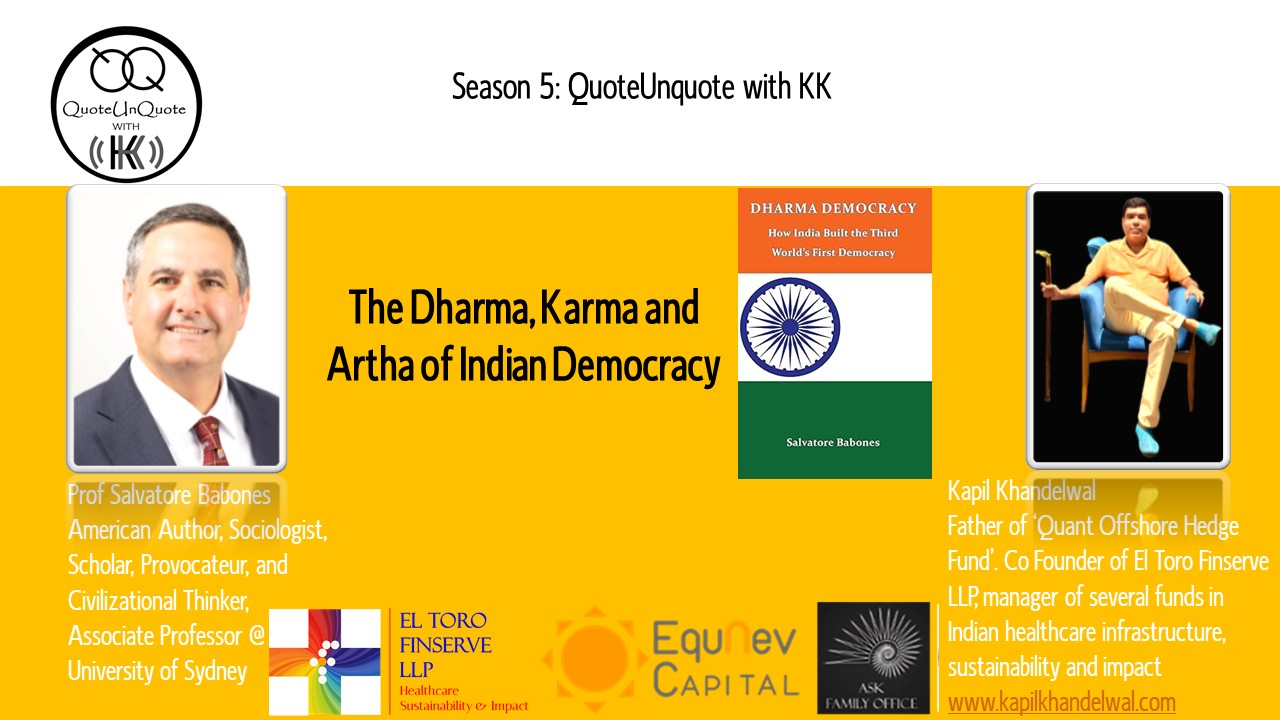
QuoteUnQuote with KK and Prof Salvatore Babones on The Dharma, Karma and Artha of Indian Democracy. India’s democratic ethos is deeply intertwined with dharma and karma. The wheel in the center of the Indian flag symbolizes this moral cycle—reminding both citizens and leaders of their duties and consequences. Artha is the outcome of the democratic system.
India has its own version of literature, books and writings on democracy and how to rule Bharat right through the Vedas, Ramayana, Mahabharat, Chanakiya Niti, etc. But if we were to link these to the neo classical view of Prof Babones, we are going to pull all the issues using the podcast on happiness with Dr Devdutt Patnaik on Dharma, Karma and Artha and map it the concept of Democracy. We will leave the Moksha of the political, the governance, the bureaucratic and the legal constitutional honchos class as a topic for another time for a podcast. This Podcast fully discuss Prof Babones book,
but focus on what’s next and link it to his book and his penchant for Challenging Western academic orthodoxy; Defending empirical rigor over ideological bias; Advocating for culturally grounded models of democracy—especially in non-Western contexts like India.
Book Link
Also Listen
Transcript
[00:00:00] Kapil Khandelwal KK Hello listeners and welcome back to Quote and Quote with KK.
[00:00:03] Kapil Khandelwal KK Today is the teachers day and we are bringing back one of a fabulous teacher not from India but out of India.
[00:00:11] Kapil Khandelwal KK He is not a Modi bhakt, although in India in context it is so binary.
[00:00:15] Kapil Khandelwal KK Either you are a Modi bhakt or you’re not a Modi bhakt.
[00:00:18] Kapil Khandelwal KK And he has also had a one on one meeting requested by our Prime Minister Modi when he visited Australia.
[00:00:25] Kapil Khandelwal KK I’m not sure whether he has turned into a Modi bhakt or not but.
[00:00:30] Kapil Khandelwal KK We have invited him back.
[00:00:32] Kapil Khandelwal KK He was a speaker on our season 4 Professor Salvatore Babones.
[00:00:37] Kapil Khandelwal KK He is now wearing a Indian topi hat.
[00:00:40] Kapil Khandelwal KK Oh, you’re in a Modi jacket now?
[00:00:43] Salvatore Babones I call this a I think of this as a Nehru jacket.
[00:00:46] Salvatore Babones Thank you.
[00:00:47] Salvatore Babones All right, Nehru Modi, whatever everyone.
[00:00:51] Salvatore Babones You know, it’s funny is I have the hat too, and I actually like the simple white hats, but if you wear one, people think you’re making a political statement and I think they’re actually very comfortable.
[00:01:00] Salvatore Babones wear the you know the Gandhi style but not only Gandhi I mean every Indian man wore.
[00:01:03] Kapil Khandelwal KK Yeah my grandfather wore and in some of our religious ceremonies we wear it or we wear a turban.
[00:01:09] Salvatore Babones Side out I find it very comfortable I really like the simple cotton white hat I have one yeah and I would wear it if except people think you’re strange you know?
[00:01:19] Kapil Khandelwal KK If you do I’m going to gift you one when you are in it as I was joking just with him.
[00:01:24] Salvatore Babones King go get the hat if you want.
[00:01:27] Kapil Khandelwal KK Not necessary.
[00:01:30] Kapil Khandelwal KK And over the last few months he has been working tenuously in writing a book on Indian democracy called The Dharma Democracy How India Built the 3rd World First Democracy.
[00:01:42] Kapil Khandelwal KK There it is.
[00:01:42] Kapil Khandelwal KK I am still not laid hands on it, but he was kind enough to send me the manuscript which I read not once but twice.
[00:01:50] Kapil Khandelwal KK And let me just talk a little bit about his book.
[00:01:52] Kapil Khandelwal KK His book is so well researched and to prove his point of view and hypothesis.
[00:01:57] Kapil Khandelwal KK You see, 21% of his book consists of endnotes and index.
[00:02:02] Kapil Khandelwal KK I have not seen such well researched content on Indian politics.
[00:02:05] Kapil Khandelwal KK Let me also tell you that Indian sociopolitic literature and book are heavily biased depending on what political thought or leanings the writer has.
[00:02:17] Kapil Khandelwal KK And hence Doctor Babonis or Professor Babonis, sorry, I’ll call him prof for short, actually dug deep into the original source of manuscripts and writing.
[00:02:27] Kapil Khandelwal KK Due to such bias, and that’s why it’s such a heavy endnote that he has created.
[00:02:32] Kapil Khandelwal KK And I would say kudos to him on his new hat that he’s wearing and his work on Indian democracy.
[00:02:38] Kapil Khandelwal KK On our podcast today, like every book podcast that we do, we would like you to listen to his previous podcast with us as well as buy his book when it is launched in India.
[00:02:50] Kapil Khandelwal KK But we will delve deep on the topic, and the topic today is the Dharma, Karma and Artha of.
[00:02:57] Kapil Khandelwal KK Indian democracy will take his point of view as India’s democracy and democratic ethos is so intertwined with dharma and karma and you see our Indian flag itself the wheel in the center of the Indian flag symbolizes the moral cycle reminding both the citizens and leaders of their duty and consequence and obviously artha is the outcome artha also means meaning so artha is also the outcome of the democratic
[00:03:27] Kapil Khandelwal KK Process and system of India.
[00:03:29] Kapil Khandelwal KK India has his own literature and book and writing right through you know, Aur Vedic times and mythological books like Ramayana, Mahabharata, Janakya and in the neoclassical times.
[00:03:41] Kapil Khandelwal KK But I guess the type of research that Prof has done is going to bring out the neoclassical and alternative view.
[00:03:50] Kapil Khandelwal KK Unfortunately, like any Bollywood movie, there’s not an happy ending.
[00:03:54] Kapil Khandelwal KK He’s not killed a villain and there’s not a.
[00:03:57] Kapil Khandelwal KK hero and he leaves that on the judgment of the readers.
[00:04:00] Kapil Khandelwal KK So the 4th part of what we will talk or we it can become a separate podcast will be the moksha and I think we’ll do delve that and perhaps that could probably be his sequel to this book some other type.
[00:04:15] Kapil Khandelwal KK But Happy Teacher’s Day from India and all our listeners.
[00:04:19] Kapil Khandelwal KK Professor, you’ve been a great teacher.
[00:04:21] Kapil Khandelwal KK I’ve learned a lot from your book.
[00:04:23] Salvatore Babones I’ve learned a lot from many people.
[00:04:25] Salvatore Babones So thank you to everybody.
[00:04:26] Kapil Khandelwal KK Lovely.
[00:04:27] Kapil Khandelwal KK Lets start on the Dharma because the title of your book is also about Dharma and it has many nuances and meanings as a word it also means religion which you have talked about, duty, righteousness, and the ethical order that sustains our society.
[00:04:44] Kapil Khandelwal KK It is also according to you in your book, the moral compass of democracy in India as welland you have actually taken it straight to the Western liberalism and right.
[00:04:57] Kapil Khandelwal KK based approach, rightist approach.
[00:04:58] Kapil Khandelwal KK And now with all this vocism, we were vocism, you are trying to bring in a new meaning.
[00:05:04] Kapil Khandelwal KK Incidentally, I asked one of the Gen Zs also to have a quick look at the book and they’ve also had a lot of questions.
[00:05:10] Kapil Khandelwal KK So the new generation who has not seen our previous fathers, who our fathers, grandfathers, who fought through the freedom struggle have no clue.
[00:05:19] Kapil Khandelwal KK And they have got some very, very beautiful questions which I may probably also want to bring in today into our podcast.
[00:05:27] Salvatore Babones Forward to it.
[00:05:27] Kapil Khandelwal KK Now I want to ask you, India’s democracy is so rooted in dharma rather than the liberalism and the wokeist ideologies that are going around the world today.
[00:05:39] Kapil Khandelwal KK How does dharma or dharmic foundation shape political legitimacy, the leadership ethic and a future for an Indian democracy?
[00:05:49] Kapil Khandelwal KK It’s a very big and important question, but I think that will shape a lot of our conversation today.
[00:05:54] Salvatore Babones The title Dharma democracy was meant to
[00:05:57] Salvatore Babones to communicate two things.
[00:05:58] Salvatore Babones It was meant to communicate in a simple, secular sense that India is a democracy of duty and that in the developing world, if we want to spread democracy in the developing world, we really need to start talking more about a rhetoric of duties than about a rhetoric of rights.
[00:06:14] Salvatore Babones Of course, rights are important and human rights are guaranteed in the Indian Constitution, and no one doubts that Indians have rights, but but rights without duties are sterile.
[00:06:23] Salvatore Babones If we don don’t all all have have a sense of duty to our nation then
[00:06:27] Salvatore Babones the nation simply can’t stay together.
[00:06:29] Salvatore Babones Before you can have a nation, people have to have a feeling that they have a duty to each other.
[00:06:35] Salvatore Babones And that sense of duty underlies the Hindu nation in India and ultimately underlies Indian democracy.
[00:06:42] Salvatore Babones But I also use Dharma in the sense that it’s a specifically Hindu form of duty.
[00:06:47] Salvatore Babones That is the meaning of Dharma is in in inextricably tied to Hindu faith and through Hindu faith faith to Sikh, Jain, Buddhist and and other related faith.
[00:06:56] Salvatore Babones And that is both
[00:06:57] Salvatore Babones the strength of Indian democracy, that it’s Hindu civil society in India that has been the basis for India’s democracy, but also it sets up the fundamental challenge of Indian democracy, which is the role of fundamentally the role of Muslims, also of Christians and atheists and Parsis, but fundamentally the role of Muslims in Indian democracy.
[00:07:19] Salvatore Babones Muslim Indians have been not part have not been part of the democratic mainstream in India.
[00:07:26] Salvatore Babones And while there are many
[00:07:27] Salvatore Babones There are many reasons for that.
[00:07:27] Salvatore Babones In the book, I go through the extensively the legacy of partition in India that led to Muslims being, Muslim Indians being excluded from the Indian national mainstream.
[00:07:38] Salvatore Babones There are lots of good reasons for that.
[00:07:40] Salvatore Babones It’s not anybody’s fault.
[00:07:42] Salvatore Babones I don’t lay blame on anyone for that.
[00:07:44] Salvatore Babones If I blame anybody, I blame Muhammad Ali Jinnah for that fact fact.
[00:07:47] Salvatore Babones But the reality reality is that that India today today is is a country with more more than 200 million Muslim citiz citizens who must be incor incorporated into India’s
[00:07:57] Salvatore Babones national story for Indian democracy to continue to thrive.
[00:08:01] Kapil Khandelwal KK I’m going to come back on the inclusion part a little bit shortly, but I wanted to talk about our kids today.
[00:08:08] Kapil Khandelwal KK When I was in school, we had social science as a subject till class 7 and that got split into history, geography and civics.
[00:08:17] Kapil Khandelwal KK Civics was a 20 mark out of 100 subject and all we had to do was basically mug it and spit it and get 2120.
[00:08:28] Kapil Khandelwal KK And it talked about democracy, roles of a citizen, role of the executive law of every aspect of the Indian Constitution and so on and so forth.
[00:08:38] Kapil Khandelwal KK And the history talked a little bit about, you know, the genesis of our freedom struggle, but a lot of it was and is still, I know we are rewriting our textbooks about the different dynasties and 8 chapters or across only on the Muslim and the Mughal dynasty leading up to the British invasion.
[00:08:57] Kapil Khandelwal KK And the transfer of power from the Mughals, because?
[00:09:00] Salvatore Babones Which is the colonial view of Indian history that the British are the successors to the Mughals and thus modern India as a successor to the British ultimately traces its history back to Mughals.
[00:09:11] Salvatore Babones Now, of course, that’s a manufactured history.
[00:09:13] Salvatore Babones That’s why India has a history well beyond the Mughals, not just in time, but in geography, and modern India is choosing other historical antecedents.
[00:09:21] Salvatore Babones So Shivaji has become a major inspiration for many Indians today.
[00:09:27] Salvatore Babones As an alternative to Mughal emperors as a source of Indian history.
[00:09:31] Salvatore Babones Of course, Tamil Nadu also feeds into Indian history.
[00:09:34] Salvatore Babones The Northeast feeds into Indian history.
[00:09:36] Salvatore Babones These are all available histories that India can choose from.
[00:09:39] Salvatore Babones That colonial narrative is not false, and I really want to stress that to people.
[00:09:44] Salvatore Babones I’ve done a lot of work on the construction of history in this book, and I never say that the narrative is false.
[00:09:50] Salvatore Babones I only want to emphasize it’s one among many true narratives.
[00:09:53] Salvatore Babones It’s not the history of India, it’s a history.
[00:09:57] Salvatore Babones history of India and of course India today is facing a reckoning with those with that history and is realizing many Indians are realizing that they have many other to them often much more inspiring history than to think of India as the successor state to the Mughal Empire.
[00:10:11] Kapil Khandelwal KK And that’s what we obviously the new generation is also probably understood this but one thing that I realized my son before he in his class 11 and did a summer with a summer training with a foundation to actually make make
[00:10:27] Kapil Khandelwal KK Content for school kids in the municipal schools in Bangalore and Karnataka and then roll it across the country.
[00:10:33] Kapil Khandelwal KK What it means to be a citizen of India.
[00:10:36] Kapil Khandelwal KK It is not about rattling the civics 20 mark paper and just writing it and forgetting it, but practically talk about it.
[00:10:44] Kapil Khandelwal KK And I guess our younger generation, those who have just browsed through your book as well, were wowed because their understanding or their understanding of the freedom movement of India and what pains.
[00:10:57] Kapil Khandelwal KK People of India have taken what they assume as given is lacking in their attitudes towards the government and the democracy.
[00:11:05] Kapil Khandelwal KK It all means voting once in 5 years and then it is done and then keep bashing the politicians or whatever and do it on social media.
[00:11:14] Kapil Khandelwal KK That level of corruption needs to be perhaps we have to step back into reality.
[00:11:20] Kapil Khandelwal KK It is not about you know, reels and it is not about Insta and it is not about doing a photo op on an independent.
[00:11:27] Kapil Khandelwal KK Day and then just putting it on social media.
[00:11:29] Kapil Khandelwal KK It has a much more deeper meaning.
[00:11:32] Kapil Khandelwal KK How do we propagate this through the message of your book and other content to the younger generation?
[00:11:38] Kapil Khandelwal KK They have got a lot of questions on your book.
[00:11:40] Kapil Khandelwal KK Let me tell you.
[00:11:40] Salvatore Babones Well, look, I hope they will have.
[00:11:42] Kapil Khandelwal KK A lot of appreciation because in my office, I’ve just rotated the book for a quick read and a glance and they’ve come back with a lot of questions which they thought they didn’t even know.
[00:11:52] Salvatore Babones Well, thank you and I hope they will.
[00:11:55] Salvatore Babones have a lot of questions because history is always a much broader canvas than what’s taught in schools.
[00:12:01] Salvatore Babones And for decades, what was taught in schools in India was what’s called the composite culture thesis, the idea that India was the product of a Hindu base plus a Mughal superstructure built on that base, which ultimately led to the development of modern India.
[00:12:17] Salvatore Babones And again, the Taj Mahal is there for people who want to look at it.
[00:12:21] Salvatore Babones It’s not false.
[00:12:22] Salvatore Babones But the problem with that narrative is that it caused
[00:12:25] Salvatore Babones much to be swept under the carpet.
[00:12:26] Salvatore Babones It may be emblematic of this.
[00:12:28] Salvatore Babones The most important single figure is Aurangzeb.
[00:12:31] Salvatore Babones Now, Aurangzeb gets talked about endlessly, not because Hindu essentialists are angry about Aurangzeb.
[00:12:39] Salvatore Babones Of course they’re angry about him.
[00:12:40] Salvatore Babones He destroyed temples.
[00:12:41] Salvatore Babones He built the mosque in in Varanasi on top of the Vishwanath temple.
[00:12:48] Salvatore Babones That’sssss……………………………………
[00:12:48] Salvatore Babones Okay,,,,, but the focus on it is not on on on……
[00:12:51] Salvatore Babones because the new Hahaa.
[00:12:55] Salvatore Babones Aurangzeb.
[00:12:55] Salvatore Babones The folks is there because the old establishment had to make Aurangzeb a centerpiece of what was good about Mogul.
[00:13:03] Salvatore Babones And of course, the problem with that is Aurangzeb was terrible, right?
[00:13:07] Salvatore Babones But that composite culture thesis somehow had to say that the Mughals were good.
[00:13:13] Salvatore Babones The Mughals did good things for India.
[00:13:15] Salvatore Babones And of course, they pointed to the music and they pointed to the Taj Mahal and all of that’s fine.
[00:13:19] Salvatore Babones There was a high culture associated with the Mughals, but you can’t make Aurangzeb out to be a good guy.
[00:13:24] Salvatore Babones And
[00:13:25] Salvatore Babones A lot of the problems that have sparked so much anger in India have been because an establishment for 40 or 50 years attempted to rehabilitate or create a false image of Mughal rulers who frankly were never very liberal, who were never very inclusive, who were fantastic fanatically destructive of the religious symbols of the people they’ve ruled over, and all in an attempt to make India seem like a Hindu Muslim.
[00:13:55] Salvatore Babones compact, when in fact, the history of India is one of Hindu-Muslim conflict.
[00:13:59] Salvatore Babones And that doesn’t mean there has to be Hindu-Muslim conflict today.
[00:14:02] Salvatore Babones But when you’re dishonest about the past, you have trouble understanding the present and reconciling the present with reality.
[00:14:09] Salvatore Babones Look, the fact is that Muslims were invaders in India.
[00:14:11] Salvatore Babones They destroyed thousands of temples.
[00:14:13] Salvatore Babones They forcibly converted millions of people.
[00:14:16] Salvatore Babones You know, they were disastrouss for the Indian economy, for Indian society.
[00:14:20] Salvatore Babones That said there are 200 million Muslim Indians today who bear no responsibility for
[00:14:25] Salvatore Babones for that.
[00:14:25] Salvatore Babones They didn’t destroy temple.
[00:14:26] Salvatore Babones They didn’t destroy the Indian economy.
[00:14:28] Salvatore Babones They didn’t murder Hindus.
[00:14:29] Salvatore Babones Their grandparents might have, but they didn’t.
[00:14:32] Salvatore Babones And that’s the challenge is for us to be honest about history, to say, you know, Aurangzeb was evil, but my neighbor is good.
[00:14:39] Salvatore Babones And that’s a difficult challenge to reckon with.
[00:14:42] Salvatore Babones We’ve done it in America with very quickly.
[00:14:46] Salvatore Babones I mean, America was at war with Native American tribes and you can watch all the western movies where you know the Indians are battling the cowboys and that was a
[00:14:55] Salvatore Babones real thing.
[00:14:55] Salvatore Babones And you know, there was vicious violence on the frontier.
[00:14:58] Salvatore Babones But as soon as those frontiers wars were over, Native Americans came to be valorized for their martial spirit.
[00:15:04] Salvatore Babones That is, Americans look to what was good about Native Americans, not what they hated about Native Americans.
[00:15:09] Salvatore Babones So that today there’s no hatred of Native Americans.
[00:15:12] Salvatore Babones There’s a feeling of guilt that white America suppressed Native Americans.
[00:15:15] Salvatore Babones There’s a feeling of of honor and respect, but there’s certainly no hatred.
[00:15:19] Salvatore Babones And in India today, what I see is too much hatred.
[00:15:21] Salvatore Babones Now that that hatred I want to emphasize, that hat
[00:15:25] Salvatore Babones not been caused by the Hindu right.
[00:15:28] Salvatore Babones Many people in India on the Hindu right may feel hatred, but the hatred was caused by the false history that they were for generations forced to swallow, even when they knew.
[00:15:38] Salvatore Babones I mean, anyone who goes to Varanasi can see that a mosque is built on top of the old temple.
[00:15:43] Salvatore Babones You don’t have to be an archaeologist to to know.
[00:15:46] Kapil Khandelwal KK It took years to bring that solution.
[00:15:49] Salvatore Babones Yes, to to to do the study and it was and and it that honest that honest engagement with history I think would
[00:15:55] Salvatore Babones go a very long way toward improving intercommunal relations in India.
[00:15:59] Kapil Khandelwal KK We’re going to talk a little bit more about the actions and karmas on our democracy by our leaders a bit shortly.
[00:16:06] Kapil Khandelwal KK But I’m going to just close this loop once again.
[00:16:09] Kapil Khandelwal KK There is also a very defensive view about how other religions have invaded and left them constrained in a geographical reason.
[00:16:18] Kapil Khandelwal KK Let’s take the instance of Jerusalem.
[00:16:20] Kapil Khandelwal KK You know again today Holy Israel is a Jewish state which is fighting
[00:16:25] Kapil Khandelwal KK for its survival, right?
[00:16:27] Kapil Khandelwal KK And history says that the Bharatiya or Hinduism existed far before the Christianity and the other religions came in.
[00:16:36] Kapil Khandelwal KK Even the Aryan and the Dravidian texts.
[00:16:39] Salvatore Babones At least as old as Judaism.
[00:16:41] Kapil Khandelwal KK And all the offshoots, the Buddhism and all existed right from Middle East Mesopotamia or whatever that place.
[00:16:47] Kapil Khandelwal KK Sorry, I’m sorry, the the Persian area.
[00:16:50] Kapil Khandelwal KK Yes, yeah, right from there are some remnants of Hindu and other
[00:16:55] Kapil Khandelwal KK Things to Buddhism, which was parts of China and some ancient Hindus architecture, Southeast Asia, all.
[00:17:03] Salvatore Babones Of as well was Hindu now.
[00:17:06] Kapil Khandelwal KK Now with the history, what we feels or the Hindus in India feel that if this subdivision and this whole thing will happen, we’ll probably end up like a space between Himalaya and the Bay of Bengal or the Indian Ocean.
[00:17:20] Kapil Khandelwal KK And that’s where how many 800 odd million Hindus will have to survive.
[00:17:25] Kapil Khandelwal KK When coexist and we cannot be dominated because the 2 nation theory that was propounded is now so deep and the hatred around it, what you have seen with this field marshal of Pakistan talking about it and then leading into that sort of terrorism that is also emanating from cross border points of view.
[00:17:46] Kapil Khandelwal KK How do we now bring inclusion over here with so much of things that are happening and so many narratives?
[00:17:53] Kapil Khandelwal KK We will talk about the politics of.
[00:17:55] Kapil Khandelwal KK you know, vote banks of religion and all a little bit later.
[00:17:58] Kapil Khandelwal KK But this is purely history till date, what’s happened.
[00:18:01] Kapil Khandelwal KK And that’s basically moving the society away from inclusion, more into, I would say, diversion.
[00:18:08] Kapil Khandelwal KK What’s the solution?
[00:18:09] Kapil Khandelwal KK How do we take the history and then reconcile that to a better future now?
[00:18:14] Salvatore Babones The first step is to be honest about history.
[00:18:16] Salvatore Babones The Two Nation theory was was Iqbal and Jinnah’s theory.
[00:18:20] Salvatore Babones It was never true true.
[00:18:23] Salvatore Babones It resulted in the creation of a
[00:18:25] Salvatore Babones state Pakistan that could not stay together.
[00:18:28] Salvatore Babones Pakistan and Bangladesh never were a single nation based on religion.
[00:18:32] Salvatore Babones They claimed to be, but it never was a functional nation.
[00:18:35] Salvatore Babones And dare say, I dare say even today, Pakistan, the former West Pakistan, is not not a single nation based on religion.
[00:18:42] Salvatore Babones That is in Pakistan, there are multiple national communities being dominated by by Punjabi Pakistanis who dominate the other national communities in Pakistan.
[00:18:50] Salvatore Babones And if these other national communities were allowed to leave Pakistan, they would.
[00:18:55] Salvatore Babones Contrast that with India, where there is a single national identity, where Muslim Indians report 95% and greater, up to 99% being proud to be Indian, where there is no Muslim out migration from India.
[00:19:09] Salvatore Babones Anyone who ever has heard the jibe go back to Pakistan has to realize that no Indian Muslim are going back to Pakistan quote unquote or moving to Bangladesh.
[00:19:19] Salvatore Babones The problem in India is that so many Muslims want to live in India, so something I explained to Western audiences all the time.
[00:19:25] Salvatore Babones time is that it’s a serious political issue in India.
[00:19:27] Salvatore Babones Now you’re aware of this, but Westerners are not, that so many Bangladeshi, Muslim Bangladeshis want to live in India and become Indian.
[00:19:36] Salvatore Babones So the idea that there are- In.
[00:19:37] Kapil Khandelwal KK Fact, our Prime Minister also announced a demographic thing on the independence day…..
[00:19:43] Salvatore Babones But even if we go back to the history of partition, when India was partitioned under the rhetoric that Muslims were a separate nation and could not live in Hindu majority India,
[00:19:55] Salvatore Babones Nearly all Muslim Indians chose to stay in India.
[00:19:58] Salvatore Babones The people who left were Punjabis.
[00:20:00] Salvatore Babones There was a exodus of Punjabi, Muslim Punjabis who left for Pakistan.
[00:20:04] Salvatore Babones It was very close.
[00:20:05] Salvatore Babones Punjabis were going to be the dominant group in Pakistan.
[00:20:07] Salvatore Babones It’s understandable that many Muslim Punjabis chose Pakistan.
[00:20:11] Salvatore Babones But the other group that chose to go to Pakistan were the intelligentsia.
[00:20:15] Salvatore Babones Muslim intellectuals from all over India left to go to Pakistan.
[00:20:18] Salvatore Babones We have data and I have data in the book about the number of Indian civil British Indian civil service officers who opted for Pakistan.
[00:20:25] Salvatore Babones of the, I think there were 103 Muslim Indian civil service officers, every single one for whom we know their destination went to Pak.
[00:20:33] Salvatore Babones That is substantially all of them either went to Pakistan or retired at the end of the British rule.
[00:20:39] Salvatore Babones The same thing for the upper echelons of the Indian military.
[00:20:42] Salvatore Babones Same thing thing for the Indian political service.
[00:20:44] Salvatore Babones You know, the Muslim intelligentsia of India, university professors, lawyers, they went to make their career in Pakistan.
[00:20:51] Salvatore Babones But Or ordinary Muslimimimimimimininininininininin in in in
[00:20:55] Salvatore Babones Right.
[00:20:55] Salvatore Babones So the 2 nation theory was never correct.
[00:20:57] Salvatore Babones It never resulted in a mass exodus from India, even in West Bengal, where it would have been easy for West Bengali Muslims to go to East Bengal.
[00:21:05] Salvatore Babones We saw that in Bangladesh, Hindus have been driven out of Bangladesh by repression in Bangladesh consistently.
[00:21:11] Salvatore Babones For the last 70 years, there’s been continuous repression of Hindus in Bangladesh, which has resulted in out migration.
[00:21:17] Salvatore Babones No Muslim out migration from West Bengal to East Bengal to Bangladesh.
[00:21:21] Salvatore Babones It just hasn’t happened.
[00:21:22] Salvatore Babones So the 2 nation theory was simply wrong from the beginning.
[00:21:25] Salvatore Babones To throw it back in the face of Muslim Indians is to sow discord where there doesn’t have to be any discord.
[00:21:32] Salvatore Babones It’s saying that your political leaders 75 years ago betrayed you.
[00:21:36] Salvatore Babones Therefore, you who weren’t even born then somehow are responsible.
[00:21:40] Salvatore Babones You know, that just doesn’t make any sense.
[00:21:42] Salvatore Babones So there has to be an honest reckoning with history.
[00:21:44] Salvatore Babones Now, that said, that honest reckoning has to occur not only among Hindu Indians, but also among Muslim.
[00:21:50] Salvatore Babones Muslim Indians have to recognize that they’ve always had full civil rights in India, that their.
[00:21:55] Salvatore Babones has been a very accommodative stance towards Islam in India, despite the fact, despite the fact that Muslim intellectuals claimed that they formed a separate community.
[00:22:05] Salvatore Babones Hindu and Sikh and other Indians, Christian Indians have accepted that Muslim Indians, no, they’re actually part of our community.
[00:22:12] Salvatore Babones So Muslim Indians have to come come with their to their own reckoning with history to realize that they’re part of this community too, and that they have to make adjustments to being part of the community.
[00:22:23] Salvatore Babones So just as H Hindu Indians.
[00:22:25] Salvatore Babones have to make some accommodation to the fact that and I hear some Hindu ideologues saying, you know, India deserves to have Pakistan and Bangladesh back.
[00:22:33] Salvatore Babones I say, oh, and you want the 400 million Muslims.
[00:22:36] Salvatore Babones They say, no, no, no, Kashmir back.
[00:22:38] Salvatore Babones We just want the country, not the Muslims.
[00:22:40] Salvatore Babones It’s completely impossible.
[00:22:41] Salvatore Babones In the same way, Muslim Indian leaders leaders have to start realizing, you know, we we have to live in this country together for the next 10,000 years.
[00:22:48] Salvatore Babones What What about that mosque in Varanasasi, is that mosque really necessary, or could we sell that mosque, build a sell the land
[00:22:55] Salvatore Babones build a beautiful new mosque 200 meters away and let Hindus have what they consider one of the holiest sites in the world.
[00:23:01] Salvatore Babones Let Hindus be able to celebrate their holy site.
[00:23:04] Salvatore Babones Muslim Indians have to start treating Hindu Indians as neighbors and friends, not not as occupiers or or majoritarians.
[00:23:12] Salvatore Babones And That’s my advice to both sides in India, and that’ssss is a sociologist.
[00:23:15] Salvatore Babones I I I I I I I I I I I’m not a Swami.
[00:23:19] Salvatore Babones I I am a sociologistist telling Indians on on both sides sides of these divides that either either you have to be behave in a more brother
[00:23:25] Salvatore Babones way, or you’ll experience a dysfunctional democracy going forward and you potential divisions in your country going forward.
[00:23:31] Salvatore Babones You Who wants to live in Northern Ireland during the troubles?
[00:23:34] Salvatore Babones Nobody, nobody wants that kind of violence.
[00:23:36] Salvatore Babones Hopefully Muslim and Hindu Indians can come come to the same conclusion.
[00:23:40] Kapil Khandelwal KK You have been critiquing the VDM democratic rating.
[00:23:44] Kapil Khandelwal KK I I’m not going to touch on that.
[00:23:45] Kapil Khandelwal KK Let’s that is for the readers to read.
[00:23:47] Kapil Khandelwal KK But But just picking up from the Hindu…..
[00:23:49] Salvatore Babones Very very very quickly.
[00:23:50] Salvatore Babones I’m just going to give like like like the 30 seconds about VDM, the statistics behind it.
[00:23:55] Salvatore Babones are terrible.
[00:23:56] Salvatore Babones It’s not just a few visible problems.
[00:23:59] Salvatore Babones You know, oh, England has a king, so how can it be a democracy?
[00:24:02] Salvatore Babones Those kind of cheap jibes at VDEM, they’re all true.
[00:24:05] Salvatore Babones The problems go really deep statistically.
[00:24:08] Salvatore Babones And I think the problem is that nobody else has spent the time to unpack the statistical methodology behind VDEM to realize that it it’s just terrible.
[00:24:16] Salvatore Babones I’ll just leave it at that.
[00:24:18] Kapil Khandelwal KK Yeah.
[00:24:18] Salvatore Babones And the book provides, the book provides the document.
[00:24:20] Kapil Khandelwal KK I want the readers to read it.
[00:24:22] Kapil Khandelwal KK That’s why I’m not going to discuss that.
[00:24:25] Kapil Khandelwal KK But.
[00:24:25] Kapil Khandelwal KK Just lets just be on that Indian, Muslim, and Hindu divide and okay, we accept it.
[00:24:30] Kapil Khandelwal KK We are the worst country on democracy as per we them.
[00:24:33] Kapil Khandelwal KK Lets just wait for some more time.
[00:24:35] Kapil Khandelwal KK Lets go to the European nations who have been ranked amongst the top.
[00:24:40] Kapil Khandelwal KK What’s happening?
[00:24:41] Kapil Khandelwal KK UK Muslims have taken over and won Sharia law in some of their municipalities and cities.
[00:24:49] Salvatore Babones Look that lets be fair, that is an.
[00:24:51] Kapil Khandelwal KK Exaggeration, but that is something that we keep listening European.
[00:24:55] Kapil Khandelwal KK right wing have seen a lot of rioting because of whatever Islamists want in there.
[00:25:01] Kapil Khandelwal KK They were people who came in, but now they want much more.
[00:25:05] Kapil Khandelwal KK How would democracy sustain and how would we them then justify these nations on their democratic rankings in future the way they have hit us?
[00:25:15] Kapil Khandelwal KK I want to bring that issue of the future.
[00:25:18] Kapil Khandelwal KK How would we them then justify their rankings as top democracies in their ranking?
[00:25:24] Salvatore Babones A very good case.
[00:25:25] Salvatore Babones can be made that the status of Muslims as a minority population is superior in India to the status of Muslims as a minority population in Britain, France, or Germany.
[00:25:35] Salvatore Babones A good case can be made or Sweden.
[00:25:37] Salvatore Babones Sweden has a serious, I mean, so we talk, I’ll just give Sweden as an example because because Sweden is the country where the VDEM rankings come from.
[00:25:45] Salvatore Babones VDEM is varieties of democracy Institute.
[00:25:47] Salvatore Babones It’s based in Sweden, but it’s funded by the European Union, broadly speaking.
[00:25:50] Salvatore Babones Swedenen has extreme residential segregation where where nativeativeborn
[00:25:55] Salvatore Babones Swedes and Muslim immigrant Swedes simply do not live together in not in the same buildings at all.
[00:26:01] Salvatore Babones They have Muslim enclaves in Sweden that are highly violent, dysfunctional, don’t speak the national language.
[00:26:08] Salvatore Babones Education rates are abysmal.
[00:26:10] Salvatore Babones The statistical difference between Muslim and Swedish native populations in Sweden is dramatically wider than any difference in India.
[00:26:18] Salvatore Babones So this challenge of integrating.
[00:26:21] Kapil Khandelwal KK Why do you blame or provide that ranking or
[00:26:25] Kapil Khandelwal KK as food for order in our political class to subdivide India.
[00:26:30] Kapil Khandelwal KK That’s the moot question.
[00:26:31] Kapil Khandelwal KK I’m coming back again and again.
[00:26:34] Kapil Khandelwal KK You see, you get your karma back.
[00:26:36] Kapil Khandelwal KK I was going to talk on karma about what you do is what you get back a bit later.
[00:26:42] Kapil Khandelwal KK But now that this whole topic of Vdem has come up and you have talked extensively in your book.
[00:26:47] Kapil Khandelwal KK I’m sure 10 years, 20 years down the line when all this happens and the US religious US department religious report also will
[00:26:55] Kapil Khandelwal KK will say they will be ranked down and what will happen?
[00:26:57] Kapil Khandelwal KK India?
[00:26:58] Kapil Khandelwal KK We are fine.
[00:26:59] Kapil Khandelwal KK We are biased.
[00:26:59] Kapil Khandelwal KK Fine.
[00:27:00] Salvatore Babones The US Commission on what happens globally.
[00:27:02] Kapil Khandelwal KK Is this not going to be a mainstream issue for the world to even look and reconsider beyond India or Indian borders or it’s Israel and India?
[00:27:12] Kapil Khandelwal KK I just want to ask that in the future.
[00:27:14] Kapil Khandelwal KK What’s going to happen?
[00:27:15] Salvatore Babones All I can do as a social scientist is assemble the data and you know in the book Donon of Democracy, I’ve pulled together as much of the data as I thought I could reasonably put in a.
[00:27:25] Salvatore Babones book for a popular audience.
[00:27:26] Salvatore Babones We could always go deeper and we could always go into deeper in the statistical methodology.
[00:27:29] Salvatore Babones But for a popular audience, the book presents the key statistical evidence that the case against India is simply manufactured.
[00:27:38] Salvatore Babones Now, and not just statistical evidence, the historical and documentary evidence as well.
[00:27:42] Salvatore Babones So take the U.S.
[00:27:43] Salvatore Babones Commission on International Religious Freedom.
[00:27:45] Salvatore Babones They consistently rate India extremely low for international religious freedom.
[00:27:50] Salvatore Babones The Pew Research Center using using USCIRF data in its religious freedom index
[00:27:55] Salvatore Babones rates India very low for freedom of religion.
[00:27:57] Salvatore Babones If you start again, going to the unpacking the actual allegations made, they’re almost entirely complaints by Christian missionary group that they can’t engage in missionary activity in India.
[00:28:09] Salvatore Babones Of course, Christian Indians can engage in Christian missionary activity in India.
[00:28:12] Salvatore Babones That’s entirely legal.
[00:28:13] Salvatore Babones Foreign missionaries camp.
[00:28:15] Salvatore Babones And the entire entire attack on India seems seems to have been orchestrated by missionary connected groups, western, and I want to emphasize, not Indian Christians but
[00:28:25] Salvatore Babones Correct.
[00:28:25] Salvatore Babones Western Christian groups wanting to use the situation of Christians in India to push for India to have a open door to Western missionaries.
[00:28:35] Salvatore Babones Now, in the last few years, actually since the Biden administration, under the Biden administration, Muslim Americans, Muslim American groups caught that narrative from the Christians, that is they realized Christians can do this, we can do this.
[00:28:46] Salvatore Babones And donors to to Joe Biden seem to have gotten one of their people appointed the U.S.
[00:28:53] Salvatore Babones Ambassador at large for international
[00:28:55] Salvatore Babones national religious freedom, someone who’s very close to the Indian American Muslim, I’m sorry, the Indian American Muslim Council, if I have the name right, and all of a sudden allegations from Muslim groups start appearing against India.
[00:29:06] Salvatore Babones Now, Hindu groups have not ever accessed the U.S.
[00:29:10] Salvatore Babones infrastructure around reporting for international religious freedom.
[00:29:12] Salvatore Babones These have been politicized for 30 years by Christians and just in 2000 started to be picked up by Muslim American groups.
[00:29:20] Salvatore Babones But All of this is weaponized, a platform, you know, trying to seize control
[00:29:25] Salvatore Babones platform to issue report after.
[00:29:27] Salvatore Babones report that manufacture a false consensus about India.
[00:29:31] Salvatore Babones And if Indians are wondering how that’s done, just look at Israel.
[00:29:33] Salvatore Babones So if you look at Human Rights SWAT, if you look at Amnesty International, if you look at dozens of international human rights organization, you can find their anti Israel stance.
[00:29:43] Salvatore Babones Now, whatever you think about Israel and Palestine, people have strong feelings, they have views on both sides.
[00:29:47] Salvatore Babones The rhetoric of these organizations is over overwhelmingly anti Israel without any with very little concern for the other side of the story.
[00:29:56] Salvatore Babones Now, why is that if you start looking at
[00:29:57] Salvatore Babones at the organizations, look at the names of the people in the organizations, you’ll see lots and lots of, I don’t want to be quoted out of context here, but you see lots and lots of Muslim women staffing the organization.
[00:30:08] Salvatore Babones Now, that gives the impression that Muslim organizations like like the Muslim Brotherhood have worked hard to get their people people.
[00:30:15] Salvatore Babones And it’s almost always women, because in the western mindset, women are sympathetic.
[00:30:26] Salvatore Babones There’s,,,,,,,,,,,,,,,,,,,,,,,,,,,,,,.
[00:30:27] Salvatore Babones Islamophobia in the West.
[00:30:29] Salvatore Babones It’s a real thing.
[00:30:29] Salvatore Babones Don’t tell me there’s no Islamophobia.
[00:30:31] Salvatore Babones There’s real Islamophobia in the West, but mostly focus on Muslim men who get characterized as being violent, who get characterized as terrorists.
[00:30:38] Salvatore Babones So you get Muslim women into the organization.
[00:30:40] Salvatore Babones They’re sympathetic figures.
[00:30:41] Salvatore Babones They’re oppressed, after all in Muslim societies, at least this is the mindset.
[00:30:45] Salvatore Babones And so you get report after report after report report condemning Israel and now in recent years those same Muslim women women at international organ organizations are now now writing reports condemning India and there.
[00:30:55] Kapil Khandelwal KK You go go go.
[00:30:57] Kapil Khandelwal KK Israel issue.
[00:30:58] Kapil Khandelwal KK Well, Kashmir was almost the same time in the ’40s.
[00:31:01] Kapil Khandelwal KK Kashmir became Israel issue and India issue and now it is catching up in India.
[00:31:05] Kapil Khandelwal KK So the book happens to be very opportunetic in time to educate a lot of Indians and people abroad.
[00:31:12] Salvatore Babones So in the book, I trace some of these connections just to show kind of how to show how the sausage is made is the expression in English.
[00:31:20] Salvatore Babones I’m vegetarian, but it’s how does sausage is made to show how these how these forces work.
[00:31:26] Salvatore Babones There are no names.
[00:31:27] Salvatore Babones I’m not alleging that any one person is anti semitic or anti Hindu.
[00:31:32] Salvatore Babones That’s not the issue.
[00:31:33] Salvatore Babones The issue is, you just look at it and you say, why are there so many senior Muslim women at a human rights organization?
[00:31:41] Salvatore Babones There’s nothing wrong with it.
[00:31:42] Salvatore Babones Any Muslim woman can decide to become a human rights scholar.
[00:31:45] Salvatore Babones Of course, that’s a good thing for her to do.
[00:31:47] Salvatore Babones But when you see the pattern replicated over and over, the United States ambassador at large for international religious freedom, there’s no reason that person can’t be Muslim.
[00:31:56] Salvatore Babones In the past, it’s been Christian.
[00:31:57] Salvatore Babones It’s been Jews.
[00:31:58] Salvatore Babones There was, I think, one Parsi, if I remember right.
[00:32:02] Salvatore Babones But when I see that the first ambassador for international religious freedom that’s Muslim has been appointed, and then immediately I see accusations made by the Indian American Muslim Council appearing in their reports, I think, oh yeah, I see the connect, you know, this guy put put that.
[00:32:18] Salvatore Babones And those kind of connections are detailed in the book.
[00:32:20] Salvatore Babones Again, I want to emphasize, these are not not Muslim Indians.
[00:32:23] Salvatore Babones These are Muslim Americans, Muslim Islam Islamic Brotherhood figures.
[00:32:27] Salvatore Babones figures very prominently.
[00:32:29] Salvatore Babones Al Jazeera figures very prominently.
[00:32:30] Salvatore Babones Al Jazeera is widely cited in the reports produced by these organizations, very widely cited.
[00:32:36] Salvatore Babones And again, you have to follow the footnotes.
[00:32:38] Salvatore Babones And you said my book, you know, thank you for saying my book was 20% footnotes.
[00:32:41] Salvatore Babones That’s great, but what really matters is is the quality of the footnotes.
[00:32:45] Kapil Khandelwal KK So That’s what I want the readers to understand the biases that are built in.
[00:32:50] Salvatore Babones It’s been incredible.
[00:32:51] Kapil Khandelwal KK I want to conclude this Dharma Park Future of India and Dharma democracyacy.
[00:32:56] Kapil Khandelwal KK Your book has led
[00:32:57] Kapil Khandelwal KK left it very open ended in terms of tolerance but somewhere down the line the younger generation has to probably understand how do we co-mingle without the fears of what is happening in the West and Israel about how the country’s democracy has been invaded to create a sustainable model of dharma democracy in India.
[00:33:20] Kapil Khandelwal KK I want your message beyond the book to our audience and Indians who are listeninging and people people beyond who want to
[00:33:27] Kapil Khandelwal KK Take a lesson or a leaf out of India’s democratic process and perhaps some Pakistanis as well who want to do Gazwa to break India into another Hindu Muslim country further because they want redemption about what they we did to them.
[00:33:42] Kapil Khandelwal KK What would be your key message on this whole Dharma democracy and inclusion, especially India and that model actually replicating to other parts of the world and maybe in the Western hemisphere now that they are also failing and becoming more right wing Doctor.
[00:33:57] Kapil Khandelwal KK cross.
[00:33:58] Salvatore Babones I would say read Vivekananda.
[00:34:00] Salvatore Babones Oh, yeah.
[00:34:00] Salvatore Babones Everyone loves Swami Vivekananda.
[00:34:02] Salvatore Babones He’s always cited.
[00:34:03] Salvatore Babones Nobody has a bad word for Swami Vivekananda.
[00:34:06] Salvatore Babones I’ve never heard a bad word from anybody.
[00:34:08] Salvatore Babones Let’s let’s take him seriously.
[00:34:09] Salvatore Babones Let me contrast to views of Hindu Muslim unity.
[00:34:12] Salvatore Babones Swami Vivekananda and Mahatma Gandhi.
[00:34:15] Salvatore Babones Gandhi’s view was very Christian inspired.
[00:34:17] Salvatore Babones I mean, he’s Hindu.
[00:34:19] Salvatore Babones I’m not saying Gandhi was secretly Christian, nothing like that but he was very educated in a Christian milieu and he took a very Christian view of
[00:34:27] Salvatore Babones of his Hindu faith.
[00:34:28] Salvatore Babones And in Gandhi’s view, it was very, a very Christian viewpoint of if my neighbor slaps me, I’ll turn and let him slap the other cheek.
[00:34:36] Salvatore Babones It’s better for me to suffer than to fight back.
[00:34:39] Salvatore Babones His nonviolence was extreme and he encouraged Hindus to accept Muslim violence on such a horrific scale, especially in the Khilafat movement and you know 19 in the the Mokla rebellion in in the 192020s.
[00:34:53] Salvatore Babones Then again, in in direct action day 1946, 1947,,,,
[00:34:57] Salvatore Babones He encouraged Hindus simply to accept being murdered by their neighbors rather than fight back.
[00:35:03] Salvatore Babones Well, that philosophy is never going to fly.
[00:35:05] Salvatore Babones I mean, not only are people not going to accept it, it’s no basis on which to build true brotherhood.
[00:35:09] Salvatore Babones You don’t create a brother by saying if you murder, if you murder my sister, that’s okay, I’ll still love you.
[00:35:24] Salvatore Babones That That’sssss………..,,,,,,,,,,,,,,,,,,,,,,,,,,,,,,,,,,,,,,,,,………..
[00:35:27] Salvatore Babones But Vivekananda wants you to treat yourself with respect.
[00:35:31] Salvatore Babones Yes, treat your brother with respect, but stand up for yourself.
[00:35:34] Salvatore Babones His writing is full of the exhortation to Hindus to stand up and get to work.
[00:35:38] Salvatore Babones His favorite passage from the Bhagavad Gita was, I’m sorry, I can’t quote the Bhagavad Gita off top of my head, but was the passage about get to work, Arjuna, don’t be lazy, stop sitting around your area, Arjuna, get to work, get back into battle at the beginning.
[00:35:50] Kapil Khandelwal KK That’s the karma part of it.
[00:35:52] Kapil Khandelwal KK We want to discuss.
[00:35:53] Salvatore Babones And there’s a lot of his favorite line from the Bhagavad Gita.
[00:35:57] Salvatore Babones But.
[00:35:57] Salvatore Babones Vivekananda said that brotherhood is based on truly understanding your fellow human being, being able to put yourself to understand that if your brother is angry with you, don’t just meekly accept that anger, but understand where the anger is coming from.
[00:36:11] Salvatore Babones And so I’ll just go back to again to because it’s so emblematic.
[00:36:15] Salvatore Babones I’ll go back to the Vishwanath temple and the Ganavapi mosque.
[00:36:19] Salvatore Babones If Muslim Indians truly understood how important this issue was to their Hindu brethren, they should then say, I understand you
[00:36:27] Salvatore Babones have this mosque, we’ll move our mosque elsewhere.
[00:36:29] Salvatore Babones And if Hindu Indians understood how difficult it was for Muslim Indians to give up a mosque, they could say, we’re going to give you $10 million dollars and an honor.
[00:36:39] Salvatore Babones We’re going to held a festival in your name.
[00:36:41] Salvatore Babones You know, we’re going to to name something important after you because we want to recognise, we know how difficult it is for you to do.
[00:36:48] Salvatore Babones And so we want to recognise that that understand and that’s Vivekananda’s ministry at its root, we talk about his universalism and
[00:36:57] Salvatore Babones is acceptance of all religions.
[00:36:59] Salvatore Babones But the root of it is simply understanding that everybody in the world wants to do good.
[00:37:04] Salvatore Babones But let’s understand how hard it is for them.
[00:37:06] Salvatore Babones So yes, read Vivekananda, take a Vivekanandan approach, not a Gandhian approach.
[00:37:10] Salvatore Babones I’m not advising that Hindu Indians or Muslim Indians just just roll over and let themselves be abused.
[00:37:15] Salvatore Babones Vivekananda would never have said that but that you should understand why someone’s trying to hit you.
[00:37:20] Salvatore Babones Someone’s hitting me.
[00:37:21] Salvatore Babones Let me understand and explain to him, look that’s not what we do to each other.
[00:37:24] Salvatore Babones I know you’re upset.
[00:37:26] Salvatore Babones Let me find out why.
[00:37:27] Salvatore Babones Let’s come to a resolution.
[00:37:28] Salvatore Babones So read Vivekananda and you can solve all the problems of India.
[00:37:32] Salvatore Babones I’m confident.
[00:37:32] Kapil Khandelwal KK My alternative view coming from one of the readers and a young person was you want dharma democracy in India, let’s kill all the religions and become a vocalist.
[00:37:42] Kapil Khandelwal KK The other extreme, would that be a prescription for India?
[00:37:45] Salvatore Babones It wouldn’t work.
[00:37:46] Salvatore Babones Look, the people are what they are.
[00:37:48] Salvatore Babones And we have to understand that India is a highly traditional, highly religious society, not only among Hindus, but also among Muslims, also among Sikhs, also among.
[00:37:57] Salvatore Babones Parsis, India is one of the most religious societies in the world and one of the most traditional societies in the world.
[00:38:03] Salvatore Babones So simply telling people forget your religion and let’s all accept a rights, you know, human rights based concept of society.
[00:38:10] Salvatore Babones It’s simply not a path forward for India.
[00:38:12] Salvatore Babones In fact, I think it’s only a path forward once any question of nationhood, once once any question of brotherhood has long since been established.
[00:38:21] Salvatore Babones The United States, for example, could never have the kind of rhetoric of rights that works today in America.
[00:38:27] Salvatore Babones had it not been for the reconciliation after the Civil War, Americans had to accept that they’re all one country before then they can build on that a philosophy, a rights based philosophy of the country.
[00:38:38] Kapil Khandelwal KK For the foundational level, the religion will be there.
[00:38:41] Kapil Khandelwal KK Then we will have to have another layer of social fabric and a governance model to take the country in the future as part of Dharma democracy, correct?
[00:38:50] Salvatore Babones Yes.
[00:38:51] Salvatore Babones Look, unless you have a nation, you can’t have a democracy.
[00:38:53] Salvatore Babones Democracy requires that we all accept accept, I mean and even in America
[00:38:57] Salvatore Babones Today, people are hearing the news from America.
[00:38:59] Salvatore Babones Oh, there’s going to be a civil war in America.
[00:39:01] Salvatore Babones Americans say that’s not true.
[00:39:02] Salvatore Babones The tantrums of Trump.
[00:39:04] Salvatore Babones Emergencies everywhere.
[00:39:06] Salvatore Babones People may argue and yell and scream, but no one is seceding from the United States because nobody even questions that they’re all part of the same country.
[00:39:15] Salvatore Babones If you look at rallies in America, whether they’re right wing rallies or left wing rallies, they’re all flying the American flag.
[00:39:21] Salvatore Babones Everybody embraces that they are Americans through and through.
[00:39:25] Salvatore Babones Now, Indians have that same kind of patriotism.
[00:39:27] Salvatore Babones And that’s the foundation for having a successful democracy because you have to feel that even if those people I hate win the election, well, we’re all the same in the end.
[00:39:36] Salvatore Babones Now, India has built that successfully.
[00:39:39] Salvatore Babones It’s the only poor developing country to my knowledge that has built that kind of solid sense of of nationhood.
[00:39:46] Salvatore Babones I don’t want to exaggerate the challenge posed by Muslim social exclusion in India, but if I were to point to to the one one fault line, you know there there there are others there there’s Hindu Muslim.
[00:39:56] Salvatore Babones There’sssssss.
[00:39:57] Salvatore Babones which you know, the Dravidianism is still there.
[00:39:59] Salvatore Babones There’s regionalism, the Northeast, these fault lines exist, but they’re relatively minor.
[00:40:04] Kapil Khandelwal KK Let’s talk about karma actions, consequences and democratic accountability.
[00:40:09] Kapil Khandelwal KK And you just talked about the Bhagwad Gita, which is the foundational piece of karma and the impact of karma.
[00:40:17] Kapil Khandelwal KK I want to say that there is the leaders of India, whatever actions that they have taken as leaders of India in building the dharma democracy as a way
[00:40:27] Kapil Khandelwal KK forward also have carried or done actions which the karmic weight of Dharma democracy and the people of India are still carrying forward.
[00:40:37] Kapil Khandelwal KK I want to just talk a few things because you know it the results are institutional decay, social fabrication, erosion of trust, more fundamentalism.
[00:40:47] Kapil Khandelwal KK And I want to bring some of our Prime Ministers who have led the Dharma democracy from our independence time, our first Prime Minister being Nehru, the first thing that he
[00:40:57] Kapil Khandelwal KK did was divided the administrative states on linguistic line and which itself is creating different identities across India how would you have viewed this karma of Nehru obviously there are many more the Kashmir issue and all but this itself has stopped dividing our dharma democracy because of this karma of Nehru.
[00:41:20] Salvatore Babones I was gonna say it’s worse than that the first thing Nehru did was separate Kashmir from the rest of India the second?
[00:41:26] Kapil Khandelwal KK Second second thing that we are anyway
[00:41:27] Kapil Khandelwal KK solving now.
[00:41:28] Kapil Khandelwal KK Yeah, the second.
[00:41:29] Salvatore Babones Thing was passed the first amendment of the Indian Constitution that limited freedom of speech from freedom of the press and gave the government the power to nationalize industry.
[00:41:37] Salvatore Babones So the Nehru did a lot that well, in an economic sense, if you will, has resulted in has had repercussions for decades for problems that India still faces today.
[00:41:48] Salvatore Babones Language based states clearly created a built in constituency for dividing India along linguistic lines.
[00:41:55] Salvatore Babones Now Ghatam Desi Raju has a fantastic
[00:41:57] Salvatore Babones fantastic book on states delimitation, where he’s suggesting, and not just does Roger, his book builds entirely on BR Ambedkar’s book from 1955.
[00:42:06] Salvatore Babones BR Ambedkar in 1955 said, India should not have, it should not have one language, one state.
[00:42:13] Salvatore Babones It should have one state, one language, which is to say that it it’s fine for administrative purposes, for places that speak Tamil to have a separate state, but there shouldn’t just be one Tamil state.
[00:42:23] Salvatore Babones There should be multiplelelelettttttttt,,,,,,,,, in the
[00:42:27] Salvatore Babones if you created a Hindi state, you know, the State’s Reorganization Commission never suggested this, but following their logic, there should have been one enormous Hindi speaking state in North India that made up, you know, a 3rd or 40% of India’s population.
[00:42:41] Salvatore Babones So the logic is clearly flawed.
[00:42:42] Salvatore Babones It’s clearly flawed when applied to Hindi, but if it’s flawed when applied to Hindi, it’s flawed when applied to other languages as well.
[00:42:49] Kapil Khandelwal KK And of course, not a unifying factor still today, from state to state, the way the administrative work happens.
[00:42:55] Salvatore Babones It encourages the creation of
[00:42:57] Salvatore Babones Languages, sorry, you can see I’m allergic to this issue and it’s not what I want What I want to discuss.
[00:43:03] Salvatore Babones No, you can obviously it tends towards the formation of single language parties and single language political parties are not really a way forward towards integrating the country.
[00:43:13] Kapil Khandelwal KK In fact, political fragmentation.
[00:43:15] Salvatore Babones Well, it’s fragmentation.
[00:43:16] Salvatore Babones I mean, I mean the BJP and the INC both have national, or at least INC used to have a close to national footprint and they compete everywhere and that’s really what a political party should do ideally.
[00:43:27] Salvatore Babones a political party should be organized around ideas for the future of the country, not around identity.
[00:43:33] Salvatore Babones Now, India has always had caste based political parties, but I think the long trend of history is for caste based parties to slowly decline in relevance as national parties rise.
[00:43:44] Kapil Khandelwal KK Unfortunatelyately, the creationationationationationationationationationationationationationationationationationationationationationationationationationationationationationationationationationationationationationationationationationationationationationationationationationationationationationationationationationationationationationationationationationationationationationationationationityationationity day.
[00:43:57] Salvatore Babones Large states based on language communities is inherently divisive.
[00:44:01] Salvatore Babones Now it hasn’t torn India apart, but it does reduce the efficiency of the functioning of Indian democracy because ideally those language based parties should instead be policy based parties.
[00:44:13] Salvatore Babones And if there were multiple states with the same language, you might find that after all, there’s not one Hindi speaking party.
[00:44:19] Salvatore Babones You know, Hindi is spoken across multiple states and union territories.
[00:44:23] Salvatore Babones There’s not a Hindi speaking party.
[00:44:24] Salvatore Babones However, there are Tamil speaking parties, right?
[00:44:27] Salvatore Babones And.
[00:44:27] Salvatore Babones Telugu speaking parties.
[00:44:28] Salvatore Babones And that’s a, you know, that’s a challenge for Indian democracy.
[00:44:31] Kapil Khandelwal KK Let’s quickly move to the karmic weight of Jawalnal Nehru and what it put on Lal Badur Shastri.
[00:44:38] Kapil Khandelwal KK One, wars, famine, food deprivation.
[00:44:41] Kapil Khandelwal KK And then he had to say jai jawan jai kisan and fast on Mondays so that we could save food.
[00:44:47] Kapil Khandelwal KK Now obviously the Hindus followed it.
[00:44:49] Kapil Khandelwal KK Don’t the Islamists or the Muslims don’t do their ramazan and offer food?
[00:44:54] Kapil Khandelwal KK What was so difficult for them to adopt that in India?
[00:44:57] Salvatore Babones But I don’t know the details of compliance with Nehru’s demands for.
[00:45:01] Kapil Khandelwal KK No, it was Lalbadur Shastri.
[00:45:03] Salvatore Babones Look, the point is it never should have been that situation never should have arisen in the 20th century.
[00:45:08] Salvatore Babones Look, that situation never should have arisen in the 20th century.
[00:45:11] Salvatore Babones And it arose because of disastrous industrial policies imported from the Soviet Union.
[00:45:16] Salvatore Babones Those policies are right there in the discovery of India.
[00:45:19] Salvatore Babones So if you want to know where Nehru got the idea for his industrial and agricultural policies, he tells you in the discovery of India, he got them from the Soviet Union.
[00:45:27] Salvatore Babones And that model was a model for, well, for famine and yeah, famine, industrial stagnation, you know, permanent poverty.
[00:45:36] Salvatore Babones It simply was never going to work for India.
[00:45:39] Salvatore Babones It’s a legacy.
[00:45:40] Salvatore Babones And I think Nehru, I know Nehru has, Nehru’s highly respected.
[00:45:44] Salvatore Babones I don’t mean to, even among people who like to dislike Nehru, it doesn’t sound good for for a foreigner to be criticizing Nehru.
[00:45:51] Salvatore Babones But from my perspective, as as a a social scientist who’s not Indian and has no responsibility
[00:45:57] Salvatore Babones in India, Nehru was a typical third world dictator.
[00:46:01] Salvatore Babones He did all the things that typical third world dictators do.
[00:46:04] Salvatore Babones He nationalized key industries, he changed the constitution to suit his electoral needs.
[00:46:09] Salvatore Babones He forced reforms that were unpopular, some of them necessary.
[00:46:13] Salvatore Babones The Hindu code bills were good good reforms ultimately, but they were forced without a a real democratic mandate.
[00:46:19] Salvatore Babones And finally he passed on power to his family and and and the.
[00:46:23] Kapil Khandelwal KK Next in the family is is is Indira Gandi.
[00:46:26] Salvatore Babones Yes, and obviously.
[00:46:27] Salvatore Babones world dictator trajectory.
[00:46:28] Kapil Khandelwal KK She promised Hindu mom that she will protect the cows.
[00:46:32] Kapil Khandelwal KK She went back on it and cursed that every member of his family would have catastrophic ending.
[00:46:39] Kapil Khandelwal KK So we have Rajiv Gandhi, she herself, Sanjay Gandhi, leaving that aside.
[00:46:44] Salvatore Babones And even her first son Sanjay Gandhi, Sanjay Gandhi, sorry, yes, right and.
[00:46:48] Kapil Khandelwal KK Again karma and she actually propagated dynastic rule in this country and hardened the erstwhile Indian National Congress into today
[00:46:57] Kapil Khandelwal KK today’s congress.
[00:46:59] Salvatore Babones But if I can pull in a Christian term, she did ultimately redeem herself.
[00:47:04] Salvatore Babones She did call elections.
[00:47:05] Salvatore Babones She did step aside when she lost those elections.
[00:47:08] Salvatore Babones She did run again for off.
[00:47:09] Salvatore Babones Now, she did a lot of things that we can blame her for the emergency operation operation blue star.
[00:47:15] Salvatore Babones There’s a lot to lay against her account, so to speak.
[00:47:19] Salvatore Babones But if I were to make the villain in my story of India, if I were to make the stage play, the villain is Nehru who who
[00:47:27] Salvatore Babones created the situation where his daughter, instead of becoming a normal politician in India, if she chose to become a politician, instead inherited the throne.
[00:47:37] Kapil Khandelwal KK And the next in line is Rajiv Gandhi and overturning the Shabano case, actually delayed bringing a unified civil code in this country, which we are still struggling to encode.
[00:47:50] Kapil Khandelwal KK And again, pandering to a certain vote bank and a certain section of that or the mails of those vote
[00:47:57] Kapil Khandelwal KK Bank and has still not been codified yet.
[00:48:00] Kapil Khandelwal KK We are trying to bring it all together.
[00:48:03] Salvatore Babones I haven’t studied Rajiv Gandhi closely.
[00:48:05] Salvatore Babones That said, my impression is he seemed to pander to everybody.
[00:48:09] Salvatore Babones So that he seemed to be someone who wanted to be liked universally.
[00:48:13] Salvatore Babones And while he did pander to Muslim, he also pandered to Hindus.
[00:48:17] Salvatore Babones Let’s not forget, you know, he started his election campaign from Ayodhya.
[00:48:20] Salvatore Babones You know, he I again, I’m not an expert on his term in office or his his life as a politician.
[00:48:26] Salvatore Babones I understand he was a
[00:48:27] Salvatore Babones an accidental politician.
[00:48:28] Salvatore Babones He had no original playboy becomes accidental politician.
[00:48:32] Kapil Khandelwal KK And leaves behind his wife now to manage the country.
[00:48:35] Salvatore Babones Well, that’s that’s one of the great ironies of Indian politics.
[00:48:39] Salvatore Babones But but there you go.
[00:48:40] Salvatore Babones But again, I want to remind Indians, this is not a uniquely Indian story.
[00:48:44] Salvatore Babones That story of a family dynasty holding on to power and trying to transform itself from from, you know, a more or less dictatorial ruler into a legitimate political party, that story is the story of of their world polit politics.
[00:48:57] Salvatore Babones politics the world over.
[00:48:58] Salvatore Babones All you have to do is, I mean, who’s the current prime minister of Pakistan, right?
[00:49:02] Salvatore Babones All you have to do is look to your neighbors, look to other developing countries to see the story of a, you know, family control, treating politics, treating a country as if it’s their personal property.
[00:49:14] Salvatore Babones That’s the common story.
[00:49:15] Salvatore Babones The unique thing thing about India is that India overcame that and India started overcoming that even during Nehru’s Congress dominance in in the 1950’s and 60s at the state level.
[00:49:26] Salvatore Babones At the state level,
[00:49:27] Salvatore Babones there was serious resistance to Congress, and that state level resistance ultimately percolated up to a national level coalition that unseated Indira Gandhi and that ultimately led to the formation of primarily of the BJP, but also other attempts.
[00:49:41] Salvatore Babones I mean, the Aam Aadmi Party, whatever people may think of Arvind Kejriwal, the purpose of the Aam Aadmi Party was to be a legitimate, modern political party that attempted to, no, attempted but failed to become a major national political challenger.
[00:49:55] Salvatore Babones But that sort of
[00:49:57] Salvatore Babones Politic the BJP politics, Aam Aadmi Party politics, you know, Samajwadi Party politics.
[00:50:03] Salvatore Babones That’s normal politics that is coming to the surface now that India has been, dare I say, liberated from Congress dominance.
[00:50:11] Kapil Khandelwal KK VP Singh very short tenured, but his karma was bringing caste and politicizing caste, which we are still being attacked and different politicians use this as a card for vote bank.
[00:50:24] Salvatore Babones Again, let’s be fair, reinforcing the politicization of caste the.
[00:50:27] Salvatore Babones Indian constitution contains caste reservations.
[00:50:30] Salvatore Babones You know, caste wasn’t invented.
[00:50:32] Kapil Khandelwal KK Yeah, but after 70 years of that, you know, if there is a survey done, the lower caste are much better off than the upper caste pyramid in some states and in certain areas.
[00:50:45] Kapil Khandelwal KK So how do you now rebalance that caste based reservation now?
[00:50:49] Salvatore Babones So I don’t even use the words.
[00:50:51] Salvatore Babones I’ve ceased using the words upper and lower caste.
[00:50:54] Salvatore Babones If they’re used in my book, it might have accidentally
[00:50:57] Salvatore Babones slip through, but I don’t think I’ve used those words at all because I’ve never met an Indian who’s told me that my caste is a low caste, right?
[00:51:05] Salvatore Babones Everyone I’ve ever met is proud of, you know, his or her caste and believes that his or her caste is descended from gods and kings.
[00:51:12] Salvatore Babones And so I see nothing wrong wrong with caste as such.
[00:51:14] Salvatore Babones Now, of course, caste reservations raise the question of how do you break the taboos that have existed in Indian society before independence around caste.
[00:51:25] Salvatore Babones Now, people like Vinayak Savakar thought in
[00:51:27] Salvatore Babones Intercaste dining was the way to do it and publicly dining with people of other caste normalized intercaste relations.
[00:51:33] Salvatore Babones And that’s probably an important way to go.
[00:51:35] Salvatore Babones Other people and Ambedkar chief among them felt that it was important to have reservations.
[00:51:40] Salvatore Babones That is people who are from caste that have been excluded from government.
[00:51:44] Salvatore Babones Well, ensure that there’s someone from that caste in government or in the legislature to normalize their presence.
[00:51:50] Salvatore Babones And as a transitional mechanism, there’s a lot to be said for that.
[00:51:53] Salvatore Babones The problem with these kind of transitional mechanisms is they tend to become permanent.
[00:51:57] Salvatore Babones That’s why.
[00:51:58] Kapil Khandelwal KK So that’s the term of the weight is what the country is still bearing.
[00:52:02] Salvatore Babones And so we understand, you know, I think we can understand the good motivation behind policies that can turn out bad.
[00:52:10] Salvatore Babones You know, policies to promote caste reservations.
[00:52:12] Salvatore Babones Well, they served an important political purpose and important social purpose.
[00:52:16] Salvatore Babones Should they continue?
[00:52:17] Salvatore Babones Well, depends to what extent we believe that there’s still caste based discrimination in India.
[00:52:22] Salvatore Babones There certainly is some.
[00:52:24] Salvatore Babones How extreme is it?
[00:52:25] Salvatore Babones It’s hard for me to tell as an outsider.
[00:52:27] Salvatore Babones I don’t
[00:52:28] Salvatore Babones I don’t live in India as a member of a caste.
[00:52:30] Salvatore Babones It’s not a good social policy.
[00:52:32] Salvatore Babones It’s poorly constructed social policy to have caste reservation, but there’s a rationale for it.
[00:52:38] Salvatore Babones It’s easy to understand why it’s happened.
[00:52:39] Salvatore Babones But as you’ve suggested, it leads to the creation of political parties to protect those reservations that have been granted and to seek to get additional get further reservation for those to get further privileges for members of the caste.
[00:52:51] Salvatore Babones And the creation of caste based political parties is certainly not a positive for the development of Indian democracy.
[00:52:57] Salvatore Babones You know, it’s these are difficult questions.
[00:52:59] Salvatore Babones There’s no look, very often you’re absolutely right.
[00:53:02] Salvatore Babones And you’ve used the word karma for it.
[00:53:04] Salvatore Babones I could use the word unintended consequences.
[00:53:06] Salvatore Babones Other people might use the word payback in ordinary English.
[00:53:09] Salvatore Babones You know, it’s very difficult to address the most, the most difficult challenges of society without in some way sowing the seeds for future problems.
[00:53:19] Salvatore Babones I don’t know the answer.
[00:53:19] Kapil Khandelwal KK Let’s move on to our other Prime Minister, Yeah, not from the dynasty, Narasimha Rao.
[00:53:25] Kapil Khandelwal KK Yeah, he challenged the dynasty.
[00:53:27] Kapil Khandelwal KK was not liked by the dynasty.
[00:53:29] Salvatore Babones Yeah, from within.
[00:53:30] Kapil Khandelwal KK And his only watch was that he allowed the Babri Masjid demolition.
[00:53:35] Salvatore Babones And it’s not clear that he allowed it.
[00:53:37] Salvatore Babones Lots of things happen under somebody.
[00:53:39] Kapil Khandelwal KK The whole blame from the dynasty was that he delayed taking action and allowed it to happen.
[00:53:45] Kapil Khandelwal KK Otherwise, a reformist turned the country from where it was to where it and led it to a path of reform and progress.
[00:53:52] Salvatore Babones So he certainly played a very important role.
[00:53:55] Salvatore Babones And Taiwan had a similar story story.
[00:53:57] Salvatore Babones that Taiwan had been ruled by the Kao Mintong KMT and the Chiang Kai Shek had become the, you know, the former warlord ruler of China had become the ruler of Taiwan and Chiang Kai Shek passed on his rulership to his son.
[00:54:13] Salvatore Babones And then they allowed a a non Chiang family person.
[00:54:18] Salvatore Babones You know, the family ran the KMT, they allowed a non family person in and and he cracked open the system and the same thing we could credit
[00:54:27] Salvatore Babones with the same kind of cracking open the system.
[00:54:29] Salvatore Babones The shame is that that opening in India did not become a flood.
[00:54:34] Salvatore Babones Ideally, what should have happened was that after 1991, India should have had a succession of non Gandhi family figures in the Congress party.
[00:54:44] Kapil Khandelwal KK And no, we had one, Manmohan Singh.
[00:54:47] Salvatore Babones Well, but but you know again, he didn’t….
[00:54:49] Kapil Khandelwal KK But the fire went somewhere else and he just signed it rubber stamped it.
[00:54:53] Salvatore Babones Yeah, but well you know had the Congress party at that point point embrace
[00:54:57] Salvatore Babones embraced modernization and said, well, you know, the family’s had its time, let’s move on from family control.
[00:55:03] Salvatore Babones India would now have very healthy politics.
[00:55:05] Salvatore Babones That didn’t happen.
[00:55:06] Salvatore Babones The family fought back.
[00:55:07] Salvatore Babones And today we have Rahul Gandhi as the leader of the opposition, simply by virtue of his name.
[00:55:12] Salvatore Babones You know, Rahul Gandhi, I think it’s safe to say, and even people who are Congress voters, I suppose will accept the proposition that Rahul Gandhi would never have become the leader of the Congress party heading up in Rahul Gandhi.
[00:55:24] Salvatore Babones Right.
[00:55:24] Salvatore Babones And And that’s a problem, right?
[00:55:26] Salvatore Babones The Congress the Congress
[00:55:27] Salvatore Babones would be a healthier, stronger movement, just like the KMT became a healthy, modern democratic party once the Chang family let it go.
[00:55:35] Kapil Khandelwal KK I guess the curse to Indira Gandhi on the dynasty, perhaps that carries on.
[00:55:39] Salvatore Babones Well, she don’t know her life with it.
[00:55:41] Salvatore Babones I hesitate to, you know, to speak ill of someone who paid who paid for her life for her devotion to her country.
[00:55:48] Salvatore Babones I may not approve of her policies.
[00:55:50] Salvatore Babones Many of you don’t approve of her policies.
[00:55:52] Salvatore Babones No one can doubt her patriots.
[00:55:53] Kapil Khandelwal KK Yeah, we some people in our family also suffered during the
[00:55:57] Kapil Khandelwal KK emergency years, so nobody really those were the harsh times of the country.
[00:56:02] Salvatore Babones But I can see Indira Gandhi did a lot of bad things, but was she unpatriotic?
[00:56:08] Salvatore Babones I have never heard anyone.
[00:56:09] Salvatore Babones I don’t think so is unpatriotic.
[00:56:10] Kapil Khandelwal KK It’s not however patriotism.
[00:56:12] Kapil Khandelwal KK However, well, but it is, isn’t it because killing the democracy and the democratic Dharma?
[00:56:17] Salvatore Babones Well, but if I were to ask you, is Rahul Gandhi patriotic?
[00:56:20] Kapil Khandelwal KK I don’t know.
[00:56:21] Kapil Khandelwal KK We’ll come to know soon.
[00:56:23] Salvatore Babones So a lot of people have when his passport.
[00:56:27] Kapil Khandelwal KK A lot of people gets resolved.
[00:56:29] Salvatore Babones And I’m not calling him unpatriotic.
[00:56:32] Salvatore Babones I’m simply drawing attention to something that people might not often think about, that Indira Gandhi did much more that was bad for her country.
[00:56:39] Salvatore Babones Royal Gandhi’s never been in government.
[00:56:40] Salvatore Babones He’s never done anything particularly bad or good or you know, he’s not responsible for terrible decisions of any kind.
[00:56:46] Salvatore Babones But Indira Gandhi is, I think, in many ways and by many people, including by Narendra Modi, remembered as a true patriot, a flawed figure, someone who if you were going to write a play about a tragic figure of
[00:56:57] Salvatore Babones India.
[00:56:57] Salvatore Babones Indira is your character, right?
[00:56:59] Salvatore Babones Rahul Gandhi is not loved and he doesn’t evoke the same emotion, I think, as his grandmother.
[00:57:04] Salvatore Babones And that’s a, you know, I think that’s in a nutshell, the difference between them.
[00:57:09] Kapil Khandelwal KK Dr.
[00:57:09] Kapil Khandelwal KK Manmohan Singh followed the dynasty and the biggest thing was the word saffron tyrant, which turned out to be again again, he tried doing things which shouldn’t have happened.
[00:57:20] Kapil Khandelwal KK He was a great great reformist under Narasimha Rao, but his karma of dividing and and being a member of the dynasty
[00:57:27] Kapil Khandelwal KK left the country much more hurt and the dharma and the karma that the country is now willing to pay, leaving the whole dynasty out maybe four years now.
[00:57:36] Salvatore Babones On the other hand, he seems to have been an effective economic leader.
[00:57:39] Salvatore Babones India did very well economically under his term.
[00:57:42] Salvatore Babones There was a movement from an India that was much more violent up until 2002 to an India that under his 10 years in office became a much more peaceful place, not just you know after the Gujarat and the the Gujarat riots, but even in Bihar.
[00:57:57] Salvatore Babones Now, I don’t know if he personally is responsible for Bihar becoming more peaceful, for Gujarat becoming more peaceful, but it did happen under his watch.
[00:58:06] Salvatore Babones So, you know, I’d like to encourage people maybe to reevaluate Manmohan Singh.
[00:58:11] Salvatore Babones Of course, he will soon soon pass away away.
[00:58:13] Salvatore Babones When he does there there there there will be a lot of.
[00:58:26] Salvatore Babones I…,, I
[00:58:27] Salvatore Babones He’s not a great leader who inspired India.
[00:58:29] Salvatore Babones But did he do more good than bad?
[00:58:32] Salvatore Babones I suspect history will be kind to him.
[00:58:34] Salvatore Babones I don’t know the answer to that.
[00:58:35] Salvatore Babones That’s for Indians to decide, not for an outsider to decide.
[00:58:38] Salvatore Babones But if I had to predict how will Indians feel about him in 10 or 15 years, I think there will be a soft spot.
[00:58:43] Kapil Khandelwal KK We have Atal Bihari Vajpayee.
[00:58:45] Kapil Khandelwal KK I worked with him also on the farm reforms.
[00:58:48] Kapil Khandelwal KK He never followed the Raj Dharma, although he was the first you know Hindu dominated Prime Minister.
[00:58:55] Kapil Khandelwal KK And he trusted our enemy, Pakistan, that we had, or he believed in peace with Pakistan that led into a very compromising position during his time.
[00:59:05] Salvatore Babones Pranav.
[00:59:06] Salvatore Babones But Narendra Modi was elected.
[00:59:07] Salvatore Babones And what did he do in 2014?
[00:59:10] Salvatore Babones He tried to declare peace with Pakistan.
[00:59:12] Kapil Khandelwal KK So I do not know what happened.
[00:59:14] Kapil Khandelwal KK These RSS and BJP guys want to get their knuckles beaten first before they retract back with Pakistan and the 2 nation theory.
[00:59:25] Kapil Khandelwal KK Now the big man, Narendra Modi, demonetization, RSS Bhakt divided the country into Modi Bhakt or non Modi Bhakt.
[00:59:34] Kapil Khandelwal KK That’s how people now look at you.
[00:59:37] Kapil Khandelwal KK Look, there’s a fascist and so many other negative things that he’s carrying the weight of.
[00:59:44] Kapil Khandelwal KK And obviously, you know, Hinduized the attack on Pakistan by the name of Sindoor.
[00:59:49] Kapil Khandelwal KK He could have called it whatever else, but he called it Sindoor.
[00:59:53] Kapil Khandelwal KK So again to Hindu Hindu Hindu.
[00:59:55] Kapil Khandelwal KK Hindu Hindu with him.
[00:59:56] Salvatore Babones Look, absolutely.
[00:59:57] Salvatore Babones But lets remember, first of all, there’s not a division of India into Modi box and anti Modi people.
[01:00:03] Salvatore Babones 60 to 70% of Indians consistently for 10 or 12 years now have had a positive view of Narendra Modi.
[01:00:10] Salvatore Babones Now that’s not, he’s no Donald Trump.
[01:00:13] Salvatore Babones Right.
[01:00:13] Kapil Khandelwal KK I mean, no, he doesn’t pick up his phone.
[01:00:15] Kapil Khandelwal KK That’s a separate issue.
[01:00:17] Salvatore Babones Yeah.
[01:00:17] Salvatore Babones Well, when 60 or 70% of people consistently year after year respect you now, they don’t vote for him, right?
[01:00:23] Salvatore Babones That is when you compare the percentage of Indians who think Narendra Modi was doing a good job in 2024, 70% versus the number who voted for the BJP, you know, 33% 32.5, I think percent.
[01:00:36] Salvatore Babones Yeah.
[01:00:36] Salvatore Babones You can see that a lot of people respect Narendra Modi who don’t support him, who don’t vote for his political party.
[01:00:41] Salvatore Babones I think that’s telling.
[01:00:43] Salvatore Babones I think it suggests that he has not been as divisive as the media and as Twitter would suggest.
[01:00:48] Salvatore Babones There is a lot of things he’s done have had broad consensus.
[01:00:51] Salvatore Babones So for example, you put in our meeting notes for today that the single, you know, the symbol, the traditional symbol of Indian sovereignty that he restored to parliament in the new parliament.
[01:01:02] Salvatore Babones Well, was that controversial?
[01:01:04] Salvatore Babones I mean, if I read Al Jazeera, it was highly controversial.
[01:01:07] Salvatore Babones You know, if I read the Washington Post, it was highly controversial.
[01:01:10] Salvatore Babones At a Yocha, something I specifically criticized.
[01:01:13] Salvatore Babones Narendra Modi for in my book is for playing a religious role in the ceremony at the new Ram Mandir in Ayojya, that he personally breathe life into the murti.
[01:01:24] Salvatore Babones And I said, no, he should never have done that.
[01:01:26] Salvatore Babones Let Advani do that.
[01:01:27] Salvatore Babones Let someone, you know, honor somebody else.
[01:01:30] Salvatore Babones I think it was a very arrogant thing for him to do that he was going to be the one to do it.
[01:01:35] Salvatore Babones But Was that unpopular in India?
[01:01:37] Salvatore Babones I don’t.
[01:01:38] Kapil Khandelwal KK So political parties abandoned it.
[01:01:40] Kapil Khandelwal KK Now there is a different view people people have.
[01:01:43] Kapil Khandelwal KK Again, within the Hindus as well.
[01:01:45] Kapil Khandelwal KK And so the jury is out within the Hindus.
[01:01:48] Kapil Khandelwal KK That didn’t translate into the votes for the 2024 election though.
[01:01:52] Salvatore Babones No, it did not translate into votes.
[01:01:53] Salvatore Babones But I wonder if it was actually controversial.
[01:01:56] Kapil Khandelwal KK And in the state where the Ayodhya temple is, he got a beating.
[01:02:01] Kapil Khandelwal KK And there are other political issues around why he got a beating there.
[01:02:04] Salvatore Babones What I’m wondering was this act divisive among Indians outside the English language media?
[01:02:11] Salvatore Babones And again, I’m not sure it was divisive.
[01:02:13] Salvatore Babones I’m not convinced of that.
[01:02:15] Salvatore Babones Now, on the other hand, Narendra Modi has clearly been borderline Islamophobic in his statements and behavior, not as extreme as Yogi Adityanath, who’s simply been instrumentally Islamophobic in his election rhetoric.
[01:02:28] Salvatore Babones Narendra Modi is more cautious.
[01:02:30] Salvatore Babones But I think if I were a Muslim Indian, I would have no doubt that, you know, I’m not very welcome under you know under under Narendra Modi’s governance.
[01:02:41] Salvatore Babones That said, it’s not been, you know,
[01:02:43] Salvatore Babones his rhetoric, and again, I’m benchmarking, his rhetoric has not been as extreme as European leaders like Angela Merkel or former president of France, Nicolas Sarkozy.
[01:02:53] Salvatore Babones So, you know, is he divisive?
[01:02:55] Salvatore Babones Well, he’s more divisive than Manmoan Singh.
[01:02:58] Salvatore Babones You know, Manmoan Singh was a bland conciliator.
[01:03:00] Kapil Khandelwal KK He is more authoritative, though.
[01:03:02] Salvatore Babones He is more far more authoritative.
[01:03:04] Salvatore Babones But I’m not convinced that Narendra Modi is as as divisive as the media wants to believe he is.
[01:03:09] Salvatore Babones More divisive.
[01:03:09] Salvatore Babones You see see the?
[01:03:10] Kapil Khandelwal KK Effect of his karma on on dharma democracyacy in the
[01:03:13] Kapil Khandelwal KK Future, lets talk a little bit about the elephant in the room, Mr.
[01:03:17] Kapil Khandelwal KK Rahul Gandhi.
[01:03:18] Kapil Khandelwal KK Whenever he goes outside the country, he talk of dividing India and issues around how bad India is.
[01:03:25] Kapil Khandelwal KK So I am not sure if he is an Indian or not, as we will probably know and at the same time he has gone about bringing issues to the fore, whether its the caste census, the voting, all these things basically signal that he is trying to show that India is a weak term.
[01:03:43] Kapil Khandelwal KK democracy and you know his flippant religious identity when it’s election time he’s an Hindu and then you know he is a wokeist or a leftist or a pro Muslim obviously the last election proved that his party has now more votes from the Muslims than what it started at the time of independence if we were to trace back how do you see him as a future and his karma impacting the
[01:04:13] Kapil Khandelwal KK politics and dharma democracy in India.
[01:04:15] Salvatore Babones Well, one thing I point out in the book that it’s very easy to criticize the BJP for having not a single Muslim member of the Loksabha.
[01:04:24] Salvatore Babones But if I were to actually quantitatively ask which which party underrepresents Muslims, that is their their vote base versus versus the number of Muslim representatives they have, it’s A
[01:04:43] Salvatore Babones without seeking to bring them into a larger national conversation, instead trying to play on fears of Hindu majoritarianism.
[01:04:52] Salvatore Babones So the Congress messages is not, here’s how we want to provide, here’s how we want to help Muslim Indians better integrate into Indian society.
[01:05:01] Salvatore Babones Their messages will protect you and make sure you don’t have to integrate, which I think is a destructive message for the future of Indian nation nationhood.
[01:05:09] Salvatore Babones Narendra Modi has his own role to play in this and he’s not blameless by any means.
[01:05:13] Salvatore Babones means and in the book, I’m very critical of Narendra Modi’s lack of genuine Muslim outreach.
[01:05:18] Salvatore Babones That said, I think the Congress is doing more to damage relations between ultimately in the long run, doing more to damage relations between Muslim and Hindu Indians than the BJP because it’s behaving in ways that encourage Muslim Indians not to face their destiny, if I may as full citizens of a free and prosperous India.
[01:05:41] Kapil Khandelwal KK And finally all all
[01:05:43] Kapil Khandelwal KK whatever has happened with the leadership and how their leanings are.
[01:05:46] Kapil Khandelwal KK Let’s talk about the karma of the citizens of the dharma democracy of India itself or Bharat as we keep.
[01:05:53] Salvatore Babones Saying.
[01:05:54] Kapil Khandelwal KK Are they actually doing their karma in electing or selecting or it’s just the recency factor that drives them to elect their leader who in turn brings in such radicalism or religious leanings or left or right leanings or whatever the whole world and
[01:06:13] Kapil Khandelwal KK these ranking agencies then kind of tend to amplify about Indians, India’s democracy.
[01:06:19] Kapil Khandelwal KK The fault or the karma of the electorate also is to blame.
[01:06:23] Kapil Khandelwal KK How do you see that evolving in the future?
[01:06:26] Salvatore Babones By and large, the Indian electorate has done its job.
[01:06:29] Salvatore Babones The job of the electorate is to hold their politically, their their politicians, their elected officials accountable for doing what the voters want.
[01:06:36] Salvatore Babones And Indian voters are they will drop with alacrity.
[01:06:41] Salvatore Babones Any politician who doesn’t
[01:06:43] Salvatore Babones deliver for them.
[01:06:44] Salvatore Babones And really, that’s what it’s about.
[01:06:45] Salvatore Babones And that’s why I said that in many ways, Congress is holding back progress in Indian politics, because too many Congress voters are not holding Congress accountable.
[01:06:54] Salvatore Babones And the obvious situation there is with, well, if Muslim voters want to see more Muslim representatives in the Lok Sabha, hold Congress accountable.
[01:07:00] Salvatore Babones You voted for them, make sure they deliver on that.
[01:07:03] Salvatore Babones But broadly speaking, across Indian society voters do do hold hold their leaders account accountable.
[01:07:08] Salvatore Babones They’re very very interested in politics.
[01:07:13] Salvatore Babones They””””
[01:07:13] Salvatore Babones affect their daily lives.
[01:07:14] Salvatore Babones Now, some of that may be in ways that are dysfunctional.
[01:07:17] Salvatore Babones We already talked about caste reservation.
[01:07:19] Salvatore Babones Well, lots of people are highly motivated to vote based on caste reservations.
[01:07:23] Salvatore Babones Well, that’s not a bad behavior on the part of the voter.
[01:07:27] Salvatore Babones That’s a rational behavior on the part of the voter.
[01:07:28] Salvatore Babones It means the voters paying attention and of the choices that are being given, the voter saying this is what I want.
[01:07:33] Salvatore Babones It’s going to benefit me and my family.
[01:07:35] Salvatore Babones There’s no sense of Indian voters wanting bad for the country.
[01:07:39] Salvatore Babones I think we can’tt hold a voter accountable and say, well, you know,
[01:07:43] Salvatore Babones We as social scientists believe that caste reservations are ultimately destructive, so you should be patriotic and not vote for them.
[01:07:50] Salvatore Babones I think that’s too far too much of an ask to ask from ordinary voters.
[01:07:54] Salvatore Babones So holding their elected officials accountable, being ready to switch parties.
[01:07:59] Salvatore Babones Indian voters have shown themselves incredibly willing willing to switch parties election after election in a way that Americans, for example, aren’t.
[01:08:07] Salvatore Babones I mean, American politics have come down to the votes of about 10% of the population who are
[01:08:13] Salvatore Babones potentially swing voters one way or the other.
[01:08:15] Salvatore Babones Only 10% of Americans are in play in an election.
[01:08:18] Salvatore Babones In India, I would say that’s closer to 80% or in play in every election.
[01:08:21] Salvatore Babones You have to win the voters back every time.
[01:08:24] Salvatore Babones And that’s what I think that’s what I think is one major strength of Indian democracy and accomplishment.
[01:08:29] Salvatore Babones Something that shows that Indian democracy is not some fragile flower that at any moment could be trampled.
[01:08:36] Salvatore Babones It is in fact a very robust system.
[01:08:38] Salvatore Babones India is going to be a democracy the rest of my life and well into the 21st century.
[01:08:43] Salvatore Babones Maybe into the 22nd.
[01:08:44] Salvatore Babones You know, I don’t have a crystal ball, but voters holding their leaders accountable is a fantastic sign.
[01:08:49] Kapil Khandelwal KK We’ve discussed about the executive and the democracy.
[01:08:52] Kapil Khandelwal KK Let’s talk about the other 2 pillars very quickly because I know there’s a we’ve stretched a lot.
[01:08:59] Kapil Khandelwal KK It’s been an interesting discussion.
[01:09:01] Kapil Khandelwal KK Judicial system.
[01:09:02] Kapil Khandelwal KK Sure.
[01:09:03] Kapil Khandelwal KK Have they delivered on their dharma and karma?
[01:09:06] Salvatore Babones I think nobody is a kind word for the Indian judiciary.
[01:09:10] Salvatore Babones Look, the India’s judicial system is.
[01:09:13] Kapil Khandelwal KK Well, again, we took it over from the British judicial system.
[01:09:16] Salvatore Babones Well, you say that, but other but Britain does not have a legal system like India.
[01:09:20] Salvatore Babones So India’s legal system, from the outsider perspective, seems to be extraordinarily dysfunctional and in many ways self-serving.
[01:09:31] Kapil Khandelwal KK Are they delivering justice?
[01:09:34] Salvatore Babones That’ssssssssssssssss…………………………………………………………………….., I I..-……………………………………….., are you I…………………………………………………………………………………………………………………………
[01:09:43] Salvatore Babones two countries in the world have a collegium system for perpetuating, for appointing new judges, India and Israel.
[01:09:49] Salvatore Babones In both countries, it’s highly controversial.
[01:09:52] Salvatore Babones Now, the reforms proposed by Benjamin Netanyahu in Israel before the October 7th attacks were fracturing the country because he wanted to put all the power for judicial appointments in his hands.
[01:10:02] Salvatore Babones He even wanted to go so far as to say that the legislature with a majority could over overrule a judicial ruling.
[01:10:07] Salvatore Babones I mean, he wanted to dramatically change judiciary.
[01:10:10] Salvatore Babones That’s I think far too far a reform.
[01:10:12] Salvatore Babones However,
[01:10:13] Salvatore Babones I don’t think you can leave the appointment of new judges in the hands of existing judges.
[01:10:18] Salvatore Babones It creates too many incentives for people to become complacent, for them to perpetuate their own, maybe not outright nepotism, but certainly proteges and to keep a closed system that is not open to new ideas, not open to scrutiny.
[01:10:34] Salvatore Babones The collegium system, I think really has to be broken open.
[01:10:37] Salvatore Babones And on top of that, the other big big challenge of the judiciary is the basic basic structure doctrine.
[01:10:42] Salvatore Babones A judiciary
[01:10:43] Salvatore Babones can’t arrogate to itself the power to decide what can go in the constitution and what can’t.
[01:10:49] Salvatore Babones That has to be something that the voters are responsible for.
[01:10:51] Salvatore Babones India is not a democracy if the judiciary is the one who gets to decide what makes India a democracy.
[01:10:58] Salvatore Babones Ultimately, that has to be there has to be democratic accountability to have a democracy.
[01:11:02] Salvatore Babones So the basic structured doctrine.
[01:11:03] Salvatore Babones I understand the legal theory behind it.
[01:11:05] Salvatore Babones It makes some sense, but like the collegium system, it’s far too open to abuse because because once you have the doctrine anything a judge will
[01:11:13] Salvatore Babones wants can be part of the basic structure of the Constitution.
[01:11:15] Salvatore Babones And that’s just too much discretion to leave in the hands of one group of people.
[01:11:19] Kapil Khandelwal KK Lastly, I want to talk the pen is mightier than sword that can overrule or kill a democracy.
[01:11:26] Kapil Khandelwal KK Is our media, social media, both Indian, outside India, global, technological, digital physical whatever.
[01:11:34] Kapil Khandelwal KK Have they really played played their part and their karma in reinforcing and uniting this country as a democracyacy?
[01:11:43] Salvatore Babones Think that they have much more than they’re giving credit for.
[01:11:45] Salvatore Babones Look, the Indian media for all the complaints about it and I read the complaints all the time.
[01:11:51] Salvatore Babones They’re so much better than the media of any other country I could name.
[01:11:54] Kapil Khandelwal KK And why are we ranked so low in terms of this this press freedom and.
[01:12:04] Salvatore Babones All the the the the the the the the the the the the the the the………………………………
[01:12:13] Salvatore Babones Is that members of Reporteur Sans Frontiers, the French group, local members of that organization who want to complain can get you low rating.
[01:12:20] Salvatore Babones On the other hand, if you go to a country like Ireland or New Zealand or Denmark, where virtually all the reporters have jobs for life paid for by the government, they think the press is fantastic.
[01:12:31] Salvatore Babones So no, India’s India’s media.
[01:12:34] Salvatore Babones Now I only have access to the English language media.
[01:12:36] Salvatore Babones So I have to be honest.
[01:12:37] Salvatore Babones I don’t know the status of the Hindi media, you know, the Marathi media, that, you know, the Telugu media.
[01:12:43] Salvatore Babones I can’t speak to that.
[01:12:44] Salvatore Babones But the English language media in India is incredibly robust, even when we have channels that are clearly biased.
[01:12:51] Salvatore Babones Nonetheless, even the channels that are accused of biased always have people from the other side.
[01:12:56] Salvatore Babones You know, they always put together balanced panels.
[01:12:59] Salvatore Babones They now they may criticize one side, they clearly lean.
[01:13:01] Salvatore Babones to one side or the other side, but they still put the people on.
[01:13:04] Salvatore Babones They have serious discussions.
[01:13:05] Salvatore Babones In the Western media, an expert like me will be lucky to get 2 minutes on a TV interview.
[01:13:11] Salvatore Babones In India, I can have 10, 15 minutes to really explore an issue.
[01:13:15] Salvatore Babones The print media in India is the biggest print media in the world.
[01:13:20] Salvatore Babones Even if you just look at the number of competing English language titles in India, I believe there are more than in the United Kingdom, right?
[01:13:27] Salvatore Babones It’s just incredible the media landscape in India.
[01:13:31] Salvatore Babones Is an extraordinary asset for the country.
[01:13:34] Salvatore Babones I’ve been reading Indian media, watching Indian media and listening to and being on Indian media for 5 years now.
[01:13:41] Salvatore Babones I am incredibly impressed.
[01:13:43] Salvatore Babones I don’t think that India has anything to worry about.
[01:13:45] Salvatore Babones You know, about their job.
[01:13:46] Salvatore Babones It’s there.
[01:13:47] Salvatore Babones They are doing their job now.
[01:13:49] Salvatore Babones You can criticise individual media outlets for being biased.
[01:13:52] Kapil Khandelwal KK But you need to have those.
[01:13:53] Salvatore Babones But well, but that’s true in every reader to judge who they want.
[01:13:57] Salvatore Babones That’s true in every democracy.
[01:13:59] Salvatore Babones The question is, does the biased outlet give?
[01:14:01] Salvatore Babones space for its opponents.
[01:14:03] Salvatore Babones So, for example, here in Australia, the ABC, the Australian Broadcasting Corporation, is a government funded end.
[01:14:08] Salvatore Babones There are long standing criticisms that there is not a single conservative commentator, not a single one on any major ABC television show.
[01:14:19] Salvatore Babones All of the ABC’s commentators are either on the more progressive side of politics or on the extreme green your radical green end of politics.
[01:14:28] Salvatore Babones Now, in India, people might make make complaints about a particular media media
[01:14:31] Salvatore Babones channel, but they’re always going to have somebody, even if it’s a BJP aligned channel, there’s always going to be some token congressperson.
[01:14:38] Salvatore Babones If they hold a panel discussion, there’s going to be someone from the Congress, someone there from the Aam Aadmi party, someone there from the Sanjuwadi party, someone from the communist.
[01:14:46] Salvatore Babones And that’s why you got these eight person panels on so.
[01:14:49] Kapil Khandelwal KK Much of shouting out over each other top of.
[01:14:52] Salvatore Babones Yeah, you get you know, there’s much more openness to the Indian media environment than I see in Australia or then I’ve seen in the US.
[01:15:00] Salvatore Babones I mean in the US, there are
[01:15:01] Salvatore Babones are five Democratic Party networks, and there’s Fox News, which is the Republican Party network.
[01:15:06] Salvatore Babones And you won’t get any Republicans on the Democratic, they won’t get interviews in the Democratic network at all.
[01:15:12] Salvatore Babones And on Fox, you won’t get Democrats getting interviews on Fox News.
[01:15:15] Kapil Khandelwal KK India is much more open than that that and I think it’sssss…………………………………………..
[01:15:31] Kapil Khandelwal KK how those mechanics are one of the blames is that India spends too much on election electionary and the time when the elections are there India’s GDP rises by 0.5 odd percent because of all the black money and the corruption money.
[01:15:49] Salvatore Babones And increased government spending to try to buy votes let’s not leave the government.
[01:15:53] Kapil Khandelwal KK All all that all that so that is one thing thing the election year and the one year after the election are always growth years and and then
[01:16:01] Kapil Khandelwal KK three years of flat.
[01:16:03] Kapil Khandelwal KK And then again, the pre election year, you have a whole flurry of pending.
[01:16:07] Kapil Khandelwal KK Is this a real norm or is something wrong about this whole economics of running democracy?
[01:16:14] Kapil Khandelwal KK I’m not sure if Trump also does that or the U.S.
[01:16:18] Kapil Khandelwal KK president in the four year term also do that to run this.
[01:16:24] Salvatore Babones I’m not going to defend it.
[01:16:25] Salvatore Babones I’m just going to say this is how democracy work.
[01:16:28] Salvatore Babones You know governments open the taps in election year with
[01:16:31] Salvatore Babones freebies to try to attract job voters to keep them in office.
[01:16:35] Salvatore Babones And then they have to pay for it later because you can’t run the deficits up forever.
[01:16:40] Salvatore Babones And India is not alone.
[01:16:41] Salvatore Babones And I think the expense of running Indian elect is actually a sign of a healthy democracy.
[01:16:46] Salvatore Babones It’s a sign that the elections matter, right?
[01:16:48] Salvatore Babones You spend a lot of money on your candidates or people are willing to spend a lot of money.
[01:16:52] Salvatore Babones Business people are willing to spend a lot of money, civil groups willing to spend a lot of money because it really makes a difference who you get elected.
[01:16:59] Salvatore Babones And that’s a sign that democracy is healthy.
[01:17:02] Salvatore Babones We all, it’s so easy for us to make fun of money in politics, to lament money in politics.
[01:17:07] Salvatore Babones I don’t want more money in politics.
[01:17:08] Salvatore Babones I wish we had less money in politics.
[01:17:10] Salvatore Babones But the fact that there’s so much money in politics is a sign that a sign that politics really matter.
[01:17:15] Salvatore Babones And that’s a sign.
[01:17:16] Kapil Khandelwal KK What about the US State Department spending, which Trump has now put a pause on influencing democracy and improving democracy process in India some, I don’t know it came out some so many million dollars.
[01:17:31] Kapil Khandelwal KK project’s been funded just before the election.
[01:17:34] Kapil Khandelwal KK Is that also part of the artha or their karma to influence democracy in India?
[01:17:40] Salvatore Babones It’s more karma, I think, in the sense that it creates enemies for America abroad because of course, when you spend a lot of money getting one side elected in a foreign country, the other side doesn’t take kindly to it.
[01:17:52] Salvatore Babones And I think that it’s been more unbalanced, more destructive for in the long run run, more destructive for American influence in the world, for American prestige in the world.
[01:18:01] Salvatore Babones then it has been a positive.
[01:18:03] Salvatore Babones That said, it has many defenders that America should be working to promote human rights abroad.
[01:18:08] Salvatore Babones And as long as it’s really to promote human rights, fair enough.
[01:18:11] Salvatore Babones You know, we all want to see better human rights.
[01:18:14] Salvatore Babones The problem is accountability.
[01:18:15] Salvatore Babones The problem is once you create these unaccountable pots of money, they in inevitably get spent spent for for less less savory purposes.
[01:18:22] Salvatore Babones They get spent to promote your friends.
[01:18:23] Salvatore Babones After All, if if I’m in charge of comm commissioning, if if if I’m in charge of of giving out out grants to Bangladeshhhhhhh,,,,,,,,
[01:18:31] Salvatore Babones Am I going to give them out at random?
[01:18:33] Salvatore Babones No, I’m going to give them out to people I like.
[01:18:35] Salvatore Babones Well, that’s not very democratic, right?
[01:18:37] Salvatore Babones There’s very little accountability there.
[01:18:39] Salvatore Babones The money USAID gives out is not accountable to the Bangladeshi people people.
[01:18:42] Salvatore Babones And thus we can see the undermininging of Bangladeshi democracy through through the action of of US support.
[01:18:49] Salvatore Babones I think India is very wise to to push back back stronglyly.
[01:18:52] Salvatore Babones Now India allows allows contrary to what what VDMMM and the international media media will tell you, India allows allows foreign organ organizationsizations to to fund,,,,,
[01:19:01] Salvatore Babones India, not nonprofits, it allows it.
[01:19:04] Salvatore Babones It’s just India just says, you have to tell us you’re getting the money.
[01:19:07] Salvatore Babones And now it’s a very low bar.
[01:19:09] Salvatore Babones And of course, in India, which is a highly patriotic, highly nationalistic country, admitting that you’re foreign funded is not a good look.
[01:19:16] Salvatore Babones And so and so no one wants to admit it.
[01:19:18] Salvatore Babones But what’s wrong with making people admit it?
[01:19:20] Salvatore Babones India doesn’t even have a foreign influence transparency scheme like Australia does.
[01:19:24] Salvatore Babones In Australia, not only do you have to declare the foreign funding, it gets put in a public database.
[01:19:28] Salvatore Babones Everybody can see it.
[01:19:29] Salvatore Babones I’d like to see that kind of reform in India where all of.
[01:19:31] Salvatore Babones foreign funding doesn’t just get reported to the government.
[01:19:34] Salvatore Babones I’d like to see it put in a public.
[01:19:35] Kapil Khandelwal KK Well, the political party funding is still in limbo.
[01:19:39] Kapil Khandelwal KK So that’s another stretch altogether.
[01:19:41] Salvatore Babones Well, electoral bonds were a bizarre and disastrous effort.
[01:19:45] Kapil Khandelwal KK I so that’s what I said, you know, in the Artha side, less spoken the better.
[01:19:49] Kapil Khandelwal KK Yeah, but final 2 questions.
[01:19:51] Salvatore Babones Sure, sure.
[01:19:52] Kapil Khandelwal KK It’s interesting to talk on this topic and I am we have stretched the first one what was it meeting Modi one on one and did he influence you to write this book?
[01:20:01] Kapil Khandelwal KK Or what were the other motivations to write the book?
[01:20:04] Salvatore Babones The book was 2/3 written when I met him.
[01:20:07] Salvatore Babones Look, he called me in to have a discussion about my work on democracy rankings and we had a real discussion.
[01:20:11] Salvatore Babones We met for 15 to 20 minutes, had a serious discussion about the international data infrastructure and trying to explain to him why India gets the rankings it does.
[01:20:20] Salvatore Babones I strongly encouraged him to make India more open about its own data and that this government should seize the initiative to publish data.
[01:20:28] Salvatore Babones And I specifically gave him the example of data about the death.
[01:20:31] Salvatore Babones Deaths of journalists.
[01:20:32] Salvatore Babones Deaths of journalists are tracked by a not-for-profit called the Committee to Protect Journalists.
[01:20:37] Salvatore Babones Now, if they’re the ones collecting the data, they provide the narrative that is they’re the one who put out the report saying, oh, India is so dangerous.
[01:20:43] Salvatore Babones They’re the one who put out support saying, you know, journalists are being murdered politically.
[01:20:46] Salvatore Babones Well, what if the government tracked, you had a database where it tracked every case of a journalist’s death, gave the full reasons, explained who had killed the journalist?
[01:20:55] Salvatore Babones Because in India, almost all the cases of murder journalist, journalist were actually murdered by organized crime.
[01:21:00] Salvatore Babones They’re not.
[01:21:02] Salvatore Babones due to government repression.
[01:21:03] Salvatore Babones But of course, the journalist tries to create the impression that it’s, you know, India’s unsafe because the government did something wrong.
[01:21:09] Salvatore Babones Well, you know, investigating organized crime is a very dangerous thing to do.
[01:21:13] Salvatore Babones We applaud journalists for doing it, but it’s not something we can charge the government with failure if an organized crime figure.
[01:21:19] Salvatore Babones Now, what we’d like to know is then was that crime investigated because in India, those crimes are investigated.
[01:21:24] Salvatore Babones Committee to protect journalists ends it there.
[01:21:26] Salvatore Babones Journalist was killed.
[01:21:27] Salvatore Babones Well, but was the person who committed the murder murder, was that investigated?
[01:21:30] Salvatore Babones Was the person eventually
[01:21:31] Salvatore Babones charge was the person eventually jailed for it.
[01:21:34] Salvatore Babones If the government provided the data, the government could, I was trying to say, they could ensure, they could ensure that the full story is available.
[01:21:44] Salvatore Babones I think he understood the point, but he hasn’t done anything to make India more transparent with its data.
[01:21:48] Salvatore Babones Indian data is terrible to access for social scientists, very obscure, very difficult.
[01:21:53] Salvatore Babones The websites are always down.
[01:21:55] Salvatore Babones Indian firms are busy building websites for Western companies and governments, like get an Indian firm to build the Indian
[01:22:01] Salvatore Babones government’s website, there could be dramatic improvement there.
[01:22:05] Salvatore Babones But he was genial.
[01:22:06] Salvatore Babones He was what we might call avuncular in that he was, you know, he was like my, he treated me like his favorite nephew who came to meet him.
[01:22:16] Salvatore Babones And he was very pleasant.
[01:22:18] Kapil Khandelwal KK And what motivated to write the book, I know I have read the preface and it’s a long one though.
[01:22:23] Kapil Khandelwal KK Yeah, but tell me, you know you’ve done a lot on India, China and people in India follow you on the India China.
[01:22:31] Kapil Khandelwal KK Yeah.
[01:22:31] Kapil Khandelwal KK lot and suddenly on this, what was the motivation to do this?
[01:22:36] Salvatore Babones My own expertise historically has been on development in post-socialist transition economies.
[01:22:41] Salvatore Babones So I had done a lot of work early in my career on Russia and Eastern Europe.
[01:22:44] Salvatore Babones I did some work on Mexico’s post-socialist transition.
[01:22:47] Salvatore Babones And then throughout the 2010s, I wrote about China and China’s economy.
[01:22:51] Salvatore Babones And I initially intended to write a book about India’s post-socialist transition into a successful full market driven economy with a prognosis for the future of what additional reforms were needed.
[01:23:01] Salvatore Babones I quickly
[01:23:01] Salvatore Babones I quickly found out that everything I wrote about India was instantly politicized.
[01:23:05] Salvatore Babones If I wrote an article about a government reform and it was the Modi government, oh, you’re a fascist supporter.
[01:23:14] Kapil Khandelwal KK Modi bugs are not a Modi buck.
[01:23:15] Salvatore Babones Yes, well eventually became Modi.
[01:23:17] Salvatore Babones Originally it was a apologist for fascism.
[01:23:19] Salvatore Babones I heard a lot.
[01:23:20] Salvatore Babones And I thought, no no, the the the issue here isn isn’t the economy.
[01:23:23] Salvatore Babones The issue here here is the democracy and the politicsics.
[01:23:25] Salvatore Babones And I just got sucked into it.
[01:23:27] Salvatore Babones And 5 years years of reading reading and thought later.
[01:23:31] Salvatore Babones I ended up with the book.
[01:23:33] Salvatore Babones And the book was five years of serious research because it’s all based on original sources.
[01:23:38] Salvatore Babones Can’t trust anyone.
[01:23:39] Salvatore Babones We were going to, we talked a little about Indian historians.
[01:23:42] Salvatore Babones Can’t trust the establishment Indian historians.
[01:23:44] Salvatore Babones They’re all playing for Nehru.
[01:23:45] Salvatore Babones You can’t trust the Hindu Indian historians.
[01:23:48] Salvatore Babones They’re all, you know, the RSS linked historians.
[01:23:50] Salvatore Babones They’re all talking about how glorious the RSSS was.
[01:23:54] Salvatore Babones No, you have to go back to original documents and judge things for yourself.
[01:23:58] Salvatore Babones And it was a lot of work, but very rewarding.
[01:24:00] Salvatore Babones And if I can say as a
[01:24:01] Salvatore Babones Final plug, I would encourage Indians to go back and read Indian sources on Demak.
[01:24:06] Salvatore Babones I have a particular soft spot for Bipin Chandrapal.
[01:24:09] Salvatore Babones I think that his writing is extraordinary.
[01:24:11] Salvatore Babones Sri Aurobindo, of course.
[01:24:12] Salvatore Babones And I mean, as you know, Swami Vivekananda has become a personal hero.
[01:24:17] Salvatore Babones I had never read Swami Vivekananda before I started this project.
[01:24:20] Salvatore Babones Now, if I’m anything, I’m a Vivekananda Bhakt.
[01:24:24] Salvatore Babones So I encourage Indians to go back and read their own independence leaders.
[01:24:28] Salvatore Babones Ambedkar has a fantastic legacy of writings.
[01:24:30] Salvatore Babones Rajendra Prasad wrote an incredible book about partition.
[01:24:34] Salvatore Babones Lala Lajpat Rai wrote a series of books about famous people in history that is worth going back and reading.
[01:24:40] Salvatore Babones Ravindranath Tagore wrote a book on on nationalism that presents a a non western perspective on Western nationalism.
[01:24:48] Salvatore Babones Sri Aurobindo wrote a book on Asiatic democracy and analyzing is one of the
[01:24:54] Salvatore Babones The first analysis of Japanese national and how democracy was failing in Japan.
[01:24:59] Salvatore Babones So this heritage, this literary heritage is incredible.
[01:25:02] Kapil Khandelwal KK This becomes a reading list for Indian people who don’t have a clue.
[01:25:08] Kapil Khandelwal KK I mean, thanks for bringing this thing up.
[01:25:10] Kapil Khandelwal KK Finally, we want to recommend you for a honorary doctorate from any prestigious Indian university you pick.
[01:25:18] Kapil Khandelwal KK We can’t offer you a Nobelprize prize.
[01:25:21] Kapil Khandelwal KK That’s is for Mr.
[01:25:23] Kapil Khandelwal KK Donald Trump.
[01:25:24] Kapil Khandelwal KK But we can obviously recommend and nominate you pick your university and we’ll send you if.
[01:25:30] Salvatore Babones I pick the university, it’s Banaras Hindu University.
[01:25:33] Salvatore Babones I yes my yes, my only real on the ground experience.
[01:25:38] Salvatore Babones I’ve hardly travelled in it and mostly I’ve travelled to hotel conference center.
[01:25:41] Salvatore Babones My only real on the ground experience was Varanasi and courtesy of Banaras Hindu University who put me up, I stayed in their dormitory and had a week as a visiting academic there and it was.
[01:25:54] Salvatore Babones Truly a magical experience.
[01:25:55] Salvatore Babones And if there’s one university I could just choose to be somehow associated with in India, it would be Vanara Sindhu University.
[01:26:02] Kapil Khandelwal KK Well, let’s hope we get a chance to get you a honorary doctorate from there.
[01:26:07] Kapil Khandelwal KK I do not know anyone there, but let’s figure that out.
[01:26:11] Salvatore Babones If JNU, Delhi, and Indian Institute of Science are listening, I’m open to you too.
[01:26:17] Salvatore Babones But.
[01:26:18] Salvatore Babones But I do feel that connection with Varanasi that.
[01:26:21] Kapil Khandelwal KK It’s a spiritual place.
[01:26:22] Kapil Khandelwal KK Yes, you feel that spiritual vibe there absolutely as a city as well.
[01:26:26] Kapil Khandelwal KK Lovely talking to you.
[01:26:27] Kapil Khandelwal KK I know we have overstretched by a lot and hearing you is always mesmerising and talking on this book and this topic was really, really interesting.
[01:26:38] Kapil Khandelwal KK What we do is on a book review.
[01:26:41] Kapil Khandelwal KK We don’t want to discuss the whole book and you know, steal the show.
[01:26:44] Kapil Khandelwal KK What we want to do is looking more like a forward looking and.
[01:26:49] Kapil Khandelwal KK your thought process sure and something which could be material for your sequel and that’s what we have done with 2 or 3 authors on a book podcast where they said oh wow this is content for my second book or 3rd book or whatever the sequel is.
[01:27:04] Salvatore Babones Going the sequel is going to be a sociology of Hinduness oh wow because Max Weber’s sociology of Indian religion is now 100 years old and it’s still the major source and it’s entirely wrong and so I want to do an update.
[01:27:17] Kapil Khandelwal KK Lovely I would like
[01:27:18] Kapil Khandelwal KK Love to host you when you’re in India next on the book launch.
[01:27:21] Salvatore Babones It’s up to the publisher.
[01:27:22] Salvatore Babones If they arrange anything, the book will come out.
[01:27:24] Salvatore Babones The Indian edition will be come out in December and then hopefully.
[01:27:28] Kapil Khandelwal KK I tried searching on Amazon and I couldn’t find it.
[01:27:31] Salvatore Babones No, there’s only an import, so it is available on Amazon India, but only as a ₹24,000 import.
[01:27:37] Salvatore Babones It’s a very no I’m sorry, what about the Kindle version?
[01:27:40] Salvatore Babones Sorry, ₹2000 import.
[01:27:42] Salvatore Babones The Kindle will be published in December as well.
[01:27:45] Salvatore Babones So in December they’ll be because.
[01:27:46] Kapil Khandelwal KK I’m all on Kindle and that’s why I.
[01:27:49] Salvatore Babones No in December in December there will be a kindle a fake AI audio book and the Indian edition and also.
[01:27:57] Kapil Khandelwal KK I would put the link of your book so once it’s available on the Indian Amazon site as well and thank you once again for giving so much time and I hope I’m not eaten into your dinner time though it’s a bit dark outside now since we started.
[01:28:15] Salvatore Babones It’s fantastic to talk you think lovely.
[01:28:17] Kapil Khandelwal KK Thanks so much bye bye.
[01:28:18] Kapil Khandelwal KK Bye, bye, bye.