
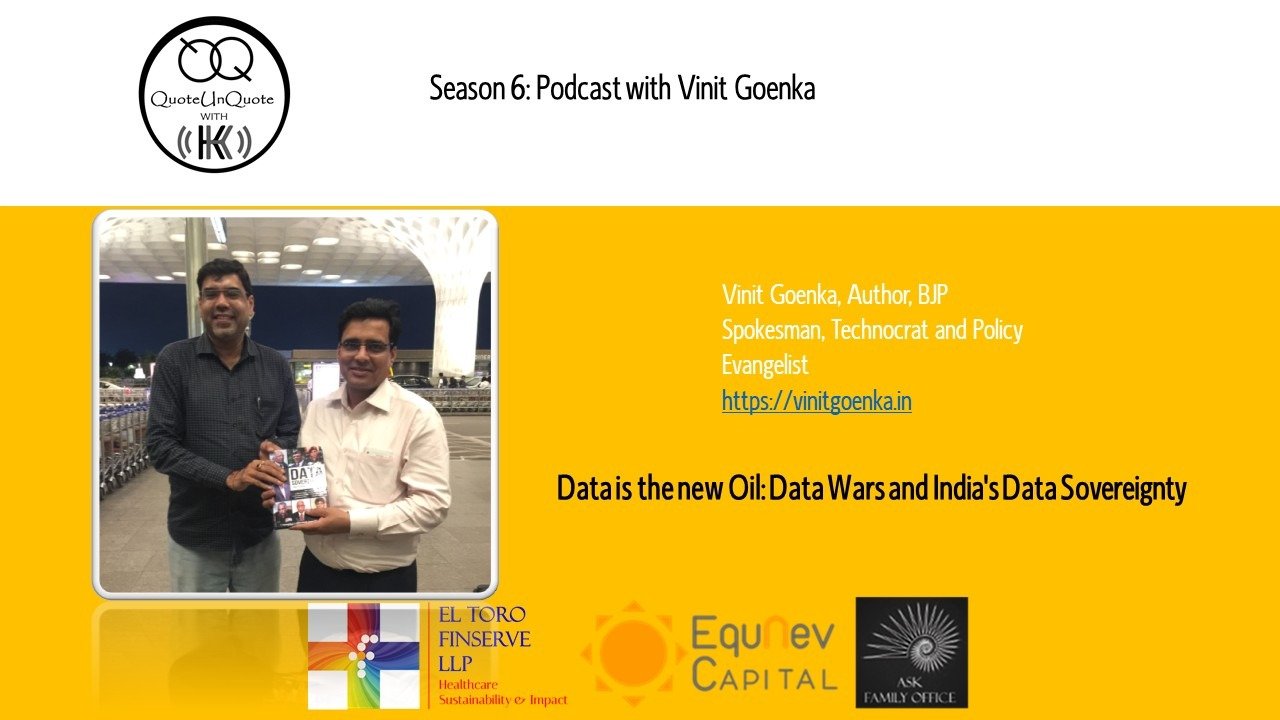
Podcast
QuoteUnQuote with KK and Vinit Goenka, Author, BJP Spokesman, Technocrat and Policy Evangelist
https://vinitgoenka.in/
Transcript of the Podcast
Transcript
[00:00:00–00:00:22] This episode was recorded sometime back before Elon Musk and Vice President JD Vance made their statements on India and the policies. Elon Musk and Vice President JD Vance made their public statements and their venting on Internet data via satellite through their startling system and about
[00:00:22–00:00:44] Indian tech workers working in the US and Elon Musk throttling their startling speed in Ukraine and many other places as well. Let’s also understand that many of the issues that we discussed seem to have preempted our response and what our view should have been to Elon Musk and Jerry Wire. So let’s rewind back and listen to the podcast.
[00:00:44–00:01:04] Hello. Listeners and welcome back to. Quote UnQuote with KK we have been inviting. On the podcast, various authors and experts on Artificial intelligence, Leslie Demonte and Jayant Kola on Growing India’s AI X triple times also discussing on their book AI Rising on India’s Growth story. I have been personally been
[00:01:04–00:01:28] talking and writing about India’s AI and data security and have been working with various organizations and industries body on regulating AI and data and putting the guard rails for the same before any new entrant or any new disruptions take place. In today’s episode, we are tackling some much more global issues and there have been many
[00:01:28–00:01:49] issues in the past and some of them not just talk about artificial intelligence and data sovereignty, but just about technology and they are about geopolitic national sovereignty and global marks. And we have seen in the past U.S. government and Clod Anthropic suspended access to their latest models worldwide and treating AI software as a
[00:01:49–00:02:11] strategic asset. So there are issues as we see in terms of foreign players and providers not just providing the best and making other users and is more reliant on them and could be very disruptive. Together, these stories tell us that AI and data are fueling not just innovation but geopolitics and policy. And today we have invited
[00:02:11–00:02:33] someone who not only has a grip on India as political narrative but also has shaped India’s policy on data sovereignty, transportation. He is an author of two book and a top political voice on Indian TV. Indian TV echoing his views on politics, policy and his publications and advocates. Listeners, let me welcome you to Vineet Goenka. With Vineet we’ll explore what
[00:02:33–00:02:54] all these mean for global power dynamic and for everyday citizens. Although I was an executive at Cisco and experience Cisco Huawei issues first hand across Asia Pacific and emerging markets of Europe. But Vineet has more current and up to date view on the issues to provide his expert views on the tech emerging wars of the future
[00:02:54–00:03:16] of data and that there is an MOU in the Middle East or oil and we will start seeing some movement there. Let me rollback in time. I met Vineet during COVID times when he had launched his book on data sovereignty at the Mumbai airport and he gave me his autograph book. I’d invited him to the podcast even earlier but we were not successful. Fast forward, we have him today
[00:03:16–00:03:37] to discuss the future of wars on data and AI and how it will impact India and his politics moving forward. Let me quickly run his profile. His earlier career began in the 90s in the corporate sector where he worked for 12 in IT and business roles. In 2003, he entered into politics, left his corporate career to join Bharatiya Jinder
[00:03:37–00:03:59] Party BJP full time and in 2006 he wrote the digital strategy for BJP and started designing digital campaigns for BJP. He was an early mover in using it for political outreach and governance. From 2010 onward, he has had a rise in politics. He became the national Co convener of the BJP IT cell in 2014.
[00:04:00–00:04:20] He played a role in the general elections of BJP using the digital campaign and contributing to BJP’s victory and has served as spokesperson for BJP Delhi Pradesh. HIS. Political career has. Been on rise, he was appointed to IT task force for the Ministry of Rd. Transport, Highways and Shipping. He was nominated to Central
[00:04:20–00:04:44] Railway Information System, Cris Governing Council where he served for seven years and then he became member of Program Committee for Gandhi Smriti at Smriti Samiti under the Ministry of Culture and he has been a policy and advocacy expert and has talked about transportation rail governance, IT governance and many such related issues. He in 2021 during the COVID
[00:04:44–00:05:06] time, he turned into an author and a thought leader where he published Data Sovereignty the Pursuit for Supremacy. Presently, he serves as Secretary for Center for Knowledge Sovereignty and continues to champion India’s Digital Independent localization and IT government. I could go on and on and on on his work, but since he has
[00:05:06–00:05:27] limitation of time and has been called to meet the minister, we’ll keep it short and start straightforward with Vineet on his views. Welcome Vineet to quote and quote with Kik. My first question that now that you have written data sovereignty is how will this now spill? Over not just from India.
[00:05:28–00:05:49] Or whatever happens outside of India affect our sovereignty in India as well, see. Primarily we have one has to understand that any technology which is evolving or has been invented will impact all these spheres of the life. So colonization is also impacted. Human beings are known to colonize people. So one man colonizes another man, one group colonizes another
[00:05:49–00:06:09] group, 1 country will colonize another country. Now, the word colonization can be replaced by dominance or also can be replaced with, you know, aggression, whatever you want to call it, but it will be obviously there. And technology is part of that particular exercise. Those who lag behind in technology will always be subjected to be exploited. So you know if you see India
[00:06:09–00:06:30] also the past the mighty Rajputs or Marathas or serious very big kings and powerful kings from the southern India were not defeated because they did not have private or valour or courage. They were defeated because somewhere they lack technology. So Mughal came with top the guns, the huge cannon and that cannon could defeat.
[00:06:30–00:06:53] Then those mighty Mughals were defeated by Britishers because they bought in better technology. The guns which were pinpointed nearer they could fire from near and lesser cost. So now if you see this ammunition has been, now what has happened in the last 4050 years is the weapon has changed in place of a gun or a sword. The weapon is your laptop, your desktop or your machine, which
[00:06:53–00:07:14] you’re using it, whatever name you want to call it, tablet or a mobile. And the ammunition side is the data and which can be used for progress and also can be used to exploit you. That’s why 2011 we thought of writing this book, Data sovereignty, pursuit of supremacy. I’m fortunate that I could write this along with three data general of military operations, one data general of Defense Intelligence Agency, one
[00:07:14–00:07:38] additional director of RNW and my civilian counterpart from NPCI. So all of us came together. This is the first book where ISRO chairman has given forward to military strategies or a military has returned with raw or a civilian because they’re unique by one way whereby we explain the idea of sovereignty, a political term, sovereignty cleft with a technological term called as data. So when the data is exploited and used as a weapon against
[00:07:38–00:08:02] you, then it is a war and we are going through this war continuously. What you have been seen in in many, many years or decades. So that’s what we talk about and this is going to be a challenge. So one has to always go with head on to the technology. We are far behind. And when I’m using this word and we are far behind, I know the political replications which can come on me. But to say that we are IT superpower and number and all is
[00:08:02–00:08:25] one part. But another real part is do we really invent technology? Do we really own the technology? Do we all harness or are we being exploited by others? Are people dictating us? So if you see, we have been dictated, we are not harnessing as it is we required. That’s my first take. So last year I we generally come out with some predictions on the healthcare and life sciences
[00:08:25–00:08:47] investment and how the markets will go through in a particular calendar year. For the first time last year actually, I made a submission to the world that AI is now leading. A lot of false positives. And false negative which is very dangerous to the world per SE in
[00:08:47–00:09:05] moving narratives or changing perceptions and also predictions based on the models and how what are your feeding into those models? India had successfully, you know, ban TikTok and all. Do you think it’s time that we
[00:09:05–00:09:27] should also ban some such, you know nefarious AI models like DeepSeek which is Chinese and Chinese origin which could be suppressing a lot of inputs and not giving a real picture about? Issues for the users. And could be probably leading to false positive or false negative.
[00:09:27–00:09:50] And I know you have done a lot of things from your book which the Government of India has listened and actually in the policy they have given direction to data centres and and investments and so on so forth. Do you think we need to now harness a? Policy for such. Eventualities as well. So you asked me 4 questions in one question, so 1 you. Yeah, no. Time is so limited. Yes, yes.
[00:09:50–00:10:13] So you asked me about healthcare, second question you was asked about it is a particular application TikTok. Third you talked about a geography and a nation which is our neighboring nation and we don’t share so-called a relationship with them. So that third part is that and 4th 1 is how does this impact forecast of business? So there’s four part. So let me go 1 by 1.
[00:10:14–00:10:37] So 1, which is the easiest parties on the neighboring country named China. See whether it is China, which is a competitive country to us or there may be a most favored nation to us or their friendly nation, not so friendly nation, whatever you want to call one thing is permanent in diplomacy. And that thing is that nobody’s your enemy and nobody is your friend forever. They are dynamics which are
[00:10:37–00:11:00] very, very dynamic situation and they change every minute. So if they achieve something and you don’t achieve, you’re behind. So one thing is very real, OK? Anything which has to be achieved, you should achieve it first. If you’re not achieved it first, you should make sure you catch up and then invent something better than that particular country. Maybe any sphere of like, not only IT, but anything else also, they should be able to do it. So that is one concern to us.
[00:11:00–00:11:23] So whether it is China or whether it is some favorable nation, some not so favorite region, it will be better. Now second part is that particular application which you named as TikTok. Now whether it is TikTok or any other words, if you see my past. I haven’t see it now in here. Yeah. So if you see, I had a case in Supreme Court, in fact, now X and then Twitter had filed a case against me in Supreme Court and I had called upon, we had
[00:11:24–00:11:48] serious allegations against them that they were using blood money. And I had pointed out that they had taken advertisements from terrorists, declared terrorists of this country against the country. They were trying to create sedition. And so we also went to court. They also went against me. And the court is a very famous case. You can go and check online. It went into the Supreme Court and then there was a lot of hearing subsequently as the
[00:11:48–00:12:09] matters were resolved and also the government has made many laws. Supreme Court was satisfied and I was also certified to that. We do not pursuit further but any application we will like to explode you. As I said if they make an explosion, they would like to see that what can be expected of you and it’s about commerce. So say they made money, whether it is Twitter which made money and subscripted, when the management of Twitter change
[00:12:09–00:12:33] their approach change but otherwise we will against it. Now can a country ban any application? We are under various treaties and there are various agreements with there, maybe bilateral agreement that can be multilateral agreement. So it is difficult for us to say no for each other’s reciprocal arrangements. And it is also not good to say no to anything and everything as a blanket because you know if you keep your backside to the
[00:12:33–00:12:57] technology, you don’t learn what the world has, then you will be left behind. But yes, in today’s world you have to be very, very cautious. And so there are various department whether it is certain, whether it is NACS, whether it is any other department, they’re very conscious about what these applications are there, what are their real motives, they do it. When they find that the real motive is not as per stated in the statement, then they take action. So not only ticked up but many
[00:12:57–00:13:18] other applications of many countries where then even home grown indigenous applications were also in stock. A reason because they felt it is not serving the purpose which is particular and which is has alternate, it’s a waging of war against this nation or exploiting our innocent citizen. So this will continue. And rather I’m little unhappy that government has been little lenient.
[00:13:18–00:13:40] So whenever I get a chance to meet anybody in the government, I said you would be little conscious and do little aggressively. But then we are known to be soft people, we are known to be good people. So we don’t get that’s the second part about that particular application. Now the third part is exploitation of technology in healthcare sector. See Healthcare is 1 which does not see what geography you come from. You come from North Atlantic or
[00:13:40–00:14:03] you come from a desert, You come from a snowflake mountain or you come from sea. Health is concerned of every human being rather nowadays to health is also concerned of animals and other living beings also. But let us focus on human beings. It is a concern. Health is agnostic to your class, whether you’re as rich as any millionaire or you are a person who depends on government age. Health is concern of both of them.
[00:14:03–00:14:26] It does not look after gender, it does not look after class, caste, ability to deliver. So it is a great leveler. Health is a concern of this. Now in old days or earlier days, once somebody health deteriorates, only then the cognizance was taken and then the remedies were prescribed to him. And then you saw that life cycle was lifespan was smaller, illness was more, people were
[00:14:26–00:14:49] not so healthy. But in the last hundred, 150 years, a lot of work has been done. So people who are conscious, who are capable and can afford take care of themselves, not waiting for the disaster to happen. They keep doing investigation, a lot of tests, which helps them to predict what is happening and they correct their course. So if small correction has been done by changing their food habit, lifestyle, some exercise, people do that.
[00:14:49–00:15:13] Now this migration happened because there was inventions and then those inventions, labs became commercial. Those could be given to the common man. So what you heard earlier as a serious science, it is simply available to you as MRI or whatever. So as a user, you may not know what is the science behind it. So a user just goes there and a technician performs that act on you and your diagnosis is done. Now that’s the miracle which
[00:15:13–00:15:36] this technology does and everyday is it changing. My answer is yes. What was there in yesterday in healthcare today’s it is absolute and there is somebody somewhere in the world making a better technology to predict, to analyze. Same way if you see second part of healthcare was what is the medicine of the ready for a problem. So they would identify a problem, then they would identify a remedy to it, go
[00:15:36–00:16:00] through trials over, you know, various animal, whatever is prescribed under the morality in various countries. Then they would have volunteers to do it. And finally the commander kit. This is certified medicine. It may take how many years? So as I’m not a student of science or mathematics or even healthcare, I only speak what I heard from or on the search of it. This should take not less than three decades to finalize the
[00:16:00–00:16:22] medicine or remedy. Minimum 3 decades in. Some cases 15 years minimum. Yeah, and in some cases it may go as high as 40 years to finalize that kid. This is what it and then they have to another wait next another 4050 years to see what is the resultant of that. So these two prescribes on medicine. But the over the breath they realized OK, oh, these people have been given this partition, are facing this challenge at the
[00:16:23–00:16:46] later stage of their life. So they have discontinued many medicines. You have seen that many have been called as drugs, many have been banned, many have been restricted to shield. Now all this happens in both the cases, whether it is identification of a disease that is investigation or whether it is prescription of medicine. They used to take time and the time period was huge. Many times a scientist or a company would not be able to subscribe a remedy within their own lifespan.
[00:16:46–00:17:09] They used to do it over the generation, 2-3 people used to do it over the time and then subscribe to the and we are thankful to those inventors, those people who have given this solution to us. Now what is happening with the introduction of computers, with the introduction of digital space, A patient or a human being when he goes for proactive investigation or reactive investigation after he’s added
[00:17:09–00:17:31] for the problem from that day till he’s been administered the medicine, all his health records, his data counts. What is his blood count? What is the plasma inside it? What is the other factors in his blood? All has been captured in one particular play which is easily storable in very, very. And then there is analysis which can run, which will tell you what happens when happens.
[00:17:31–00:17:53] So if two people have a similar disease and they are given two different medicines, how do they react? What will happen if they are in desert? What will happen if they are in snow clad area or these kind of variations and variables, all these combinations which were not so easily possible for human mind to do it with the help of technology. They are speeding it up. There is a speeding limit. There is an element of size.
[00:17:54–00:18:16] Now they’re comparing more size. This is helping to invent or prescribe better medicine, better solutions, identify better. The cost is coming down, but at the same time it is generating huge data of individual. Now the challenge of which I always keep speaking whenever I get a chance to speak in public forum as well as to the
[00:18:16–00:18:38] authorities is that when these hospitals or the labs, when they collect your data, are they deleting the data? Are they collecting the data and showing it with your permission? Are they making sure that you understand what is called as permission? Because many of my brother in this country may not understand what is called as permission. So they may give permission that I permitted to keep without knowing what is it. And these people then they
[00:18:38–00:19:01] harvested data make monetary benefits out of this which is not passed on to the victim or the user or the person who is called as sample circuit. And those who is to invent now they take less time because they can run through this on a quantum computers. They can understand through the algorithms what will happen. A prediction can we have done
[00:19:01–00:19:21] with the help of this available data which can be then narrowed and identified. You may not even now know that earlier this to ask you to sign up saying that you are a volunteer to the medicine. Now you may be a victim of this cartel, which will not tell you, but you are actually a Guinea pig to them. I was here. What has? Also happened is during COVID,
[00:19:21–00:19:42] if you are aware Chinese people hacked onto our aims and and several other, you know servers and try to take information, genetic and phenotype information of Indians. Maybe that was to help them to develop their COVID vaccine or? What? But that’s a very.
[00:19:42–00:20:01] Dangerous thing. And you know, today if I upload my diagnostic report to say to ChatGPT or DeepSeek, they give me some some bit of diagnosis and recommendation, which obviously then I can talk to my doctor to verify or cross verify or whatever. Now a lot of this information
[00:20:01–00:20:23] going on DeepSeek is dangerous. It is in the hands of Chinese. It’s not a democratized AI system. But it’s all a lot of data which is going into hands of our neighboring country. As you said. Which is dangerous for them to create certain countermeasures
[00:20:23–00:20:45] or bio weapons. Which is why I said, like TikTok, should we ban even deep? Seek or should we restrict? DeepSeek for certain type of applications only and not for say healthcare or some other use. So one what you rightly said can can they make some bio weapons and this can be a new age of weapons which will come up or
[00:20:46–00:21:07] let me put it a little simple not get so paranoid and let me say in simple terms can they make the medicines expensive? The simplest way will be that pharma lobby will come together and they know that this has happened in this particular geography. So let us make the molecule expensive and once the molecule, the salt component is expensive, naturally your population will be up.
[00:21:07–00:21:29] So they say penicillin has helped human being to survive and stay longer. But the same penicillin after even been invented, it was denied to common man because it was very expensive and because of that in the absence of the delivery of penicillin, thousands of people died even after the invention was done. So, will there be a greed which
[00:21:29–00:21:50] will decide that this set of poor people will not get this medicine and we will only give it to her. So you see many medicines are very very expensive which actually can be afforded. And I should upload the efforts of the Government of India, especially Modiji whereby introducing Ayushman Bharat, the scheme where it takes cares of
[00:21:50–00:22:13] the cost of the medicine. The same time Gen. Ashudis where generic medicine, general forumers, they have been taken out of branded and they can be reproduced or they can be manufactured here in this country. So those patterns which are now lapsed, those medicines have been made. So this kind of. Policy interventions are also needed along with technology. But overall, if you ask me, will countries or geographies or
[00:22:13–00:22:35] corporates play with your data and use it as a tool to extract more money or extract political power out of you? Answer is yes, it can do it. Whether we should ban one application or not. Now that call is by the authorities because it has to establish that whether that application has been used for this particular purpose only. But yes, anything which is foreign, Sir. Your book has actually led to a lot of policy changes.
[00:22:35–00:22:59] Also, now we’ve got the data center policy. I guess the spark of it came out from your book. That’s why I said policy. I was the youngest writer in that book. I was the youngest writer in the book. My Co theaters are great. As I said, we are total 7 authors in that. Three of them are Data, General Military Operations and they are all colored people. They have lot 1. Of them very recently even engaged in some operations
[00:22:59–00:23:22] Hindu. So data General Defense Intelligence Agency Lieutenant General Vinod Kandare he had certainly puts additional Director RAW Jaideva Ranadevi he had so I was blessed that all these great people were there and they had vision and access to information far more than me and to they have seen life in a broader canvas. So that book encompasses experience of all these people and the vision what will happen in the next 30 years.
[00:23:22–00:23:44] Yes, I was one more blessed that this book was inaugurated by honorable Sunil Ambekarji in Delhi. So what happened is it has was sanctity by the establishment and then I was fortunately that I was called on various dispositions to go and tell what has happened so humbly. I I can say yes, it has been referred by various people who matter to this country. So what’s next? I know there is a shortage of time.
[00:23:44–00:24:04] I wanted to understand how the whole, you know, the Indian tech services and Indian tech export is also now going to be impacted given the recent Accenture and all these debacles that are happening globally. It’s going to also impact India shortly. And for, and obviously now we
[00:24:04–00:24:24] have the visa issues with the US, the H1B visa for exporting our human resources there. Do you think, Sir, what the government is now trying to do is to create the GCC in India and try and retain everything in India, allowing the corporations to come to India and work within India with Indian talent is the
[00:24:24–00:24:47] way forward or should we be doing the the political and the geopolitical and diplomatic negotiation on visas that used to happen when I used to be in Wipro every year there used to be this haggling and this back and forth negotiation with the US diplomats to increase the quotas. See, as I said, there are multiple questions which you ask in one question. So let me answer it 1 by 1 so
[00:24:47–00:25:08] that for the user to understand. One is geopolitical situations are always dynamic, they are fluid. So what you see today morning may not be the same evening. Few days back, 2 great nations of West were together, then one of the presidents I guess. OK. And now if you see there will be a lot of this kind of diplomatic thing, geopolitical things which will impact technology
[00:25:08–00:25:30] inventions, technology transfer employment because they are all guided by agreements. Even if it is guided by bilateral or multi level agreements or we are governed under charters, there will be the mood of the nation is decided by the relationship of that two countries on that day. So today we have a lot of good relationship with say for example, USA, but yet currently they may have their internal compulsions of not hiring people from outside.
[00:25:30–00:25:53] And so we are being impacted. But the best thing is you invent your own technology written. My anger is not against those countries which are not hiring us, rather I’m unhappy on why are we not producing good engineers. So if I have to submit, I would request the education ministry, the MHRD ministry to focus on improving the syllabus so that the bus which we missed our children’s or our generations to come should not miss that particular part.
[00:25:53–00:26:17] So an engineer coming out after 10 years should not have to face the same challenge which you and I have faced. So I would rather suggest that we have to see, look inside our own house and 1 #2 the compliances, all the other statutory norms which forces a person to become an employee rather than becoming an entrepreneur, rather than becoming a founder, he chooses to become a CEO for somebody
[00:26:17–00:26:41] else’s company. Those compulsions of compliances strategy should be discussed and how we can make ease of doing business and which Prime Minister Modi’s trying to focus. But we have to run fast and get it done. Third one is the cost of capital. Unfortunately, in India Today, the cost of capital is very, very high. Most of the inventors or most of the founders fund from their own money or they’re a close family which is limiting this, which is not ample.
[00:26:41–00:27:04] When you want to make a world class technology which will run over the world, then you’ll require institutional funding mechanism which everybody has to come together. Yes, for the same time we will have to put in regulatory compliances, stringent global regulations. We’ll have to put in security features around it so that those interventions are not leaked and not been migrated outside. So this all challenges will be there. What will happen because X country is employing you, not
[00:27:04–00:27:27] employing you. It’s a concern of local right now, not a larger concern. Larger concern is we’ll be able to invent. See the number of patents been filed in 2014 versus number of patent filed in 2025 is very good. That tells us one thing that Indians are now getting cautious about IPL. But the number of patent filed in 2025 is not even 1 ninth of the total number of patent filed in Japan.
[00:27:27–00:27:48] Whereas Japan is 1 ninth of my size of geography. So we are actually 181 level of Japan. So we have to really multiply our since 80 times more to to contest with these geographies. So we are far behind and we should not sigh out from saying that. So one academic environment, two, financial agreement environment for provision and 3rd with the regulatory.
[00:27:48–00:28:10] We have to think all the three while the external affairs should engage with our counterparts in the world, see how they can we can become favorable nation to them. See how our citizens, our engineers are getting opportunities which other countries are getting. So it’s a very complex thing. It’s easy for me to sit here and tell you what should be done, but I’m sure those who are
[00:28:10–00:28:28] sitting there know more details and that’s why they are more competitive people. But the reason they are not able to do it maybe, probably they have challenges at hand. Sir, you have also been working on the renewable and side of things and I just recently attended the Economist Resilience Summit in and one of the things was the energy
[00:28:28–00:28:52] consumption for even AI just to type 1 command and get a response. The server and the chip consume so much of energy and don’t you think that along with our data and EI resilience, we’ll also need energy resilience to run this all infrastructure? And what is your recommendation for the government to run this infra?
[00:28:52–00:29:14] See one good part is in the last one decade various new sources. When I say new source I don’t mean that new element has been invented but various new. For example in hydro hydral power they would have identified more locations geography to generate hydral. If it is solar, then you’ll see that can massive farms are coming up whether it is a renewable or whether it is the conventional.
[00:29:14–00:29:36] We have also identified more basins for extraction of oil. Of course, one good part is even Atomic Energy has been harnessed and tapped and there are provisions of going. So the establishment, the government has been very consciously trying to tap all these sources which are there and judicially mixing it. So the dependence of a thermal power plant is not purely on coal now it has been gas fired,
[00:29:36–00:29:58] it is oil fired so that we have the energy. And you have seen in this recent past the challenge which has come up because of the waste. Asia, we have not found anywhere something called as blackouts. The reason is because there has been an energy storage, energy storage and they have very judicially been done. Yes. Do we have to just triple it? Answer is yes, we’ll have to triple it. But it is not so easy to say
[00:29:58–00:30:18] triple it. It requires huge capital. Secondly, it requires huge land to build this kind of generation centers. So you will displace the original landowner, whether it is a farmer or the tribal or a minor. We have to. So whenever you displace somebody, that will be a pain and you have to see and think about his livelihood also. So in a democracy, this will take time, but I’m happy that
[00:30:19–00:30:40] this is going on #2 if there is less power, if there is a challenge of power, do we avoid this kind of opportunities of data centers? Answer is no, we may have to compromise, cut your residential literacy but direct it there. Now it might sound very, very ridiculous but for a strategic reason we will have to put in priority the data centers, more
[00:30:40–00:31:01] data centers in the country. It will give you limited employment. Yes, data centers are not great employer but it also still gives you Employment Opportunity. But two thing is the data is in your control. Then can you decide whether the data will remain in the political boundaries or not? That is on the agreements which you do and the technology which you have, but yet you would still have it. So my goal will be in my hand
[00:31:01–00:31:24] whether it is exposed or not. It depends on what kind of algorithms it is and what kind of agreements I have. So I’m a great elevate of having more data centers, even if the cost if the others rather than has to suffer a shortage of electricity. And in the meantime, we should invest in generating more power, localized power. Do we have to really go and make big dams for idle?
[00:31:24–00:31:48] I don’t know. I’m not an expert of electricity, neither do I understand photovoltaic nor do I understand Heidel. But what I understand is if we can tap that and one small contribution, which common man is doing it? I don’t know whether you have ever realized this. Nowadays, if you go, every house now has something, either water heater or maybe they have street light, or maybe they are generating power for their own house. So even if you would generate a
[00:31:48–00:32:11] friction of your consumption, you’re actually helping the entire country. So a few teaser questions I have before I let you go. I know time is limited. I wanna know what excites you most now that you are in the policy and governance and also with the politics about India’s journey in the coming years. And what’s your idea or vision for 2047? So what excites me is that there
[00:32:11–00:32:33] is an in the generation especially the next generation that they should not become employee but employer, they should not become user but inventor. That excites me more because my next generation is smarter than my generation and that is a satisfaction 2 for the reason of 2014. It’s Modiji has already given Bixit Bharat and we’ve all follow him blindfolded. So our region is that. But yes, if you ask me
[00:32:33–00:32:56] personally, what excites me is the region of Antodaya, which the last man in the line, last man who is should not sleep without proper nutrition. So if he sleeps with full nutrition, he has enough shade on his head. That is what is happiness that would I would be really happy if I survive till then or otherwise my soul will be happy if I see
[00:32:56–00:33:17] every Bharatiya clipping full stomach under a nice shield. So 2047 no data colonization freedom for India of its own on the. Type the Prime Minister was when the Prime Minister said Vixit Bharat. It encompass these two words are magical words in campuses everything Vixit Bharat data me hoga Vixit Bharat, aya me hoga Vixit Bharat. Politically, geographically,
[00:33:17–00:33:39] strategically, invention wise, education wise, health wise, everything. Vixit Bharat. We I know we have made some steps in every direction. I want to understand what’s your next book looking like? I know your second book I couldn’t grab your greens on but so data soberity. I can humbly claim that we have subsidized all. I have got opportunity to speak in National Defence College thrice.
[00:33:40–00:34:03] I’ve been invited where journals and bigoted to sit. I’ve been invited many times where the bureaucrats, senior bureaucrats at the level of joint secrets and also party has been very kind. Many times I’ve been getting opportunity to speak in front of senior leadership. So sensitizing the influencer has been done. Now the second thing which we are thinking very seriously is about data resilience. Now the time has come where you say data resilience. So that will happen.
[00:34:03–00:34:26] Correct. And is that the topic of your next book, or is something else altogether? I don’t know, but I’m seriously thinking something else should be done. I definitely agree with you and obviously there is a lot of geopolitically legal stuff both between India’s legal architecture versus other countries architecture. I guess there’s a lot to be
[00:34:26–00:34:45] upgraded or reverted or relook as we would move to govern ourselves to 2047 vision. There are a lot of things that we send through our industry bodies, CII, FICCI, but I don’t see direction from the other side as. To what is the thought? Process there.
[00:34:46–00:35:08] How can this kind of be more frictionless and be more proactive in creating the legal framework for the future? I know I have been talking a lot on the health UPI but nothing is moved forward there. First, let me give you my honest personal answer, which is incorrect and and diplomatic, but I would like to be candid on that and then I’ll tell you how
[00:35:08–00:35:30] it is. So when I hear this words of the key, when we can upgrade our legal systems or upgrade our compliances, I greatly object to it. Just because one country or another economy has introduced one law or a policy and it is dominantly pushing it does not mean that my systems are downloaded or it is backward. Because that is a sense of maclose education where we are
[00:35:30–00:35:52] thinking that the masters are others are masters and we have to follow them. They have proposed something which is good to them and is it genuinely good to them? Answer is yes. But is it genuinely good to the human kind? Answer is no. They made sure that it is good to human beings, but it will be probably a protectionist approach of them. So you name something, they don’t want to call it as a PPMA, professional market access. But these are barriers which
[00:35:52–00:36:12] they create and sometimes of course they create standards which help their country, intern, human beings, everybody. So what we should do is learn from them which is good for their citizens and we should adopt that. While while everybody does it, we should also do that. Adoption is very good if you do it 2. Not follow them blindly but we should have our counter majors for their Pmas. So if.
[00:36:12–00:36:32] They want us to have some kind of certifications quoting that it will assure them that the process validation is there. We should also increase our BIS. We can also increase our processes here to a level where people code this. What is currently missing is that our standards are not as per the horizon of many, many countries which are there and
[00:36:32–00:36:56] hence many of us feel that whose country calls economic standardization the process. But do we have to blindly follow? The answer is yes. But one more thing if your business, your industry, if your talent wants to service that particular market, then you may have to be compliant to that particular market. And also back home we should. We are far behind in standardization, we are far behind in IPL.
[00:36:56–00:37:19] We are far behind in creating hurdles which are camouflaged with nice scheme of processes. We should do that. We have been kind to the world saying that we you know we are very kind to say that. So everybody’s our brother. But now it is time you have to look into, make sure that we also create a counter damage that 1/6 of the human beings,
[00:37:19–00:37:41] Some economy which is not even 180th of the human beings may come out with standard and tell you that what is good for the entire planet, if it is really good, we should follow it, we should imitate that. But the same time we should learn from that and immediately come out with which is better than that particular solution. And we don’t do that. And when you don’t do that, then in internationally when you sit on the platforms, you feel little behind, you feel
[00:37:41–00:38:04] dejected. So I wish that what I could not do or my generation could not do, the listener, their generations can help us to create that kind of standards where people could say Bharatka standard, a Bharatka processor compliance. If you’re not compliant with Indian, this thing, you will not be having access to that market if you don’t lose the Indian. So that murmur, that noise, I don’t listen when I travel abroad and that pains me.
[00:38:05–00:38:27] Am I talking to the future Minister of National Data Security and Governance? No, see, I’m not a political person being in politics. So I’m not a public representative neither. I have this kind of qualities. It requires a lot of qualities. It requires a lot of different attributes which I lack. And I know about this, the best part of this, I’m aware of this particular short run of mine.
[00:38:27–00:38:51] So I don’t pursue that particular path. Yes, I’m more like a policy enabler. So I would like to talk in the policy space and be in the policy space, and I’m happy here. So I don’t want to dilute my vision. Lovely chatting with you Vinitji. I know you have to rush to meet the minister and have your other, but thank you so much for taking time out and giving your
[00:38:51–00:39:10] open thoughts on what’s going on and your mind and your time to us to talk about it. Love. I would love to connect back and call for another round of discussions when time permits. But it’s great to have you here on quote and quote with KK and talk on multiple topics and
[00:39:10–00:39:33] issues in the recent past in this space of AI and data and our country, which is in the crossfire of multiple things as we talk. It was a learning experience for me to talk to you and many questions which have been raised. I know that I don’t have a perfect answer, so I’ll go back, study and make myself better. The same time, I also wish that the bus which we have missed
[00:39:33–00:39:44] should be done. And next time when I come on your show, we have our own browser, our own app, rather than using a foreign app and a foreign browser to talk to each other. I agree. Thank you. Very much. That’s, well, lovely.